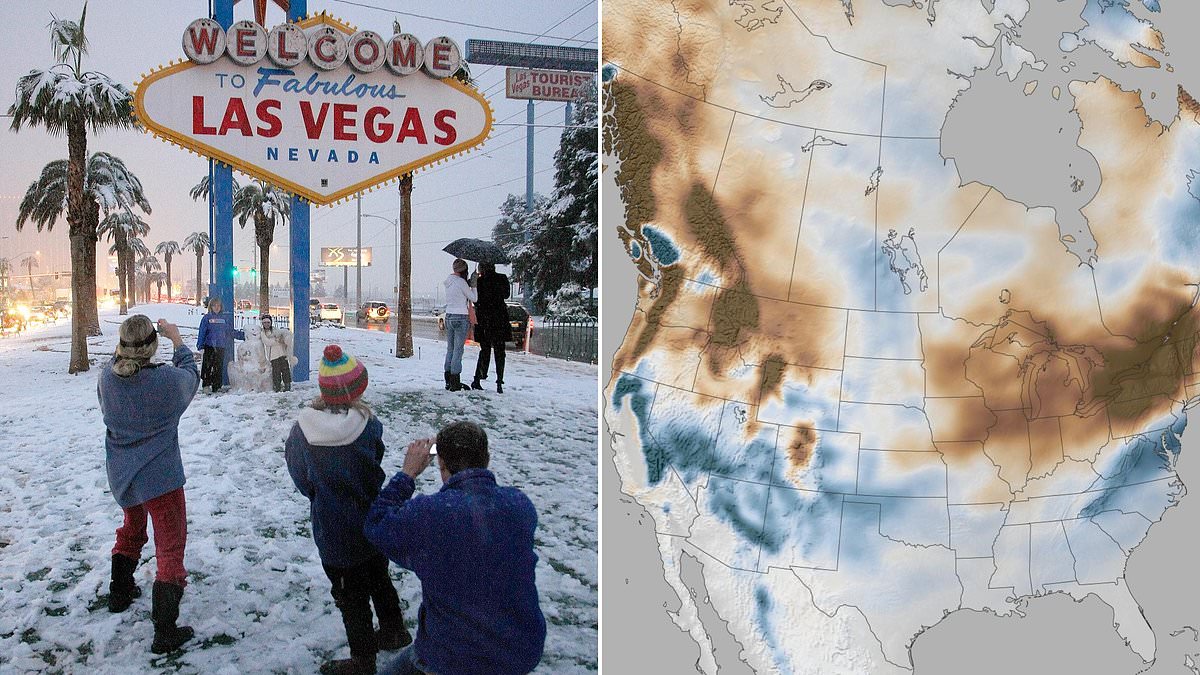
NOAA gives a super El Niño more than a 79 percent chance of lasting through January to March 2027, with a roughly 60 percent probability it becomes the strongest on record since 1950, Only In Your State reported.
The pattern shifts the jet stream south, steering Pacific storms toward the southern United States and leaving Nevada split: Southern Nevada leans wetter, while the north — Reno, Carson City and the Lake Tahoe basin — faces equal odds of a wet, dry or normal winter, the outlet said. NOAA expects the event to peak around November through January and weaken in early 2027.
CNN Weather analyzed January-through-March snowfall from 1959 through 2026 and found above-average snow occurred in more than half of El Niño winters across parts of the Southwest, lower Midwest, southern Appalachians and Interior Northeast. Much of the Pacific Northwest, northern Rockies and Great Lakes saw below-average snow more often than not, and the signal strengthens in moderate-to-strong events, CNN reported.
“They’re very strong, energetic and they’re very wet,” Jon Gottschalck, chief of NOAA’s Operational Prediction Branch and lead forecaster for the winter outlook, told CNN, describing the nor’easters that can juice Mid-Atlantic snow totals during El Niño.
For Nevada, the 2015-16 “Godzilla El Niño” brought wetter conditions across almost the entire state even as Southern California and Arizona finished drier, Only In Your State noted. Lee Canyon in the Spring Mountains above Las Vegas stands to benefit if storms arrive cold enough; the valley floor beneath the Ruby Mountains was bare of snow in January 2025, a reminder of how thin coverage can be in the northeast.
AccuWeather meteorologists project sea-surface temperatures 4.8°F (2.66°C) above average, which would surpass the 1982-83 and 1997-98 events, KSFO reported. Long-range meteorologist Paul Pastelok said the atmospheric lag could extend impacts through 2027. The Farmers’ Almanac, by contrast, calls for more rain than snow in Nevada and Arizona, KSFO noted.
NOAA updates its outlook monthly; the next seasonal outlook arrives mid-month.
El Niño’s influence on U.S. weather peaks in winter when the jet stream shifts south and extends east across North America, CNN reported. “They’re very strong, energetic and they’re very wet,” Gottschalck told CNN.
SUPER EL NIÑO COULD FLIP THE WINTER WEATHER SCRIPT: NOAA announced Thursday that the 2026 El Niño has officially reached Super El Niño status. So, what does that mean for the upcoming winter? According to FOX Weather, Super El Niño patterns typically bring wetter conditions and… pic.twitter.com/YlXe0I5jhg
Worth a look

Louisiana Menhaden Season Ends, Supports 2,000 Jobs and Family Ties
Louisiana's menhaden fishing season ended Nov. 1 when the last boats tied up in Empire and Abbeville, closing...

Eugene Airport Overstated Economic Impact of $450M Expansion With Double Counting, Report Finds
Eugene Airport officials overstated the economic benefits of a proposed $450 million expansion by combining overlapping measures that...

Brew Crew Ball: Brewers’ Senzatela Deal Has Up to $3M in Start Incentives
The Milwaukee Brewers re‑signed right‑hander Antonio Senzatela to a one‑year contract for 2027 that includes up to $3 million...

Job Outcomes Drive Enrollment Surge at Maritime, Aviation, Nursing Schools
Students and families are choosing colleges based on proven job placement and earnings data, driving enrollment surges at...