Crime was not a primary driver for voters during the recent US midterm elections. According to a report by Jeff Asher at Jeff-alytics, only about 3 percent of voters identified crime as their most important issue.
While the political headlines focused on broader economic and social shifts, a massive survey conducted by the NORC Civic Health & Elections Project offers a more nuanced look at how Americans actually view safety. The project provided raw data for 113,000 surveyed individuals, allowing for a granular look at the gap between perceived danger and statistical reality.
The findings suggest a recurring theme in American civic life: people often believe crime is much worse in other places than it is in their own backyards. This mirrors a common psychological trend where citizens may feel the national economy is struggling even when their personal financial conditions remain stable.

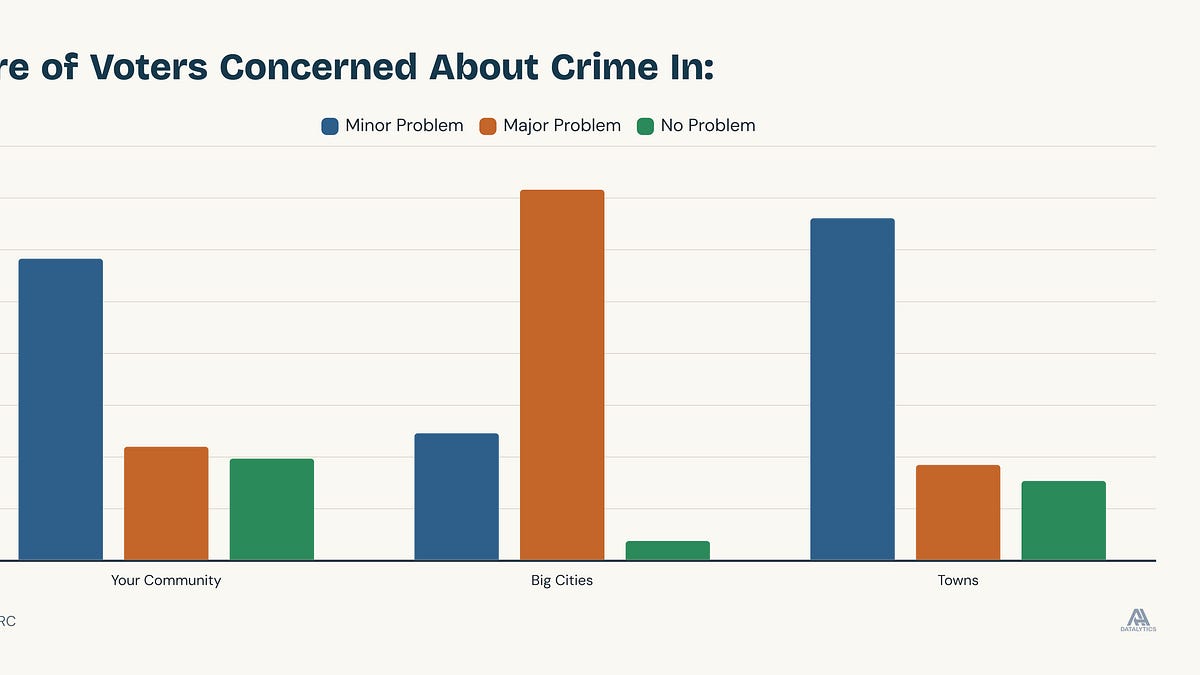
Public perception of crime follows distinct demographic and geographic lines. Most respondents do not view crime as a major concern within their immediate communities, yet a majority view it as a significant problem in large cities.
The data reveals specific pockets of concern across the country. People living on Native American Lands, in African American South regions, in Hispanic Centers, and within big cities were the most likely to label crime a major concern in their own communities.
In contrast, those living in aging farmlands were the least likely to see local crime as a major issue, though they were the most likely to view big-city crime as a significant problem.
Political affiliation also dictates how voters interpret urban safety. Republicans tend to view murder in big cities as a major problem regardless of the specific murder rate in their own state. For Democrats, the perception of crime is more closely tied to local statistics.
Asher found a “pretty strong relationship” between the share of Democrats in a state who view crime as a major problem and that state’s 2025 murder rate. Essentially, Democrats in high-murder states are more likely to report crime as a major concern than those in low-murder states.
This suggests that for liberal voters, the perception of danger is more reactive to actual local violence levels than it is for conservative voters, whose concerns appear more ideologically fixed regarding urban centers.
| Demographic/Region | Likelihood of seeing crime as a major local concern |
|---|---|
| Native American Lands | Highest |
| African American South | Highest |
| Hispanic Centers | Highest |
| Big Cities | Highest |
| Aging Farmlands | Lowest |
Addressing crime is not a one-size-fits-all endeavor because the nature of the threat changes based on the environment. Gun violence, for instance, presents different challenges in an urban setting compared to a rural community.
The tension between falling crime rates and public perception presents a challenge for policymakers. While many metrics show that violent crime is falling to historically low levels, the survey data shows that the “major problem” label is still applied frequently to urban areas. This disconnect makes it difficult to implement large-scale solutions that satisfy both the statistical reality of declining violence and the lived anxiety of the electorate.
Whether the focus should remain on property crime, which shows a decent relationship with voter concern, or the more visceral issue of murder rates, remains a central question for local governments. As crime rates continue to fluctuate, the gap between data and voter sentiment may continue to define politics.

Missouri Democrats Flip 16 State House Seats Amidst Blue Wave
Missouri Democrats achieved their best electoral performance of the 21st century by flipping 16 state House seats and...
Minnesota Farmers React to Democratic Political Wins
“Democrats are back in power,” said Steele County farmer Jason Keck. “It feels like the state's controlled by...

Reviewer Says Mudan Modern Asian Cuisine Dim Sum Lacks Heart
In a recent dining review, Paul Tibbets reports that Mudan Modern Asian Cuisine's dim sum offerings fall short...

Colts Fielding Multiple Inquiries for QB Daniel Jones
The Indianapolis Colts are fielding multiple inquiries regarding quarterback Daniel Jones as the NFL trade deadline approaches, Touchdown...