
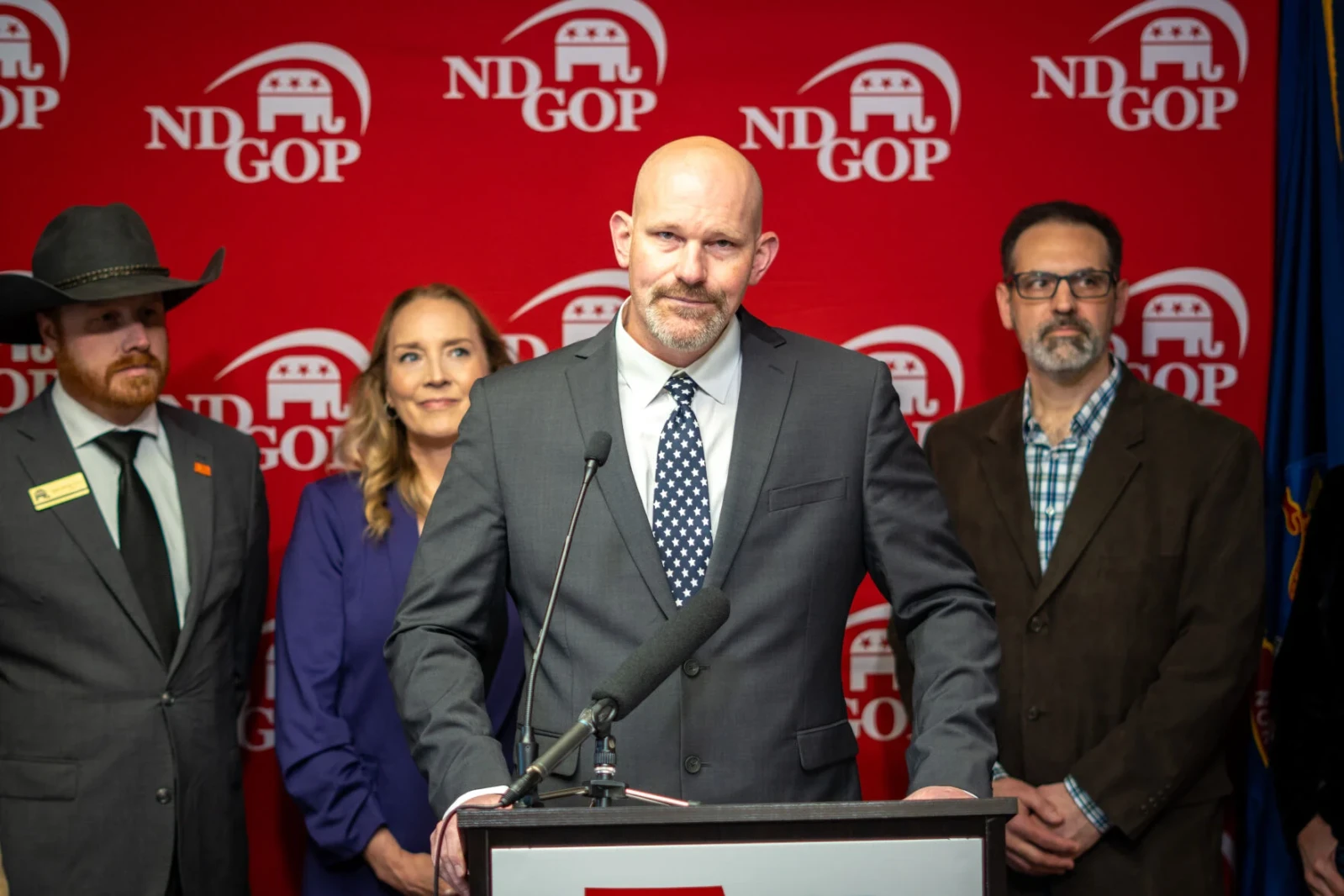
The North Dakota Republican Party filed a federal lawsuit Monday challenging the state’s open primary system, arguing it violates the party’s First Amendment right to freedom of association by allowing non-Republicans to vote in its primaries.
The 32-page complaint, dated November 24, names North Dakota Secretary of State Michael Howe as defendant in his official capacity, WDAY Radio reported. Plaintiffs include the state party, Chairman Matthew Simon, and Republican district committees from Districts 2, 8, 14 and 46. The suit seeks declaratory and injunctive relief in U.S. District Court for the District of North Dakota’s Western Division.
How North Dakota’s primary works
North Dakota does not register voters by political party. During primary elections, voters receive a consolidated ballot with separate sections for each qualifying party. Voters may participate in any one party’s primary without declaring affiliation, though voting in more than one party’s section results in the partisan portion of the ballot being rejected, WDAY Radio reported.
“The Party is made to hold out as its standard bearers, and to govern itself through, individuals selected in part by voters who oppose its platform,” attorneys for the Republican Party wrote in the complaint.
Crossover voting allegations
According to the filing, 11% of self-identified Democratic primary voters reported casting Republican ballots for strategic purposes. Nearly 46% of self-identified Democratic primary voters reported being contacted and encouraged to vote in the Republican primary during the 30 days preceding the election.
Among Democratic voters who cast Republican ballots, 53.5% said their primary motivation was to influence the outcome of a Republican primary race, while 33.5% said they wanted to support a particular Republican candidate and 12.9% said they wanted to oppose one, WDAY Radio reported.
“The First Amendment protects freedom of association, the right to form a group around shared political beliefs and choose who represents it,” Simon said in a video statement. “But North Dakota law grants non-Republicans a say in that process by allowing them to vote in our primary.”
Legal precedents and internal party division
The lawsuit also challenges state laws making primaries the only path to the party’s nomination and requiring legislative nominees to serve on party governing committees. On the committee requirement, the NDGOP has a strong case: in Eu v. San Francisco County Democratic Central Committee, the U.S. Supreme Court struck down California laws prescribing party governing committee structure, Rob Port wrote in Forum Communications.
However, the case against mandatory primaries is weak, Port wrote. In American Party of Texas v. White, the Supreme Court upheld a Texas system requiring major parties to nominate through primaries.
The open primary challenge is “muddier” because North Dakota’s system differs from the blanket primary struck down in California Democratic Party v. Jones (2000): North Dakota voters must choose one party’s slate and cannot cross between parties on the same ballot.
The filing blindsided the NDGOP executive committee, several members told Port.
Senate Majority Leader David Hogue called the suit “profoundly unproductive” and challenged Simon’s authority to initiate it. The party is estranged from its statewide candidates, all of whom skipped the state convention earlier this year, and recently let go its communications director and office manager due to funding shortfalls, Forum Communications reported.
Chairman accuses Democrats of ballot infiltration
“Democrats are putting their priorities on the ballot under our name,” Chairman Matthew Simon said in the announcement quoted by MyDakotan. The party also challenged the state’s petition process that allows candidates to reach the primary ballot without a party endorsement, a point noted in the WDAY Radio account of the complaint.
Analysis links crossover estimates to specific legislative races
The same analysis identified four additional contested Republican primaries in 2024 where estimated crossover participation exceeded the nomination margin, though the estimates do not independently establish that crossover voting changed those outcomes, WDAY Radio reported.
What happens next
The court has not set a timeline for proceedings. The party is soliciting donations for the legal effort at ndgop.org.
Worth a look

NPR: Food and Beverage Cargo Theft up 47% as Hackers Hijack Dispatcher Accounts
Food and beverage cargo theft jumped 47% as organized crime rings began targeting load boards through hacking, according...

Seahawks Ranked 6th–12th in Power Rankings; 49ers Game Called Season-Defining
The Seattle Seahawks enter their Week 12 matchup at the San Francisco 49ers ranked around 10th in major...

Helena Fire Department Demonstrates Turkey-Fryer Safety Ahead of Thanksgiving
The Helena Fire Department conducted its first turkey-fryer safety demonstration ahead of Thanksgiving, intentionally igniting a grease fire...

Harrisburg School Board Expels 4 Students After Principal Assault; District Announces Safety Measures, Camp Curtin Review
"We don't adhere to violence or acts onto our students or staff." “I know it's confidential, but I'm...