
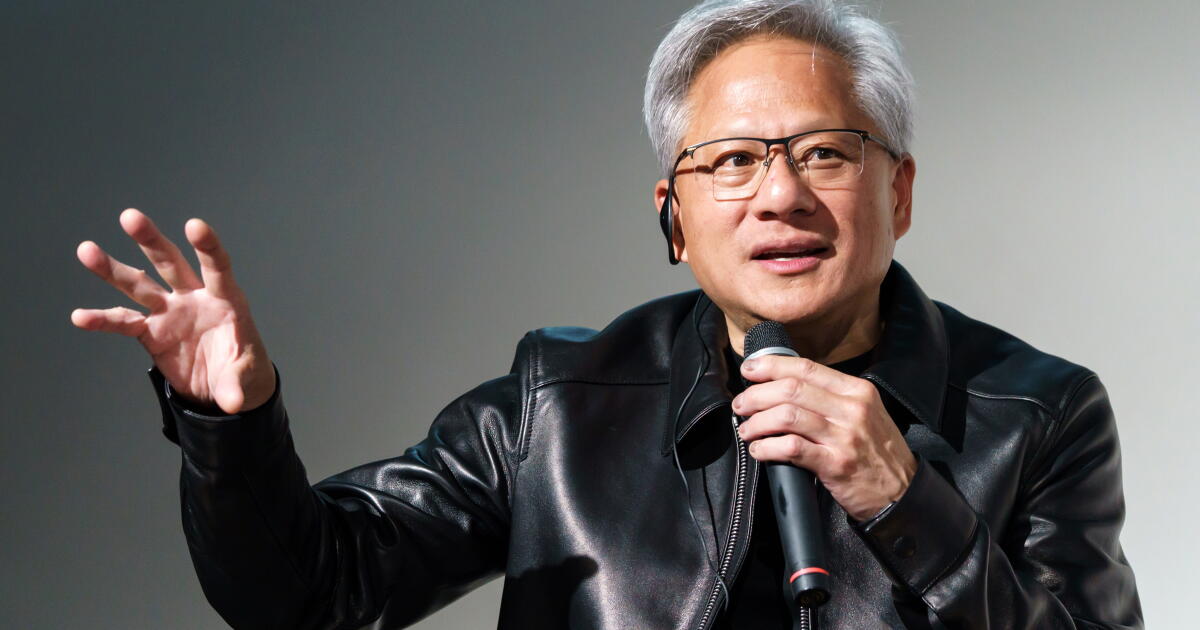
“The bigger threat would be losing the brainpower of somebody like Jensen,” President Donald Trump said, defending his push to reinstate Nvidia’s CEO.
Two weeks later, the stock market agreed — Nvidia shares surged 31.48 per cent, adding nearly US$1 trillion in market value on Monday.
Huang resigned on Nov. 12 after reports of affairs with a subordinate and a woman identified by intelligence officials as a Chinese spy. By Nov. 23, Trump had dialed into Nvidia’s Sunday board meeting, the White House declared “we have to protect our geniuses,” and the board unanimously voted to bring him back. The reversal turned a corporate governance crisis into a political flashpoint.
Jensen!
Trump Intervenes and the Market Roars
Trump took credit for the turnaround, telling CNBC “I spoke to them – let me just put it that way – and I convinced them. And I must tell you, it was a lot easier to convince them yesterday than it was a week and a half ago”. He called Huang “a national treasure” and argued that losing him to a Chinese competitor would pose a greater threat than any governance lapse.
“If we didn’t do this, I could see China coming in and saying to Jensen, ‘Hey, how would you like to come to China?’” Trump said, adding “He’s got a little blood there. ‘How would you like to come to China and head up Huawei, OK, and head up one of our companies?’”
The world’s best CEO vows to become even better. pic.twitter.com/0fvBk4icdw
The market response was immediate. Nvidia shares closed at US$165.05, gaining more than $950 billion in a single session — the largest one-day capitalization increase in history. The Nasdaq 100 jumped nearly 7 per cent. Asian suppliers TSMC and Foxconn hit their daily 10 per cent limits.
Investors treated the reinstatement as a signal that the AI boom’s central figure was “too big to fail”, a phrase analysts at William Blair used to title their note on the episode.
Silicon Valley Fractures
Elon Musk declared “The mistake has been corrected”. Venture capitalist Jason Calacanis posted an AI-generated image of Huang as “GPU Jesus” holding a graphics processor. Former Uber CEO Travis Kalanick wrote “I will always sign up to serve him”.
But the CEOs of Google, Meta and Apple stayed silent. Entrepreneur Anil Dash told the Guardian the episode felt like gaslighting: “We’re all being gaslit and we’re at a certain point where we’re like, ‘No, the sky’s not green.’” Critics pointed to the board’s reported concerns about Huang’s “lack of candor” and the unusual structure that gave him roughly 60 direct reports — a governance model Fox Business analysts called a “private fiefdom”.
The mistake has been corrected https://t.co/UKvEng9rCD
Bipartisan Backlash on Capitol Hill
Lawmakers from both parties condemned the reinstatement. Sen. Elizabeth Warren said “The reckless decision to bring Jensen Huang back as CEO does not change the fact that Mr. Huang, Nvidia executives and the company’s board still owe Congress answers about the company’s compliance with U.S. export controls”.
Republican Sen. Pete Ricketts, who serves on a public company board, posted “His behavior does not support reinstatement”. Sen. John Cornyn, leaving Congress after a Trump-backed primary challenge, also criticized the move.
Christós anésti! GPU Jesus has risen! $NVDA 🚀 Going on @MSNOWNews with @SRuhle shortly to chop it up! pic.twitter.com/yZKSpzFzxq
Huang is scheduled to testify before the Senate Banking Committee on Dec. 3 and face closed-door interviews with three House committees. An independent board committee continues investigating whether Huang was targeted by a foreign intelligence operation.
Succession Vacuum Remains
Governance experts say the episode exposed a deeper failure: Nvidia has no visible succession plan. Patrick Moorhead, CEO of Moor Insights & Strategy, told Fox Business that “With roughly 60 direct reports and command and control running through one person, nobody steps into Jensen’s chair as is”. He contrasted Nvidia with Apple, where Tim Cook ran operations for years before succeeding Steve Jobs.
We can not lose the race for super intelligence to China — period, full stop. Thank you for your attention to this matter @SRuhle! ❤️ my sister in Christ! https://t.co/naYQweDZLi
Dan Ives of Yorkville Ives argued Huang is “not replaceable” and called key-man risk “front and center in this tech world”. But analysts warn the relief rally may not last. James St. Aubin of Ocean Park Asset Management said “Jensen’s return doesn’t answer the big questions investors were grappling with”, including Nvidia’s financing of AI customers and the board’s independence after presidential pressure.
Racial Undertones Amplify Controversy
Trump’s remarks about Huang’s ancestry drew sharp criticism. After sharing a doctored image parodying his own assassination-attempt photo with Huang’s face, Trump suggested Huang might have moved to China to run Huawei because he has “got a little [Chinese] blood in him”.
Asian-American leaders called the comments racist and said they reinforce “conditional American-ness” — the idea that loyalty is questioned based on ethnicity. Beijing denied the espionage allegations as a “smear” against China.
Huang, who is Taiwanese American, rejected the narrative that Trump pressured the board. “Everything he’s done, it’s just his affection, his admiration, his recognition of the great company that you are”, Huang said of Trump. He promised employees “I’m going to be a better CEO the second time around” and thanked industry leaders for “extraordinary support”.
NVIDIA Board reinstates Jensen Huang as president, CEO and board director, with immediate effect pic.twitter.com/OQMh7HXtPt
Governance Experts Condemn Board Reversal
Adam Grant, a management professor at the University of Pennsylvania’s Wharton School, said Nvidia’s message is that “with great power comes no accountability” and called reinstating Huang a failure of corporate governance. Alison Taylor, an associate professor at New York University’s Stern Business School, said the mentality that protects Huang extends beyond Silicon Valley to the White House given Trump’s role in the return.
The Nvidia board chair released a statement declaring “We have every confidence in Jensen,” but the National Catholic Reporter’s commentary dismissed that assertion, noting the board would never have sought Huang’s resignation if it truly held that confidence.

Investor and Analyst Reactions Split on Sustainability
Tom Plumb, portfolio manager of the Plumb Balanced Fund in Madison, Wisconsin, said replacing Huang was something nobody could feel comfortable would succeed. King Lip, chief strategist at BakerAvenue Wealth Management in San Francisco, described a perfect storm of uncertainty creating a crisis of confidence. James St.
Analysts at William Blair titled their note “Too Big to Fire,” while Dan Ives of Yorkville Ives called Huang the linchpin to the AI Revolution and said key-man risk is front and center.
Patrick Moorhead of Moor Insights & Strategy told Fox Business that Huang’s return restores the next round of big bets and keeps talent that stayed for him, comparing the dynamic to OpenAI’s 2023 episode when staff threatened to walk and Sam Altman returned within a week.
December Hearings Will Test the Settlement
The political fight now moves to Capitol Hill. Warren has demanded the Trump administration explain what “input” senior officials gave to support reinstatement. The independent board investigation continues. Nvidia’s stock, while recovered, still carries the questions that triggered the sell-off: whether a company worth $3 trillion can function without its founder at the center, and whether presidential intervention in corporate governance sets a precedent that outlasts this administration.
Nvidia board reinstates Jensen Huang as President and CEO, effective immediately
Keep reading

Daniel O’Donnell, Vogue Williams, Brian O’Driscoll Honored at 49th Irish Post Awards in London
Country music singer Daniel O'Donnell received a Lifetime Contribution to Country Music award at the 49th Irish Post...
WWE Star Bronson Reed Dies at 38 from Medical Complications, Company Announces
WWE star Bronson Reed died Friday at 38 from medical complications two weeks after suffering broken ribs and...
Princess of Wales Documentary Heal Frames Cancer Recovery as Shared Pilgrimage
Catherine, Princess of Wales, will air a BBC documentary on Saturday that frames her cancer recovery as a...
GTA 6 Star Manni L. Perez Breaks Silence, Thanks Fans for Launch
Manni L. Perez, the actor behind Grand Theft Auto 6 protagonist Lucia Caminos, broke her public silence with...