
Ohio teenagers can apply for a Temporary Instruction Permit Identification Card at age 15½ and, after holding it for six months, completing required education and practice hours, and passing road tests, become eligible for a probationary license at 16. The graduated system requires 24 hours of classroom or online instruction, eight hours with a licensed instructor, and 50 supervised driving hours including 10 at night.
Ohio’s graduated driver licensing program moves teens through three stages: a temporary permit, a probationary license, and full privileges at 18.
Permit eligibility starts at 15½
Teens may begin the process at 15 years and six months by studying the Ohio Driver Manual, passing a 40-question knowledge test with a score of at least 75%, and completing a vision screening.
The knowledge exam is available at BMV driver exam stations or through an approved online testing process. A passing test result alone is not a physical permit; applicants must also present identification and parental consent at a deputy registrar to receive the TIPIC.
Six-month holding period and supervision rules
Drivers under 18 must hold the TIPIC for a minimum of six months before applying for a probationary license. During this period, permit holders must not drive independently.
Ohio specifies which licensed adults may accompany the teen, with additional restrictions based on the driver’s age and time of day. The state advises families to use the holding period for varied practice including starting, stopping, lane positioning, intersections, parking, traffic scanning, and night driving.
Classroom instruction: 24 hours, online option available
Ohio requires 24 hours of approved classroom instruction, which students may satisfy through an Ohio-approved online Class D course. National Driver Training offers an online option for this component. The curriculum covers traffic laws, risk recognition, defensive driving, signs and signals, and decision-making. The online course does not authorize independent driving, count as behind-the-wheel instruction, or eliminate the BMV road test.
Behind-the-wheel training: eight hours with a licensed instructor
The state mandates eight hours of in-car training with a licensed driving instructor. This requirement is distinct from supervised practice with a parent or guardian and cannot be replaced by it. Families should confirm that their selected driving school can provide the required instruction and properly document completion. National Driver Training provides the online classroom portion only; the in-car component must be arranged separately with a qualified Ohio school.
Fifty supervised hours, including ten at night
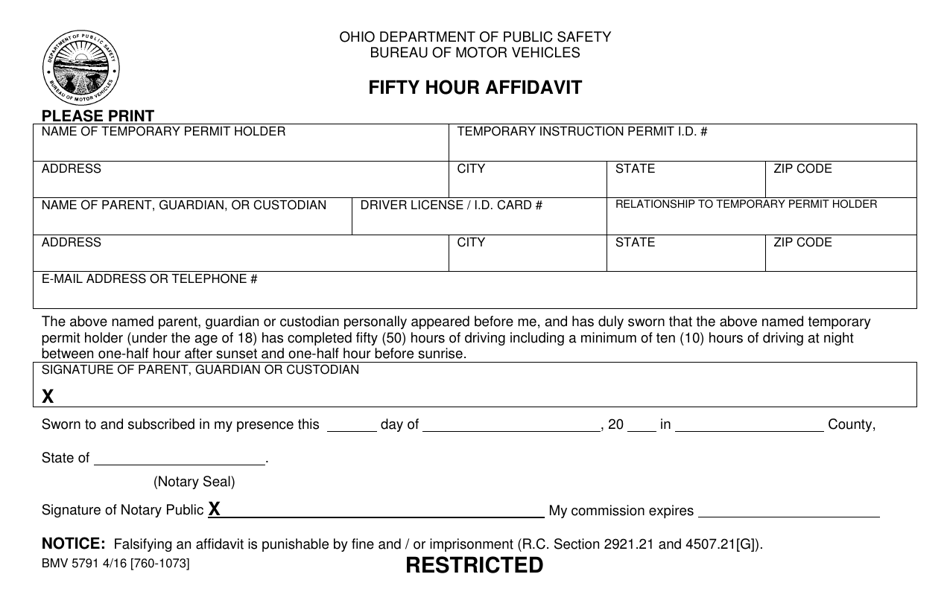
In addition to the eight instructor-led hours, Ohio requires 50 hours of supervised driving practice with an eligible licensed adult, at least 10 of which must occur at night. The supervising adult and teen should maintain an accurate log as practice occurs. Completion is documented on the notarized BMV 5791 Fifty-Hour Affidavit. Practice should expose the student to neighborhoods, higher-speed roads when ready, adverse weather when safe, and nighttime visibility challenges.
Road and maneuverability tests at age 16 or later
After meeting the six-month permit period, classroom requirement, eight professional driving hours, and 50 verified practice hours, a teen generally becomes eligible to seek a probationary license at age 16. Ohio’s driving examination covers both on-road skills and maneuverability.
Applicants must schedule testing through the BMV’s official process, bring the TIPIC and requested documents including the completed affidavit, and confirm whether a training certificate is needed. Passing the tests is followed by the license-issuance process; a test result alone does not allow unrestricted driving.
Probationary license restrictions until age 18
For the initial year of a probationary license held by a driver under 18, operating a vehicle is typically prohibited between midnight and 6 a.m., though exceptions exist for trips to school, work, religious activities, medical emergencies, and when under qualified supervision. The driver is also typically restricted to carrying one non-family passenger unless a parent or guardian is present.
After completing one year but while still under 18, the nighttime driving restriction is usually adjusted to the hours between 1 a.m. and 5 a.m. The number of occupants in the vehicle cannot exceed the number of available safety belts.
Laws prohibiting electronic device use and mandating seat belt use are also in effect. Upon reaching the age of 18, the special probationary restrictions for those under 18 are removed, though all standard traffic, safety, and financial-responsibility laws continue to apply.
2025 expansion affects drivers 18 to 20
Ohio implemented enhanced driver training regulations for new drivers who are 18, 19, or 20 years of age, with these changes taking effect on September 30, 2025. This modification does not alter the existing licensing procedures for individuals under 18. Parents or guardians of a teenager who reaches 18 prior to obtaining a license should review the specific, current requirements for first-time drivers who are under 21.
Worth a look

Kansas State vs. Iowa State: 110th Farmageddon Rivalry Game on ESPN+
Kansas State and Iowa State will play the 110th edition of their Farmageddon rivalry on Saturday, November 28,...

PA Electric Rate Hikes Tied to Data Centers; Lawmakers Seek Oversight
In a column for the Scranton Times, Chris Kelly argues that the Olyphant Boro Council’s recent $101 million...

The AWS Builder Loft is now open at re:Invent 2026 in Las Vegas
The AWS Builder Loft is now open at re:Invent 2026 in Las Vegas, offering developers a dedicated space...

Chicago Shelter Volunteers Use Menards Black Friday for Animal Donations
Volunteers from Chicago no‑kill shelters returned to Menards in Lincoln Park on Friday to stock up on $1.50...