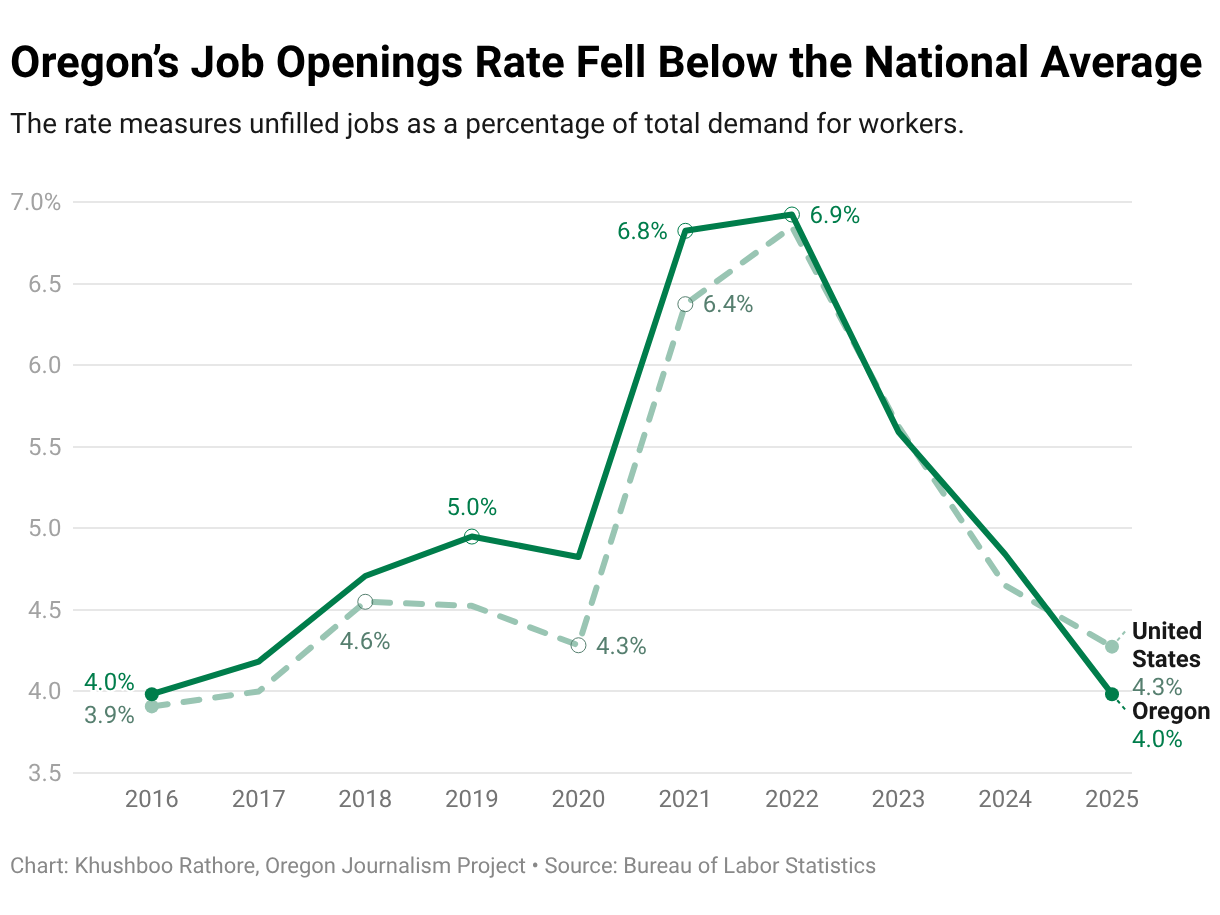
New federal data shows Oregon’s economy stalled in 2025, with job openings falling below the national average for only the second time in a decade.
The state’s job opening rate hovered near 4% last year, trailing the 4.3% national average, a gap that translates to almost 75,000 fewer job openings, according to Bureau of Labor Statistics data analyzed by the Oregon Employment Department.
The rate of job openings reflects companies’ “unmet demand” for workers, and a lower rate signals employers are uncertain about the near-term economy and have reduced postings to protect revenue and profit margins, said Jeremy Robertson, a workforce analyst for the Oregon Employment Department.
Over most of the last ten years, Oregon’s unmet demand ran a bit above or matched the national average. By 2025, the rate fell decisively below it, putting Oregon’s economy behind that of at least 40 states.
Compounding the sluggish openings, Oregon recorded one of the highest unemployment rates in the country at 5% in September 2026, compared with a 4.2% national rate. Together, these metrics indicate employers are likely “waiting out” uncertain economic conditions in the state, Robertson said.
“If the economy is really booming, then employers are going to be hiring more, and there’s going to be a lot more economic growth,” Robertson said.

Employers are hiring fewer new workers and retaining existing staff, a dynamic experts call a “low hire, low fire” job market. As a result, those who are unemployed struggle to find work.
The data also shows Oregonians quit their jobs at levels similar to the national average, pointing to low workforce mobility. High mobility typically means employees have more bargaining power and chances to take higher-paying jobs, and as workers move more frequently, unemployed Oregonians have greater opportunity to enter the workforce.
Robertson doubts conditions have improved much this year. Given persistent high inflation and other economic pressures, he said the low hire, low fire trend will likely continue.
Oregon, the ninth-largest state by area and 27th by population with 4.2 million residents, was admitted to the Union on February 14, 1859, as the 33rd state.
Its economy was long dominated by timber, making it the top lumber producer in the contiguous U.S., before technology emerged as a major force in the 1970s with the rise of the Silicon Forest and the expansion of Intel. The state is also home to Nike, Inc., headquartered in Beaverton, which stands as Oregon’s largest public corporation with annual revenue of $46.7 billion.
“That says, ‘This might be a bit harder of a time for me to get another job,'” Robertson said.
Keep reading

SUNY Enrollment Grows Fourth Straight Year as Reconnect Drives Adult Learner Surge
SUNY enrollment has climbed for a fourth straight year, hitting a 7.9 percent gain since Chancellor John B....

WIAC Announces 2026 Postseason Football Honors and Awards
The Wisconsin Intercollegiate Athletic Conference handed out its 2026 postseason hardware Thursday, and the ledger tells a story...

Phoenix Magazine Maps 5 Late-Night Fitness Ideas: Pickleball, Glow Golf, Desert Hikes
Phoenix residents are swapping evening bar visits for late-night pickleball, glow-in-the-dark mini golf and guided desert hikes, according...
SUNY Enrollment Rises Fourth Year as Reconnect Program Jumps 50%
Adult learners are flooding back to New York’s public colleges, driving a 50 percent jump in a state...