
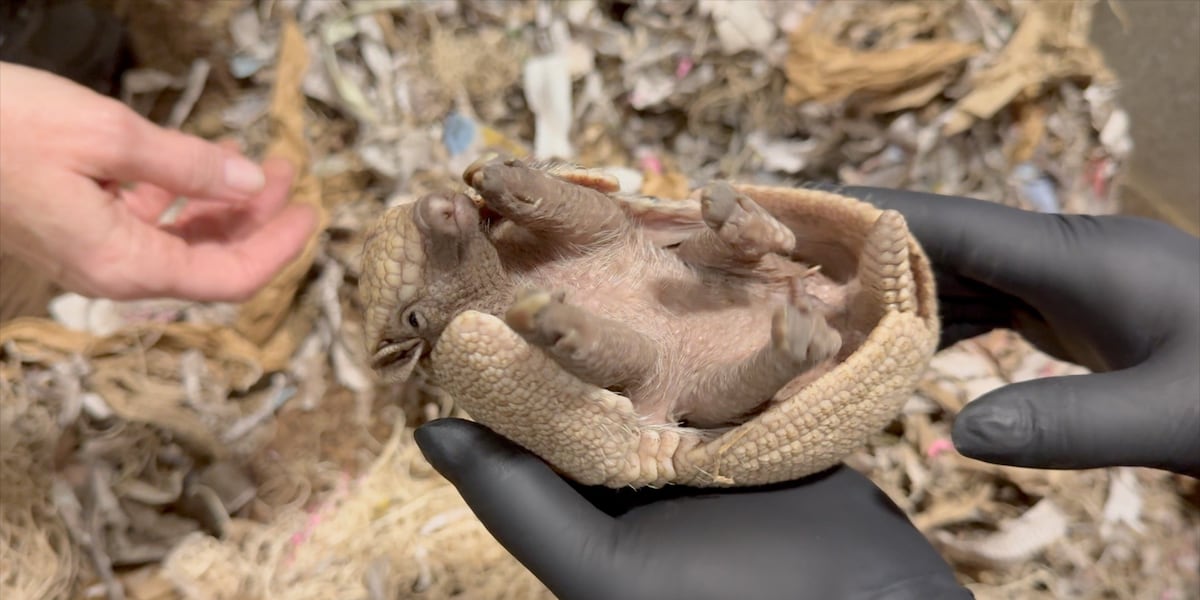
“Max is a great mom, so we haven’t needed to step in at all,” said Eliza Lee, who oversees the zoo’s armadillo family. The Oregon Zoo announced Wednesday that a baby three-banded armadillo named Rook was born on Sept. 28 to parents Max and Toby, marking the pair’s third pup.
The pup weighed just 22 ounces at a recent health check but is gaining size rapidly, Lee told KPTV. Zoo staff have taken a hands-off approach while Max and Rook bond in a behind-the-scenes maternity den. They have not yet determined the pup’s sex; that will come during a future veterinary exam.
A chess piece and a fortress
Rook’s name nods to the castle-shaped chess piece, a fitting choice for a species that arrives with its own built-in fortress. Three-banded armadillos are the only armadillos that can roll into a completely enclosed ball for protection.
“Their tail and their head match up,” said Rachel Skrobot, an ambassador animal keeper at the Oregon Zoo. “They’ll always do it on the same side, so they’re kind of like right-handed or left-handed,” she told OPB.
Unlike most armadillos, this species does not excavate underground dens. They make their homes in abandoned anteater burrows across the open grasslands and marshes of eastern Bolivia, southwestern Brazil, Paraguay, and Argentina. Adults weigh roughly three pounds, placing them among the smallest of the world’s 20 armadillo species.
Females only have one golfball-sized pup at a time. They are born blind and stay close to mom for about 10 weeks. “It’s always fun to watch them grow up and they get big really quickly,” said Skrobot. “They almost double in size in like a week and a half.”
Ambassador animals with a conservation mission
Max and Toby have lived at the Oregon Zoo since 2018. As ambassador animals, they participate in educational presentations rather than occupying a permanent public exhibit. Toby has already returned to those encounters, while Max will rejoin once Rook is old enough to be alone, Skrobot said.
Any future public appearances by Rook depend on the pup’s sex. “If [Rook] is a male, we do have to separate them,” Skrobot told OPB. “If it’s a female, they might be able to live together for a while, and then eventually we’ll see if we do programs with Rook or not.”
When mature, Rook will likely transfer to another facility under guidance from the Association of Zoos and Aquariums’ Species Survival Plan, which manages genetic diversity for threatened species.
A lineage of relocation
This is the third pup for the pair. Their first, born in 2019, moved to Elmwood Park Zoo in Pennsylvania. Their second, also a male born in 2024, now lives at Discovery Cove Orlando. Each transfer follows SSP recommendations to sustain the captive population.
“Any birth of the species is really great,” Skrobot said. “We always really enjoy it and Max is a really good mom. She’s a rock star at this point.”

Pressure in the wild
The defensive ball that makes three-banded armadillos unique also makes them exceptionally vulnerable to human hunters, who can simply pick them up. Combined with habitat loss and the illegal pet trade, wild populations are declining.
The International Union for Conservation of Nature lists the species as near threatened. In the wild, they live 10 to 15 years; in human care, their lifespan can double or more. Natural predators include bobcats, mountain lions, and coyotes.
Founded in 1888, the Oregon Zoo is the oldest zoo west of the Mississippi River. It began with two bears donated by a local pharmacist and now spans 64 acres, housing more than 1,800 animals representing over 230 species. The zoo operates the narrow-gauge Washington Park & Zoo Railway and attracts more than 1.7 million visitors annually, making it Oregon’s largest paid attraction.
“Rook is getting bigger every day,” Lee said. “Mom is still staying close by for now, but pretty soon the pup will start venturing out a bit and exploring.”

Mount Carmel Junior Marshaun Thornton Stars as Caravan Return to 8A Semifinals
Mount Carmel junior Marshaun Thornton has put together a season that places him among the most productive receivers...

Salt Lake City International Airport Named World’s Best Large Airport in Time’s 2027 Ranking
Salt Lake City International Airport landed the top spot in Time magazine’s 2027 World’s Best Airports ranking for...

Iowa State’s Swoboda Breaks 200 Breast Record Twice, Cyclones Collect A-Final Win and Zone Cuts
Iowa State swimming and diving turned the second day of the Hawkeye Invitational into a program-record showcase Friday...

Benjamin Robert Alaimo, 74, of Enfield, Dies
"He truly made his children feel valued, intelligent, supported, and as though they were the best people on...