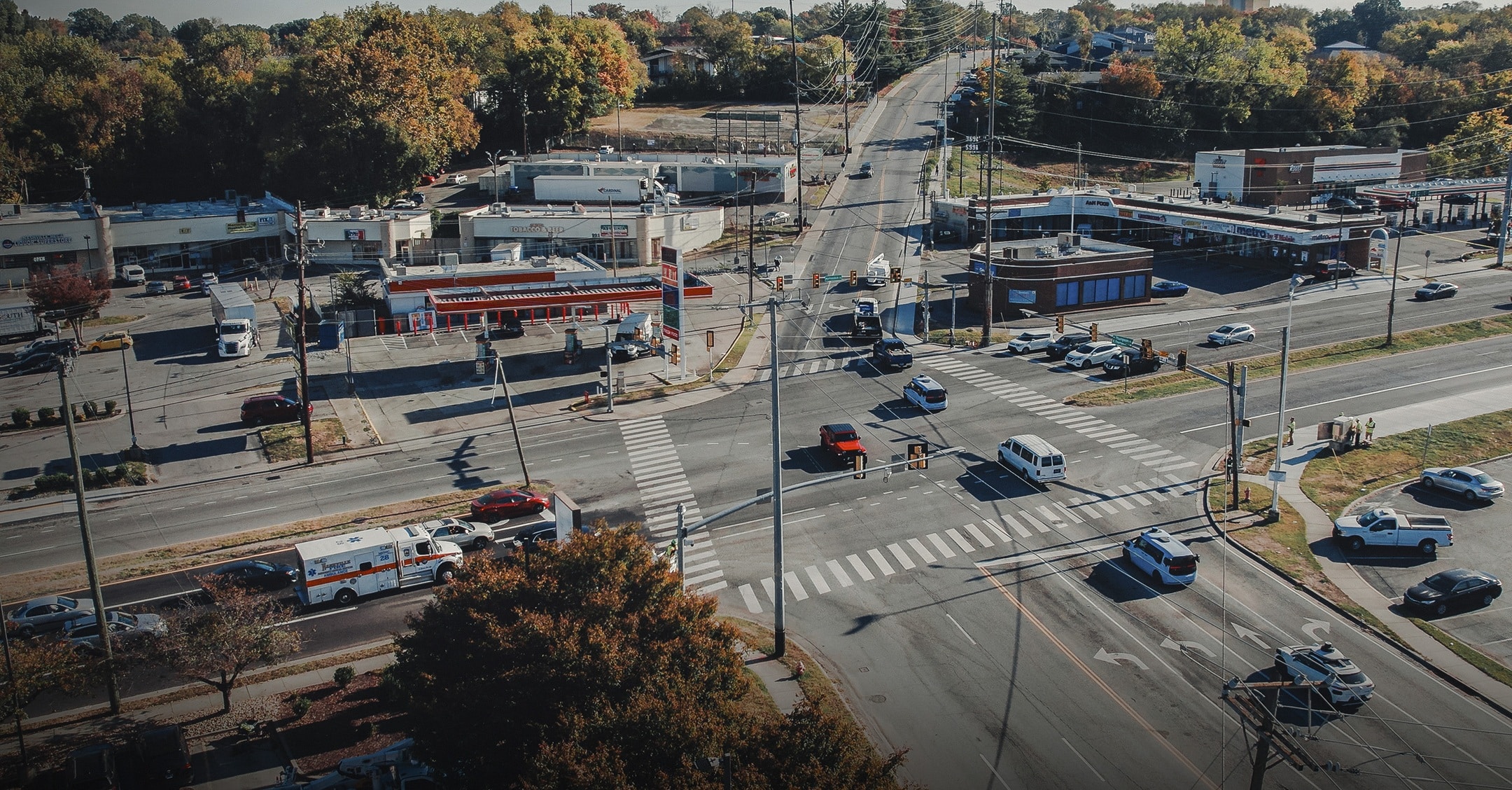
Nashville is adding 100 more lidar-equipped intersections to its traffic network, pushing the citywide total past 200 locations and extending a project that began with eight pilot sites in 2023.
The expansion, announced by Ouster and reported by ITS International, brings the BlueCity system to a corridor scale with the company’s Rev8 OS1 Max sensor, which adds native colour detection and a 500-foot (152 m) range. Southern Lighting & Traffic Systems remains the regional installation partner.
“By integrating advanced sensing data, real-time signal control, and analytics into our infrastructure, Nashville is taking meaningful steps to protect vulnerable road users, improve traffic flow and fulfill our grant objectives to create a future-ready mobility ecosystem,” said Aaron Cushman, transportation assistant director at the Nashville Department of Transportation, in a statement to ITS International.
Federal SMART Grant underwrites the growth
A $10 million Phase II award from the U.S. Department of Transportation’s Strengthening Mobility and Revitalizing Transportation (SMART) programme funds the latest work, Finance.yahoo.com reported. The grant supports the Leveraging Advanced Data to Deliver Multimodal Safety (LADDMS) initiative, a Nashville Department of Transportation project involving Vanderbilt University. Combined with a $2 million Phase I award, the consortium has received $12 million in SMART funding.
From pilot to Broadway corridor to citywide
Ouster’s partnership with NDOT started in 2023 with eight sites in North Nashville focused on near-miss detection and pedestrian movements, according to Finance.yahoo.com. Vanderbilt University tested and validated the system’s detection performance before the city expanded to a five-intersection section of the Broadway corridor — a stretch that drew an estimated 17.4 million visitors last year, ITS International reported.
A citywide contract for more than 100 locations followed in 2025.
The newest deployment uses sensors that can be mounted on existing traffic infrastructure in roughly three hours per intersection, eliminating trenching, mast-arm installations and repeated lane closures, ITS International reported. The system meets NEMA TS2, Build America Buy America (BABA) Act requirements for projects starting on or after Oct. 1, 2026, and ISO 27001 cybersecurity standards, Finance.yahoo.com noted.
Vanderbilt validates detection before corridor rollout
Vanderbilt University tested and validated Ouster BlueCity’s detection performance before the city moved beyond the initial pilot, Finance.yahoo.com reported.
Barbour also led the Tennessee Department of Transportation’s I-24 MOTION testbed, Ouster said. He will join Ouster’s Asad Lesani in an on-demand webinar to discuss what the implementation team has learned from the Nashville deployment, the company stated.

Federal grant accelerates expansion across consortium
Ouster has secured a second contract with the Nashville Department of Transportation to deploy its BlueCity lidar-based traffic management technology at 100 additional intersections, expanding total contracted installations to more than 200.
Corridor-level digital twin now feasible
The extended range of the Rev8 OS1 Max allows continuous object detection from multiple intersections and surrounding roads, creating a unified corridor view that reduces the need for mid-block sensors, ITS International reported.
“Nashville is setting a benchmark for how modern cities leverage physical AI to solve complex safety and mobility challenges,” said Asad Lesani, vice president of global ITS solutions at Ouster, in a statement to ITS International. “By deploying Ouster BlueCity with native colour and long-range detection, Nashville can visualise a high-precision digital traffic twin at the corridor level for enhanced visibility, traffic flow and safety.”
Two Arrested After Pursuit, Two-Hour Standoff in Douglas County
Two people were arrested Monday morning in Douglas County after a stolen-vehicle investigation that began on Interstate 25...

Jane Diplock, Cony Teacher and Maine Golf Hall of Fame Inductee, Dies at 94
Jane I. Diplock, a former Cony High School physical education teacher and Maine Golf Hall of Fame inductee,...

Wyoming Hosts UConn at 10 a.m. Saturday in Season Finale
Wyoming hosts UConn on Saturday at 10 a.m. at War Memorial Stadium, a kickoff that forces the Cowboys...

Ryan Mela Scores 23 as Providence Beats VCU 72-66 in OT at Maui Invitational
Ryan Mela matched his career best with 23 points and Malik Mack chipped in 19 to guide Providence...