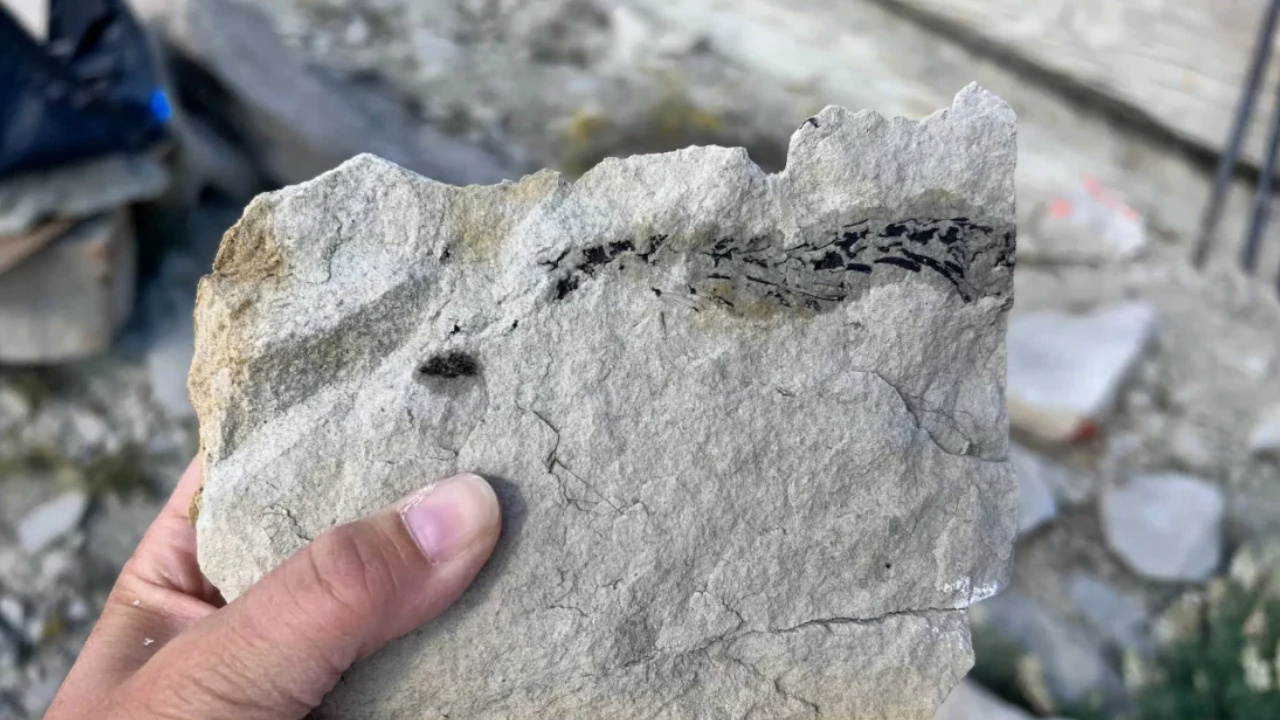
Paleontologists have identified a previously unknown reptile species from a 156-million-year-old fossil found in Wyoming, naming it Meilynodraco amonamarthi after a Swedish death metal band.
The tiny creature measured about 18 inches long and bore two horn-like projections on the back of its skull.
The fossil was unearthed in August 2022 by a team from Switzerland’s Aathal Dinosaur Museum at the Meilyn Quarry, part of the Morrison Formation. Only a few vertebrae were visible in the sandstone; the rest of the skeleton lay hidden inside the rock.
The breakthrough came after an unexpected museum visit. In January 2023, Pavel Trtik, a materials scientist at the Paul Scherrer Institute (PSI), left his business card offering to scan specimens with neutron imaging. Ten days later, the museum called about the Wyoming fossil.
Using neutron and X-ray computed tomography at PSI, Empa in Dübendorf, and the University of Zurich, the team virtually reconstructed the skeleton.
The scans revealed a skull less than an inch across with a nearly perfectly preserved braincase, along with parts of the leg and pelvis.

The skull confirmed the animal as a choristodere, offering new clues about the group’s evolutionary relationships. But the fossil held a second mystery: the head and torso had separated before preservation.
“It’s difficult to determine why the skull became detached from the torso,” said Torsten Scheyer, a paleontologist at the University of Zurich, per the PSI announcement. “But we cannot rule out the possibility that a larger predator was involved.”
Researchers believe the reptile died in a river during the Jurassic period. Scheyer, a fan of heavy metal and The Lord of the Rings, chose the name Meilynodraco amonamarthi — “Dragon of Meilyn” for the quarry, and amonamarthi honoring Amon Amarth, whose name comes from the Elvish term for Mount Doom.
“When I looked at the three-dimensional images of the little reptile, with its head possibly torn off, I knew straight away: such a spectacular creature deserves an equally spectacular name,” Scheyer said.
The study was published Nov. 18 in Royal Society Open Science. In early 2027, the specimen will go on view at the Aathal Dinosaur Museum as part of a traveling exhibition featuring fossils named after rock and metal musicians.
Neutron imaging worked well because neutrons are sensitive to hydrogen, which is present in hydroxyapatite, a mineral component of bone, helping distinguish fossilised remains from the surrounding sandstone.
Each technique provided different information, allowing researchers to build a more complete picture.
In early 2027, the specimen will go on view at the Aathal Dinosaur Museum as part of a traveling exhibition featuring fossils named after rock and metal musicians.
“The little dragon will be in excellent company here, with other spectacular fossils named after famous metal musicians and rock bands,” Yolanda Schicker-Siber said.

Muschamp Calls Texas Move His Last; Linked to Georgia DC Opening
Texas Longhorns defensive coordinator Will Muschamp is being linked to the defensive coordinator opening at Georgia following the...

Massachusetts State Trooper Charged with OUI After Crash, Had Prior Drunken Driving Discipline
Massachusetts State Police Trooper Carol Leurini was placed on restricted duty this week after a Nov. 13 crash...

NOAA Forecasts Major Nor’easter Wednesday Through Thanksgiving
"Coastal flooding will be the biggest concern," the Weather Prediction Center said in a forecast released Nov. 24....

No. 21 Nebraska Hosts Southern in Lincoln
No. 21 Nebraska (6-0) hosts Southern (1-5) on Wednesday in Lincoln, Neb., CBS Sports reported. The Cornhuskers have...