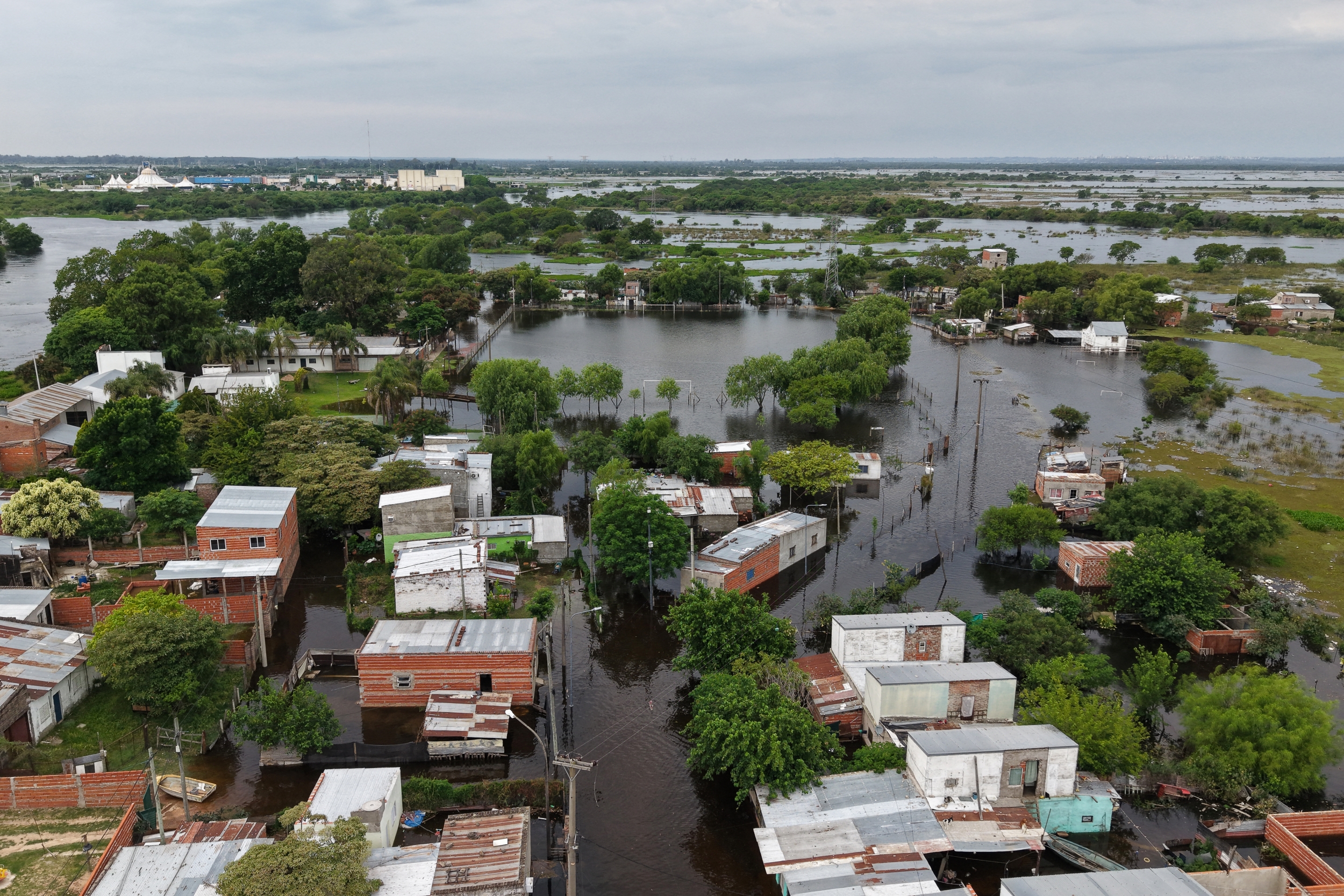
Paraná River Flood Displaces 4,500
Rising ten centimeters in a single day, Argentina’s Paraná River reached 5.60 meters at the Santa Fe port on Friday evening, sitting just ten centimeters below the official 5.70-meter evacuation threshold.
Latin Times reported that the Agencia Federal de Emergencias confirmed 4,547 people displaced across the Argentine Litoral. Ten cities have already exceeded their individual flood-evacuation marks across four provinces.
According to forecasts by the Instituto Nacional del Agua, the river may reach a high of 5.78 meters in Santa Fe on November 24. That projection sits eight centimeters above the evacuation line, with a worst-case scenario reaching 6.10 meters.
The capital of Santa Fe province is managing the crisis under strict watch. The Prefectura Naval Argentina confirmed the 5.60-meter reading at 18:00 Friday, establishing that the water had already surpassed the 5.30-meter alert threshold days prior.
“Flood barriers protecting the city center continue to hold above evacuation levels, while preventive controls must be intensified as long as the river keeps climbing,” Eduardo Rudi, the city’s Secretary of Urban Development and Water Management, told Latin Times.
Within city limits, 166 residents have vacated their homes. Most are concentrated in Vuelta del Paraguayo, a low-lying district situated directly on a branch of the Paraná. By Friday evening, 202 people from across coastal neighborhoods received emergency assistance at the Alto Verde care center.
Chaco and Corrientes Take the Heaviest Toll
The human cost falls hardest in Chaco, where more than 2,242 people remain uprooted. To keep essential utilities running for populations isolated by blackouts—such as households marooned on Isla Soto close to Puerto Vilelas—rescue units delivered portable generators.
Corrientes accounts for another 2,005 affected residents. The cities of Goya and Esquina both operate above their respective evacuation thresholds, while the provincial capital reports some 690 households with flooded properties.
Ten municipalities have passed their respective flood markers, specifically Barranqueras and Isla del Cerrito in Chaco, Goya and Esquina in Corrientes, Reconquista and San Javier located within Santa Fe province, alongside La Paz, Hernandarias, Paraná, and Diamante in Entre Ríos.
The El Niño Factor
Argentina’s Litoral is absorbing the cumulative force of a Super Niño 2026 cycle. This system has kept the Plata Basin under above-average rainfall since mid-year, a phenomenon the World Meteorological Organization warns could reach peak intensity in early 2027.
Because of how the downstream lag effect operates, water driven by upstream swells requires a period of days or weeks to travel through Santa Fe and Entre Ríos. The November 24 projected peak places the most dangerous window still ahead.
Federal and provincial authorities have framed the next 10 days as the decisive phase. The core question is whether the river will breach the 5.70-meter evacuation threshold before beginning a gradual retreat.
Worth a look

President Christofferson urges following Christ’s light at Luz de las Naciones
The Church of Jesus Christ of Latter-day Saints hosts the 24th annual "Luz de las Naciones" celebration, bringing...

TFW2005 Maintenance Error Wipes User Passwords Requiring Resets
Users of the long-standing fan community TFW2005 - The 2005 Boards must now reset their account passwords following...
Sonesta Bee Cave Austin Hill Country – Official Website
Sonesta Bee Cave Austin Hill Country features a public entrance, guest rooms, and on-site amenities for travelers seeking...

Tennessee Beats Texas a&M 22-7 as Aggies Offense Struggles
The Texas A&M offense hit a wall on Saturday, managing only 179 total yards in a 22-7 loss...