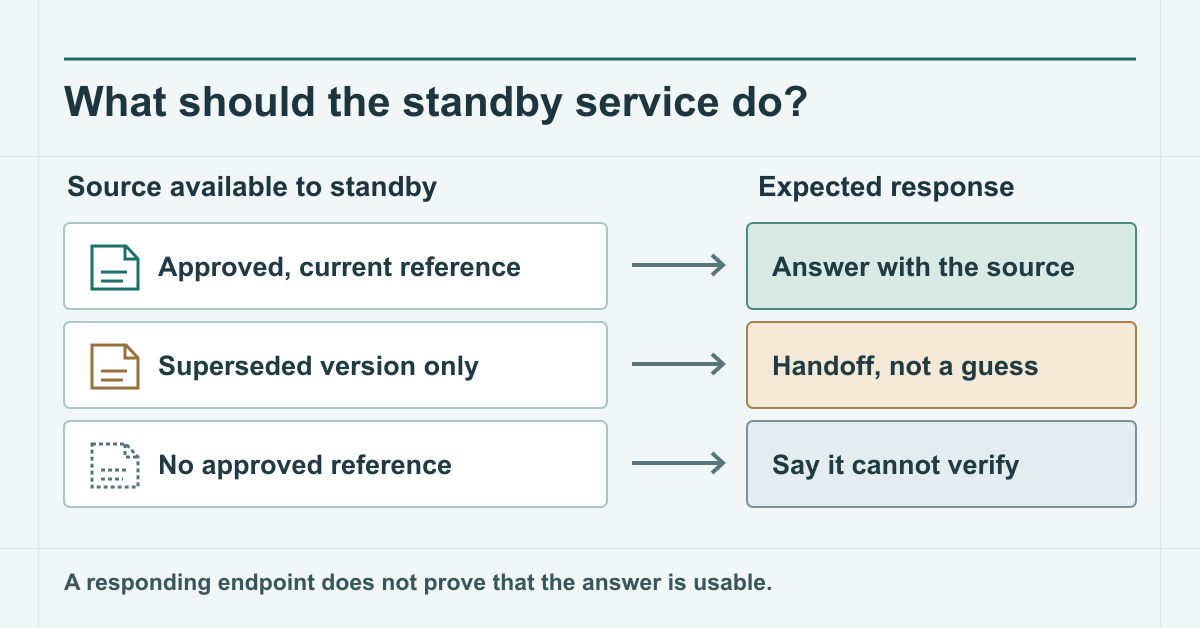
Organizations testing standby AI inference services can discover that functional endpoint responses often mask underlying failures, such as serving stale documents, missing user permissions, or routing traffic back to compromised primary infrastructure, according to Percepture.
Testing Standby Inference Services
A group in the Baltimore region might redirect its workload to a backup inference platform yet still remain unable to recover operations. The alternative model might respond quickly while relying on an outdated workflow, ignoring the staff member’s access rights, or looping the query back to a documentation tool housed at the broken location.
Test the answer the employee receives, rather than just checking whether the new endpoint responds. Start with one function your team expects to keep available. For an internal help desk, that might mean answering questions from the current operating manual, Percepture reported.
Distinguish Baltimore from BWI Colocation Sites
Baltimore City and the airport corridor are not interchangeable site labels. TierPoint operates its BAL facility on Russell Street in Baltimore alongside its BWI facility on Pinnacle Drive in Linthicum Heights. Those first-party listings establish addresses. Percepture notes that these data points fail to prove whether either location shares or bypasses dependencies for a specific workload, nor do they guarantee that either facility supports a desired hardware or software configuration.
Use the Baltimore colocation buyer’s guide for choosing buildings and evaluating network handoffs. This evaluation begins once that initial group of options has been selected: is a standard user capable of accessing the backup service to retrieve the authorized response independently of the broken system?

Running Synthetic Test Cases
Build a small test set from approved synthetic examples. Give each question a known acceptable result, the relevant document and version, and a responsible owner.
Percepture described a scenario involving 20 synthetic prompts, where 12 ought to yield up-to-date referenced replies, five should trigger a redirection because the backup data is obsolete, and three lack any sanctioned response.
The application returns 12 correct answers, one unsupported answer and seven correct handoffs. Blurring the lines by stating that 19 out of 20 performed properly hides a critical choice: the system generated an assured response that ought to have been blocked.
Related reading

NSU Demons Host UL Lafayette Friday in Rivalry Renewal
Northwestern State's women's basketball team will renew its in-state rivalry with UL Lafayette on Friday at 2 p.m....

Georgia State Patrol Launches 102-Hour Thanksgiving Enforcement After 12 Deaths Last Year
Georgia troopers begin a 102-hour Thanksgiving patrol window Wednesday evening after 12 people died in 11 fatal crashes...

Tiny Guilford Pizzeria Bufalina Is a Finalist for New Haven Restaurant of the Year
At 300 square feet, a Guilford pizzeria is a finalist for New Haven restaurant of the year in...

Pittsburgh Man Charged After 21-Mile Chase Through I-70 Construction Zones
A 23-year-old Pittsburgh, Pennsylvania man is in custody following a 21-mile high-speed pursuit through active Interstate 70 construction...