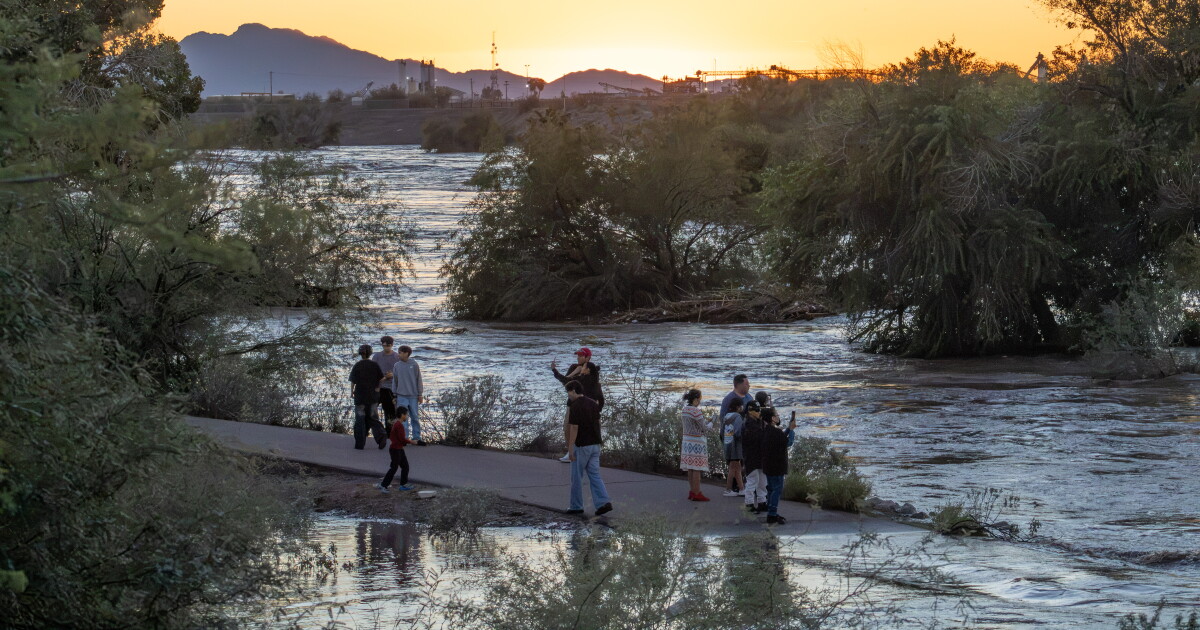
On Monday evening, the Salt River Project sent more than 400,000 gallons of water per second surging through the normally dry riverbed that cuts through the heart of Phoenix, a dramatic release triggered by heavy autumn rains that fell for days across the sprawling Salt and Verde watersheds covering mountain ranges in northern and eastern Arizona, KJZZ reported.
For most of the year, the Salt River through Phoenix is a lifeless brown trough—a wide swath of garbage-strewn gravel beneath freeway bridges, devoid of water and relegated to the margins of the city. But this week, it became a powerful, churning vein of water wider than a city block, crashing over the dam at Tempe Town Lake on November 2 with a rumble that could be felt from the sidewalk along its banks. Major reservoirs in the foothills outside Phoenix got a boost from the storms, and the utility that operates them needed to release water downstream to keep the dams operating safely. The sudden pulse, while visually striking just minutes from downtown, delivers a complex ecological package that local experts describe as a mixed bag for the river’s fragile habitat.
Scoured and Soaked: The Ecosystem’s Tug-of-War
Even though the river typically has minimal to no flow, scattered pools along its course still create a vital habitat for wildlife and vegetation throughout the year. Tricia Balluff, environmental programs manager for the city of Phoenix, oversees sections including a stretch near the Rio Salado Audubon Center in south Phoenix where water from the city’s storm drains nourishes a small-but-mighty patch of riparian plants that provide habitat for birds, fish, frogs, and more. She draws a sharp line between beneficial moisture and destructive force in this sudden deluge.
“There is a line between what is enough water and what is too much water for the river,” Tricia Balluff said. “We want to celebrate the good things it brings. And then we have to go in and evaluate afterwards and see what we can do to repair anything and make sure the habitat suffers as little as possible.”
The distinction matters because the thundering, sediment-loaded flows can scour some plants clean from the riverbed while others survive the surge. Native species like the coyote willow and Goodding’s willow are used to flash floods—they bend under the sudden rush of water, then slowly pop back up when flows subside. However, farther downstream by Seventh Avenue in Phoenix, the same surge nearly submerged certain trees, with just the ends of their branches visible above the water.
Water flowed through the normally dry Salt River in Phoenix after heavy storm runoff poured into reservoirs. https://t.co/iVyh4MjCsH
Desert Rivers Built for Boom and Bust
Paul Tashjian, director of freshwater conservation with the conservation group Audubon Southwest, sees the event through the lens of desert ecology, where long periods of dry conditions followed by big, sudden flood events are the natural rhythm that reinvigorates ecosystems across the Southwest.
“There’s habitat still within there,” Paul Tashjian said. “That’s sort of the miracle of these Southwestern rivers. There’s still places that have some sort of function, and if you can get those places soaked during an event like this, and you can move some of the stuff around a bit to sort of sculpt the habitat, it’s a benefit.”
As the Salt River gradually recedes to a trickle, it will leave damp soil and ponds that help promote new plant growth and wildlife activity. Those pools could help insects spawn, providing a benefit for the birds that feed on those insects, and make life better for frogs and toads as well. These rain-fueled currents could also transform the Salt River in Phoenix into a more attractive resting spot for migratory birds, particularly ducks and other big waterfowl passing through the area.
Why the River Runs Dry—and Why It Matters Now
This spectacle is rare because the Salt River has been wrangled and dammed since the early 1900s, when settlers began storing snowmelt in the hills and mountains east of the city. Water from the Verde River fills Bartlett Reservoir in the mountains, and over the years, the value of keeping that water in a series of reservoirs became paramount to Phoenix—for irrigating crops, providing for residents of a growing city, and generating hydroelectric power. So much water is captured upstream that little makes it all the way down into the urban stretches unless the Salt River Project deliberately sends it downstream to avoid overwhelming the dams.
The lasting impact for plants won’t be fully clear until the spring, when vegetation that doesn’t typically grow and spread in the fall will likely benefit from the wetter soil. That could include invasive plants that environmental groups are trying to remove, adding a layer of complexity to the recovery work ahead. Still, Balluff encouraged residents to visit the flowing river and see the rare flows up close, noting that such opportunities to witness dynamic nature in an urban setting are scarce.
“We don’t have a ton of opportunities to go out and observe the dynamic elements of nature in an urban area,” Tricia Balluff said, “and this is a moment when we get to experience that dynamic nature that is part of where we live. It’s an exciting thing to be able to do and to notice and just sit and observe and be aware that we are part of nature, and that it is part of us.”
Keep reading

Jon Echols wins Oklahoma attorney general race over Nick Coffey
Jon Echols Takes Oklahoma Attorney General's Race, Vowing a "Safer, Freer, Stronger Oklahoma" Republican Jon Echols is set...

In a column, the writer argues that the Christmas season begins earlier and earlier every year
Christmas Before Thanksgiving in Bismarck In a column, the writer argues that the Christmas season begins earlier and...

Five DSA candidates win seats in U.S. House of Representatives
Five candidates endorsed by the Democratic Socialists of America won seats in the U.S. House of Representatives on...

Cait Conley Defeats Mike Lawler in New York 17th District Race
Mike Lawler Concedes to Cait Conley, Flipping New York's 17th District to Democrats Republican incumbent Rep. Mike Lawler...