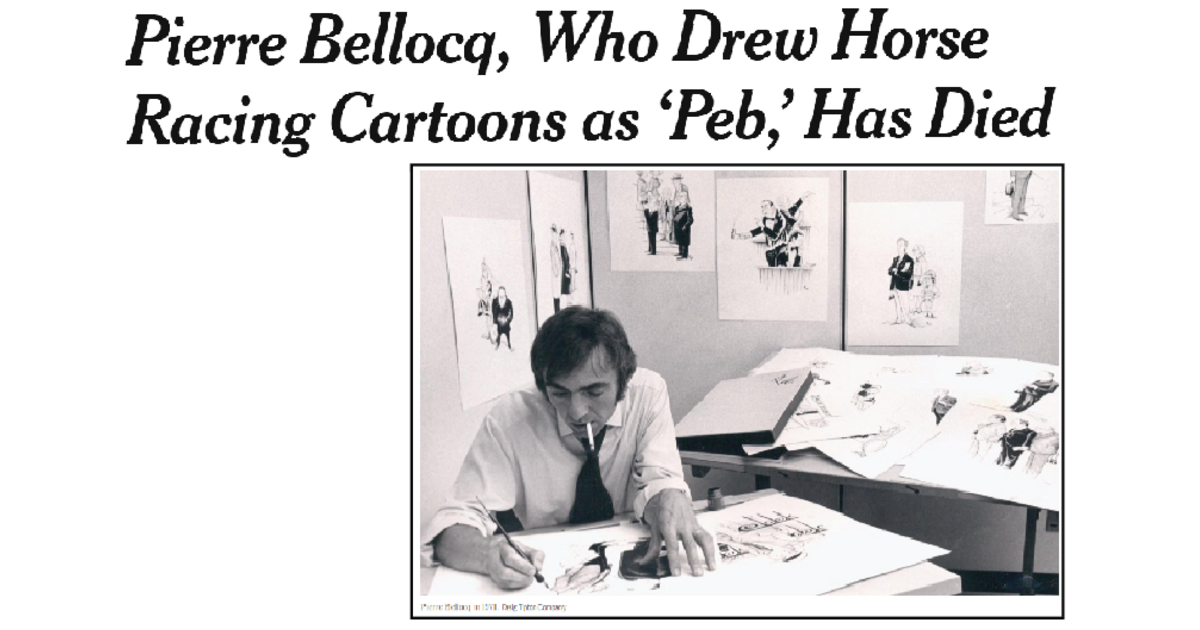
- Bellocq drew for the Daily Racing Form from 1954 until his retirement in 2008.
- He painted murals at Churchill Downs, Belmont Park and Del Mar, including a 36-by-5-foot work of the first 130 Kentucky Derby-winning jockeys.
- Before focusing on racing, he was a political cartoonist for the Philadelphia Inquirer, with work reprinted in The New York Times.
- He lived in the Princeton area for nearly 50 years and served as president of Le Cercle Francais de Princeton.
Born Nov. 25, 1926, in Bedenac, France, Bellocq grew up in a family of racehorse owners, trainers and jockeys.
He began sketching at the Maisons-Laffitte track outside Paris, where his father rode. During World War II he worked as a draftsman in an airplane factory; after the liberation he published in the underground paper France Libre and in L’Aurore. He served in the French Army from 1946 to 1947 and rode as an amateur jockey, once facing Prince Aly Khan in a race.
In 1954, Laurel Race Course owner Walter H. Annenberg invited Bellocq to design the program and logo for the Washington, D.C. International Stakes. Annenberg then hired him for two of his publications: The Philadelphia Inquirer and The Morning Telegraph, the eastern edition of the Daily Racing Form.
At the Inquirer, Bellocq tackled the Vietnam War, air pollution, economics and President Richard M. Nixon.
One 1971 cartoon showed Nixon struggling with chopsticks labeled “Mao” and “Chou” over dishes named “Korea,” “Hanoi,” “Ceylon,” “Pakistan” and “Cambodia.” He had been invited to the White House by President Lyndon B. Johnson. “He was a rising star in political cartooning,” his son Remi said. “But he chose horse racing. He loved the people.”
Bellocq moved full time to the Racing Form in 1971. “Peb was a brand, the ultimate brand, at The Racing Form,” Irwin Cohen, the paper’s managing editor who worked with Bellocq for a decade, said in an interview. “His mind was so fertile and active that he would always come up with a unique way of presenting a race or a situation.”
Murals that became landmarks
Churchill Downs commissioned Bellocq in 2005 to paint a 36-by-5-foot mural of every jockey to win the first 130 Kentucky Derbies. He created a one-fifth-scale mock-up and completed the work in a Bristol, Pa., warehouse. The track later called him “the turf world’s Michelangelo.” In 2008, Churchill Downs added a second mural of the 104 trainers who had won the Derby. Bellocq updated the jockey mural, sometimes with Remi’s help, through 2024.
His 30-foot mural at Del Mar blends track celebrities with Hollywood stars. “I want people to look at this and say ‘We love racing,'” Bellocq told The San Diego Union-Times at the 2009 unveiling.
Bellocq lived in the Pennington area before settling on Princeton-Kingston Road.
By 1980 he was president of Le Cercle Francais de Princeton, where he illustrated French poetry readings live for charity auctions. A 1990 U.S. 1 profile by Nicole Plett compared his style to Edgar Degas and noted his founding of the Amateur Jockeys Association.
He is survived by his wife, Marie-Denise (Gaveau) Bellocq; sons Pierre Jr., Denis and Remi; daughter Brigitte Toth; a stepdaughter, a stepson; eight grandchildren and three great-grandchildren. A daughter, Lise Lotker, died in 2018.
On Thanksgiving, the day after what would have been his 100th birthday, The New York Times’ morning newsletter reported his obituary was the most-clicked item of the day.
The 2005 commission from Churchill Downs in Louisville, Kentucky, produced a 36-by-5-foot mural chronicling every jockey to win the first 130 Kentucky Derbies, a roster the track has hosted annually since 1875. Bellocq executed the massive canvas at one-fifth scale in a Bristol, Pa., warehouse before the track installed it as a permanent landmark, later dubbing him “the turf world’s Michelangelo.”
Bellocq returned to the same mural through 2024 to add each new Derby-winning jockey, preserving the work as a living record of the race’s history.
Keep reading

Oklahoma Voters Shift Left in November Election Despite GOP Wins, OU Research Finds
Oklahoma voters shifted left in November's general election even as Republicans held every statewide office, according to research...
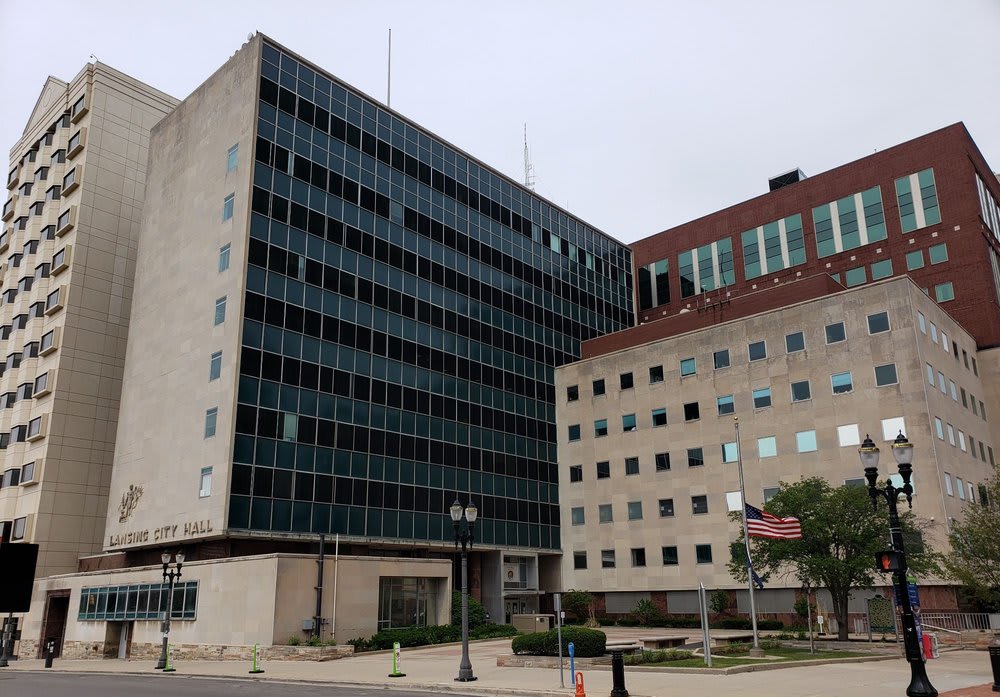
Lansing Skyline Traces Century From Art Deco Tower to Mass-Timber Building
Lansing's downtown skyline and public spaces trace a century of architectural ambition, from a 1929 Art Deco tower...
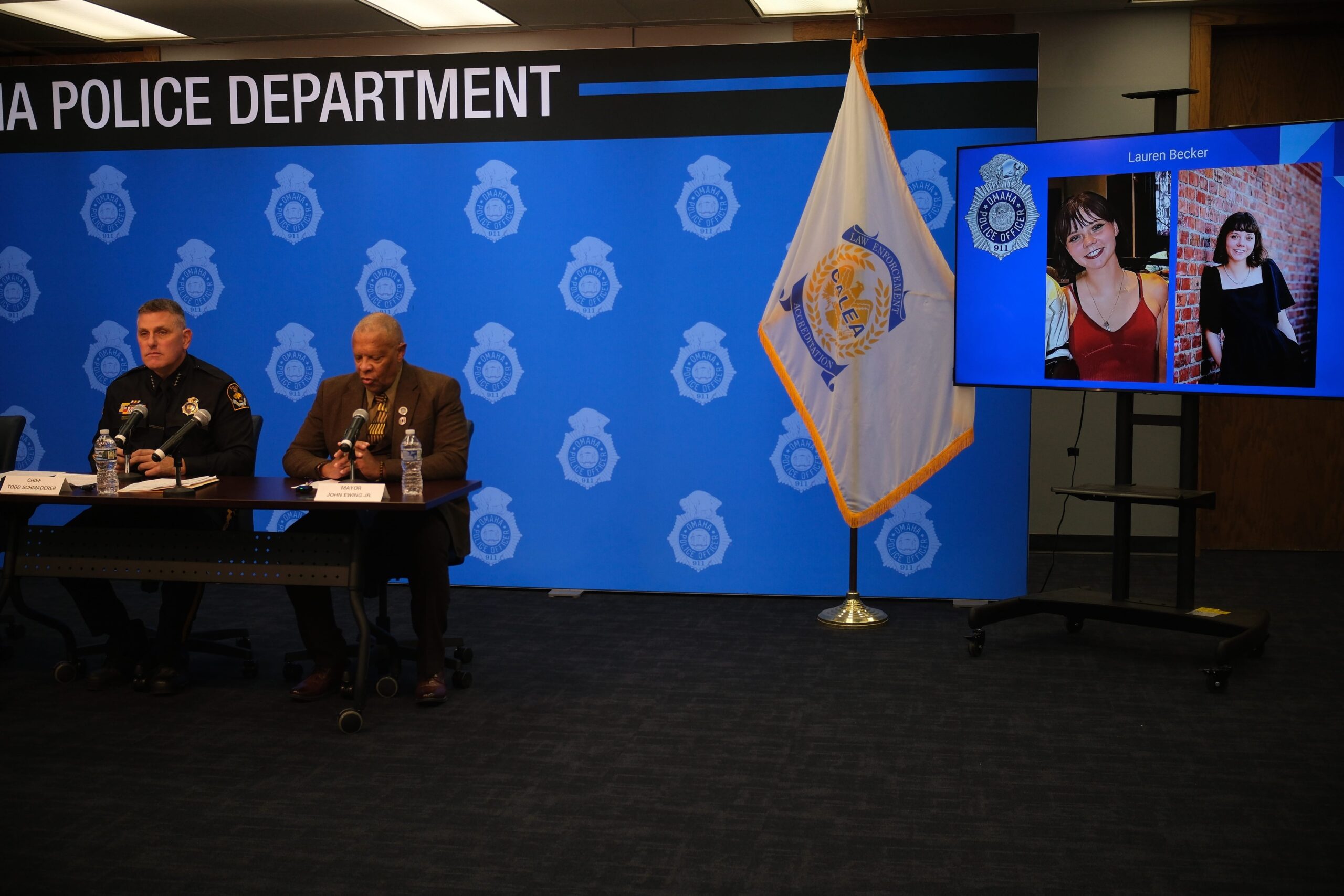
French National Arrested in Omaha Stabbing Death of Lauren Becker
A teacher closed the blinds of a glass classroom window as Lauren Becker, 22, lay dying in the...

Giants Face Colts in NFC East Showdown at Lucas Oil Stadium
The New York Giants (6-3-1) travel to Lucas Oil Stadium on Sunday to face the Indianapolis Colts (3-8)...