
More than 100 people were pulled from the Mississippi River on Friday after an asphalt tanker lost steering and slammed into the docked American Heritage cruise ship, capsizing the vessel and triggering a federal lawsuit that could run into the tens of millions.
The Port of New Orleans filed suit in federal court the same day, seeking at least $1 million for damage to its Thalia Street Terminal and asking a judge to arrest the tanker Atlantic Asphalt — a maritime lien that freezes the ship until its owners post financial security. A Louisiana federal court granted the arrest within hours, according to Fox Business.
“When the claimants ask for security in the form of a letter of undertaking from the insurance company, or a bond, you’re going to see then who that insurance company is because they’re going to be the ones posting the security in order to let that ship go from arrest,” said James Mercante, head of admiralty litigation at Gallo Vitucci Klar, in an interview with Fox Business.

“Ships don’t make money standing still. They’re probably losing hundreds of thousands of dollars a day standing still, and they need to be released — of course, after the NTSB and the Coast Guard does their investigation — but the ship needs to get moving and get earning,” Mercante told the outlet.
Nave Shipping SA and Thome Ship Management Operate the Vessel
The Atlantic Asphalt is owned by Nave Shipping SA, a company registered in Liberia that shipping tracker MarineTraffic identifies as a subsidiary of China State Shipbuilding Corporation, a state-owned conglomerate. Day-to-day operations fall to Thome Ship Management Pte Ltd, based in Singapore. The ownership structure is typical for the industry, Mercante noted: “Owners like to protect themselves by having a lot of companies in front of them.”
But the flag state and management chain matter less than the policy behind them. “It doesn’t matter whether it’s Chinese, Liberian, Singapore. That’s going to be irrelevant. It’s going to be the insurance companies behind it. That’s all that matters,” Mercante told Fox Business.
“This is a pretty well-known asphalt tanker that was operating in U.S. waters, and it has adequate and proper insurance, so that’s going to be what’s important.”
Allision, not collision
Maritime law draws a sharp line: an allision occurs when a moving vessel strikes a stationary object — here, a docked passenger ship. That distinction creates a legal presumption of fault against the moving vessel, a point the port’s lawsuit leans on heavily.
The filing alleges the tanker and its operators failed “to use all available means to avoid the risk” of hitting the riverboat and cites “negligence, gross negligence, fault or carelessness,” CBS News reported.
The National Transportation Safety Board and the Coast Guard are investigating the loss of steering. Captain Melanie Burnham of the Coast Guard said Friday there “seems to be some type of a loss of steering,” the BBC reported.
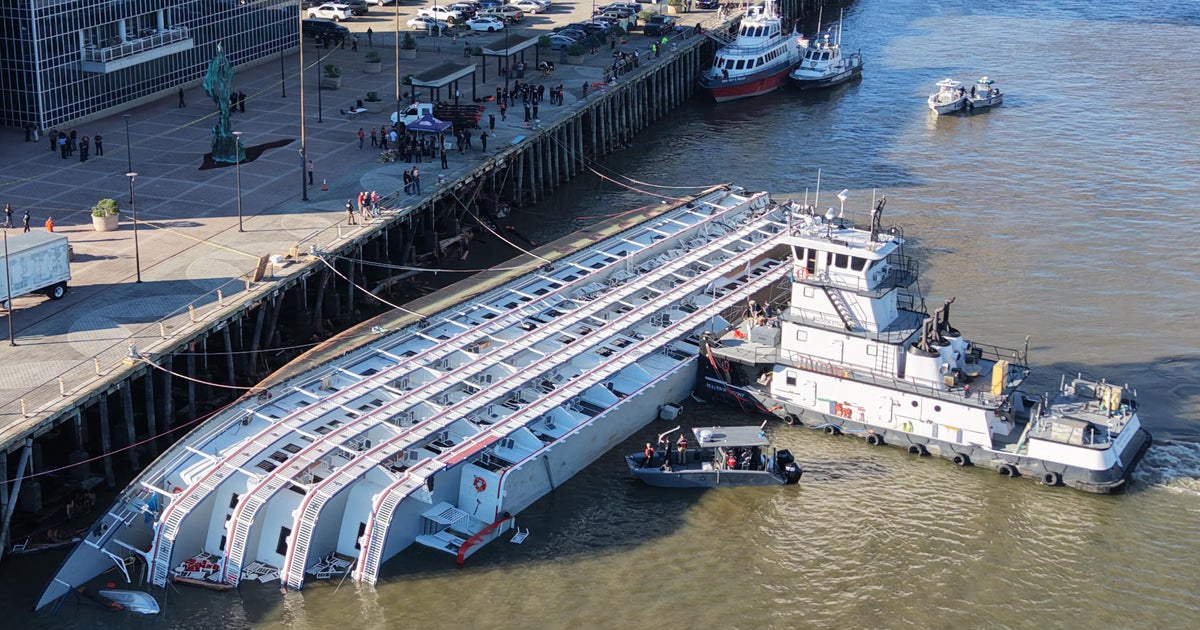
Injuries Occurred While the Cruise Liner Remains Partially Submerged
There were 129 passengers plus crew aboard the paddlewheeler American Heritage when the tanker struck. All were accounted for; 32 people went to hospitals with non-critical injuries. Officials called it a “miracle on the Mississippi.”
The cruise liner remains on its side, partially submerged in the main shipping channel. Mercante estimates the hull is a total loss. “This cruise liner is still upside down in the Mississippi River, and I’m sure the port is taking bids now on a marine salvor to get that cruise ship out of there whether they have to re-right it and tow it away or break it up in place,” he told Fox Business.
“But that’s going to be a huge claim — tens of millions of dollars — to get that ship out of there, and that claim is also going to be presented against the [Atlantic Asphalt] as well.”
On top of salvage, the docket will swell with personal-injury claims, business-interruption losses for the port, and the hull value of the American Heritage itself.
“The ship is facing a lot of litigation, personal injury, damage to the Port of New Orleans, business interruption … and the hull claim and the injury claim,” Mercante said. “So, there’s going to be a lot of claims, and it’s going to be an interesting battle to watch.”
Insurers Must Post Bonds Before the Tanker Resumes Operations
The tanker sits under arrest at anchor while the NTSB and Coast Guard complete their on-scene work. Once the insurers post a letter of undertaking or a bond — likely in the range of the total exposed damages — the vessel will be released to resume commercial operations.
The litigation then moves to federal court in the Eastern District of Louisiana, where the port’s $1 million property-damage claim will be joined by the cruise line’s hull claim, passenger injury suits, and the salvage bill.
Thome Ship Management issued a statement Saturday confirming its crew was safe and accounted for and that it is “fully complying with the local authorities as they carry out the necessary investigations,” the BBC and CBS News reported. Nave Shipping and China State Shipbuilding Corporation have not responded to requests for comment.
The first status conference in the port’s arrest proceeding will set the schedule for security negotiations and the consolidation of the inevitable follow-on suits.

North Dakota Audit: Bioscience Grants Went to Ineligible Recipients
North Dakota State Auditor Josh Gallion released an audit Tuesday showing the Bioscience Innovation Grant Program sent millions...

Pace University Rolls Out Revised Human Research Policies Section by Section
Pace University has begun rolling out a rewritten rulebook for research involving human participants, replacing its institutional policies...
Pace University Restructures Human Research Protection Program
Pace University has restructured its Human Research Protection Program, rolling out revised policies in sections as each wins...

Mountain West Football Rankings: New Mexico Remains No. 1 After UNLV Upset
Nevada Sports Net still has New Mexico at No. 1 in its Mountain West power rankings despite the...