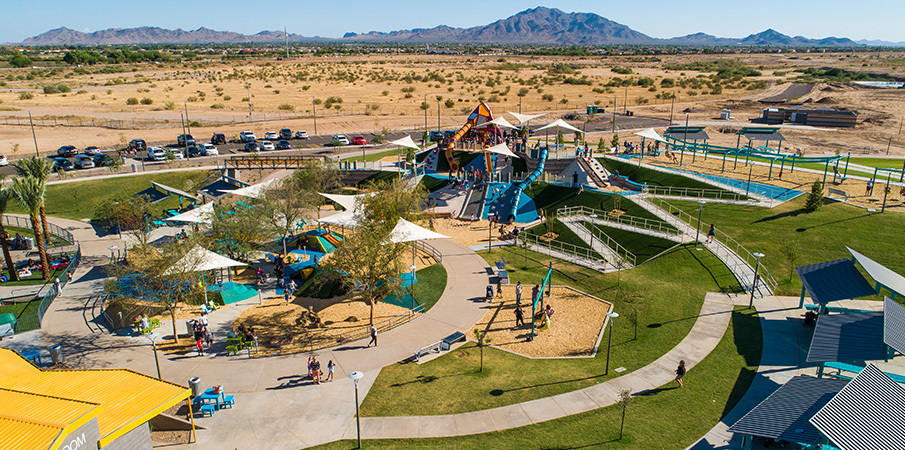
A luxury resort and championship golf course could transform Gilbert Regional Park, though millions of taxpayer dollars are already committed to a different blueprint at the site.
Urban Planning Partners proposed a sweeping public-private partnership to turn the 272-acre south Gilbert property into a major destination landmark. The pitch introduces a five-star resort, spa, conference center, and an 18-hole golf course to land currently designated for standard park amenities.
The timing brings financial pressures into sharp focus. The Town of Gilbert currently faces a $20 million annual budget deficit.
Proponents argue that a commercial destination could generate substantial revenue to close that gap. However, executing the new vision requires dismantling plans already in motion.
The $56 Million Construction Conflict
Work on Gilbert Regional Park has evolved over more than a decade. The town entered a 225-acre easement agreement with the Flood Control District of Maricopa County back in 2015 to transform a flood-control basin into recreational space. That acreage was later combined with 47 town-owned acres.
Initial earthwork, grading, and underground utility construction began following a June contract approval, with a subsequent construction contract approved on September 15. The existing Phase 2 program features a six-field youth softball complex, parking, lighting, and a roadway connection to the new Ocotillo Road bridge.
To clear the way for the resort concept, the development team urged local officials to pivot entirely. Broker and consultant Adam Stevens told the Gilbert Town Council that the town should terminate its Phase 2 contract for Gilbert Regional Park, cancel its current request for proposals for 40 acres, and craft an entirely new master plan.
Stevens led the presentation during a council study session alongside Urban Planning Partners partner Ken Morrison and Snell & Wilmer attorneys Eric Spencer and Nick Wood.
Legal and Environmental Hurdles
The proposal must also work around strict property restrictions tied to its original purpose. Because the acreage serves as a flood-control basin, any changes require careful regulatory clearance.
Addressing the property’s flood-control restrictions, Spencer told the council that existing agreements provide a pathway for compatible recreational development subject to Flood Control District approval while preserving the site’s core function. He added that the hotel itself would be located outside the recreational easement area.
Morrison outlined the operational structure during the presentation, explaining that Urban Planning Partners would assemble the institutional financing, design, and construction partners. Under the proposed ground lease and private investment model, the town would receive lease revenue, a share of operating profits, and related tax revenue.
The Gilbert Town Council discussed the concept during its November 16 study session. No vote was taken to approve the resort concept or to cancel the ongoing construction contracts.
Worth a look

KALB Obtains Body Camera Footage After Two-Year Investigation in Fatal Deputy Shooting
A family in Catahoula Parish is demanding accountability following the release of body camera footage that captures the...
Dover Council Committee of the Whole Reviews MPO Briefing, Fence Project, Garrison Oak Change Order
The City of Dover Council Committee of the Whole will convene to address a series of infrastructure and...

Drone Operator Admits ‘Error of Judgement’, Deletes Pochettino Training Footage
A drone operator uploaded 12 minutes of Manchester United’s first training session under Mauricio Pochettino to YouTube on...
Arizona Wildcats Defeat New Mexico State 62-55
The Arizona Wildcats edged past the New Mexico State Aggies on Thursday closing out a competitive matchup with...