
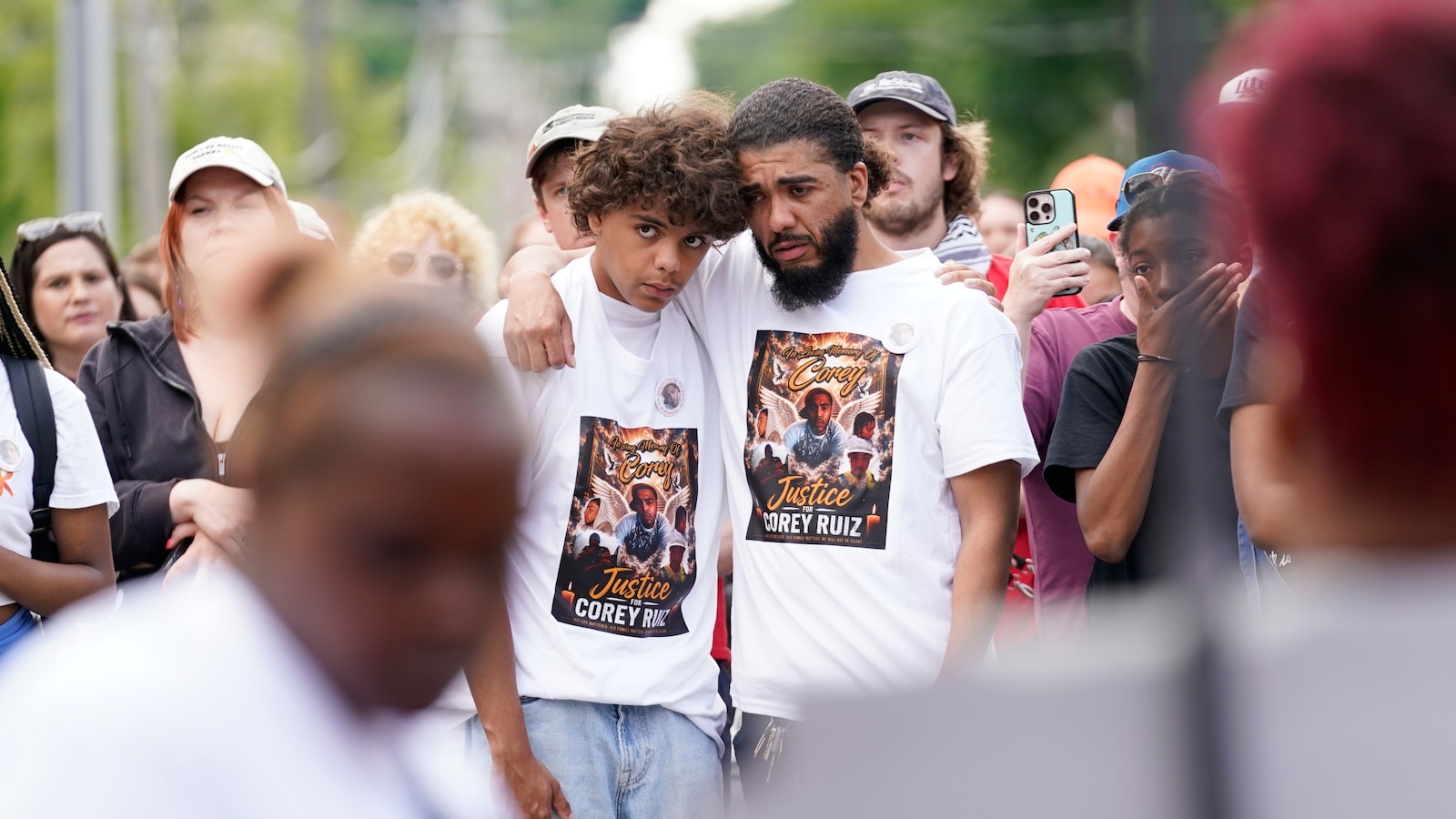
“We’re destroyed. We won’t accept this,” Adam Ruiz told reporters Thursday, hours after Dane County District Attorney Ismael Ozanne announced his office would not file criminal charges against the Madison police officer who shot and killed his brother Corey in July.
Ozanne concluded that Officer Kiel Baitinger-Peterson acted reasonably when he fired three rounds at close range on July 22, striking the 38-year-old Black man in the chest and head after Ruiz produced a knife and resisted arrest, PBS reported. The decision immediately reignited protests in a neighborhood that has now seen three fatal police shootings since 2012.
Civil rights attorney Ben Crump, representing the Ruiz family, called the shooting an execution. “In the video you see they tackle him, they tase him, they kick him and then the police officer executes him,” Crump said at a Thursday news conference. “When you are shooting a man who is on the ground, three times. It hits him in his chest and the kill shot hits him in his head.”
The prosecutor and the family’s attorney watched the same dash-camera and bystander footage. They reached opposite conclusions.
The encounter on July 22
Four officers responded to calls about someone checking parked cars and an alleged burglary attempt on Madison’s north side. They surrounded Ruiz, who was on a bicycle. Dash-camera video released Thursday by the Wisconsin Department of Justice shows three officers wrestling with Ruiz in an intersection.
“He’s got a knife! He’s got a knife!” officers yell repeatedly. A blade is visible in Ruiz’s right hand, pointed downward, as a fourth officer deploys a Taser. Ruiz stumbles and falls onto his right side. Baitinger-Peterson, arriving as the fourth officer, fires three shots at close range, WTOP reported.
Baitinger-Peterson, a white officer with more than a decade of experience, told investigators days later that he grabbed Ruiz’s right arm before realizing he held a knife.
He said he struggled to control the arm, feared Ruiz would stab the officers, and fired a third time because Ruiz’s expression and body did not change after the first two shots, leading him to believe they had not struck him, according to investigative records released Thursday. The officer sustained minor injuries to both hands.
Two readings of the law
Ozanne reviewed police reports, diagrams, surveillance video, squad-car video, and citizen video. Madison officers do not wear body cameras. “I conclude it was reasonable for the officer to use deadly force when this person resisted officers, produced a knife, and was not affected by multiple attempts to use Tasers while officers attempted to take him into custody,” Ozanne said in his statement.
“A person does not have to like and/or agree with the law, however I am sworn to apply the law to the facts at hand. The law applies equally to members of law enforcement and to those who are not.”
“The medical examiner told the family that if the officer had not fired that shot to his head, Corey would have survived. It was clearly an excessive use of force. This police killing in Madison, Wisconsin, was unjustifiable, unreasonable, unnecessary, and unconstitutional.”
Ben Crump, attorney for the Ruiz family, in a statement to ABC News
Crump said the medical examiner told the family Ruiz would have survived the chest wounds. He described the case as one of the worst instances of excessive force he has worked on. The Wisconsin Professional Police Association, the state’s largest police union, backed Ozanne’s decision.
Executive Director Jim Palmer said the determination that the use of force was legally justified “is supported by the evidence and consistent with the legal standards governing the use of force by law enforcement officers.”
A neighborhood’s pattern
This was the third fatal shooting by Madison police in the same neighborhood since 2012. The July killing sparked days of protests and forced the city to confront demands for police reform. Baitinger-Peterson and the three other officers involved have been on paid administrative leave since the shooting.
Madison Police Chief John Patterson said he trusts his officers but acknowledged the decision “will bring various emotions.” He urged protesters to remain peaceful and said the department will now conduct an internal review.
The city has no body-camera program. All Madison officers could be equipped with body cameras by the end of 2027, funded by a $350,000 donation from a local nonprofit announced in September, along with grants and other city funds. Until then, the only visual record of encounters like this one comes from squad-car dash cameras and bystanders.
Crump vows federal lawsuit as vigil planned
Crump said his team will “explore every possible avenue,” including a federal civil-rights lawsuit. A couple of dozen people gathered at the intersection where Ruiz died Thursday afternoon, where bouquets of flowers marked the pavement. A candlelight vigil was planned for the evening.
“The video is the objective unbiased witness here,” Crump told the crowd.
Keep reading
Lawmakers Question 8 Star’s Pipeline Land Rights Conversion Request
Lawmakers questioned 8 Star's request to convert land rights for a pipeline corridor the state and Glenfarne Group...

Cheyenne Schools Locked Down as Police, U.S. Marshals Arrest Escapee
Three Cheyenne schools went into lockdown Thursday morning as police and U.S. Marshals hunted a 19-year-old escapee from...

Central Florida Braces for Up to 30 Inches of Rain Across Multiple Counties
Daytona Beach had already swallowed nearly seven inches of rain by Wednesday evening, and the heaviest bands were...

Austin City Council Accepts $25M for Lady Bird Lake Boardwalk After Years of Disputes
Austin City Council accepted a $25 million state payment for a Lady Bird Lake boardwalk Thursday, ceding to...