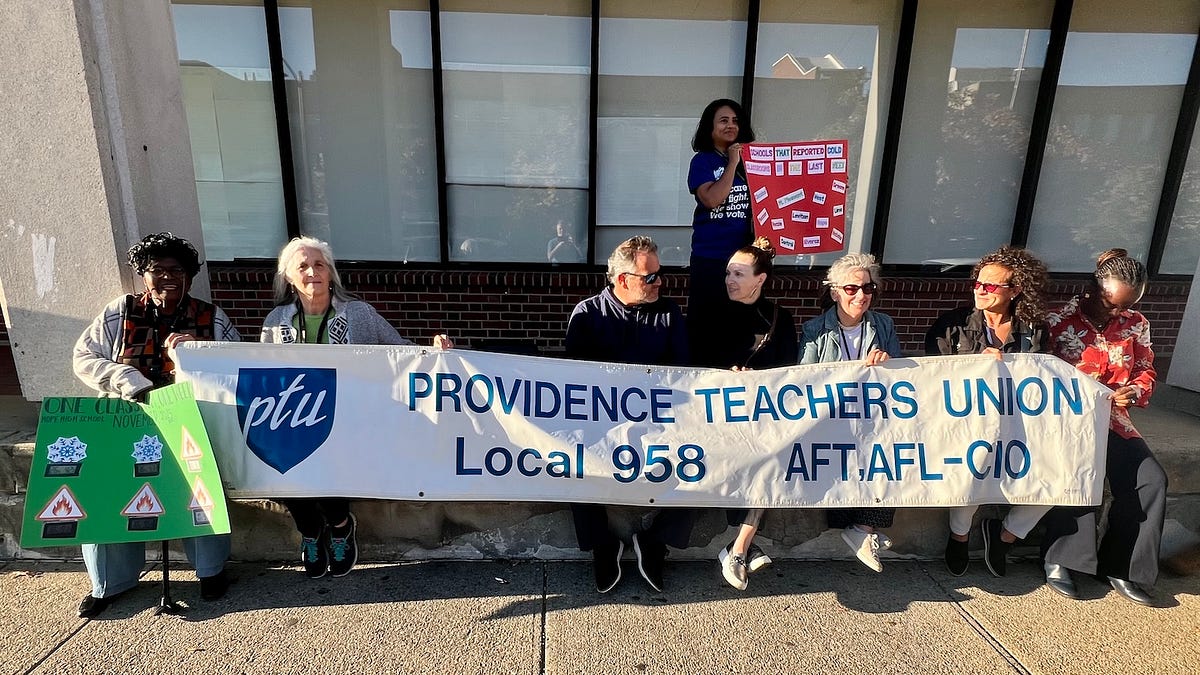
Providence Teachers Rally as Cold Classrooms Spark District-Wide Crisis
On an unseasonably warm Wednesday in November, the Providence Teachers Union (PTU) and its supporters took their fight for safe school conditions directly to the district’s doorstep, staging an informational picket outside the Providence Public School District (PPSD) offices on Westminster Street.
The union’s protest is a direct challenge to what PTU President Lindsay Paiva calls a systemic failure of maintenance and spending, highlighting a pattern of neglect that leaves students and teachers in the cold. The immediate trigger is the failure of multiple school heating systems, but the underlying demand is for accountability and a seat at the table in decisions that affect the thousands of children currently learning in aging, often hazardous, buildings.
Inside the Freezing Schools: A Day-by-Day Account
The scale of the problem is staggering. Paiva stated that the union has received reports from 13 different schools with little to no heat throughout their buildings. At Nathaniel Greene Middle School, classrooms were documented dropping to a bone-chilling 53 degrees.

The district’s response has been a patchwork of stopgap measures. According to the steveahlquist.substack.com report, PPSD delivered space heaters to only a fraction of the affected classrooms. This solution, however, created new dangers. The outdated electrical systems in many of these older schools couldn’t handle the load, leading to blown fuses, overloaded circuits, and even power outages that cut class short. The impact on the curriculum is direct: blown fuses mean inactive smartboards, and without technology, a significant portion of the modern lesson plan grinds to a halt.
Jessica Pollard, a teacher at Nathaniel Greene, reported heating issues in her classroom. With only one or two electrical outlets per room, teachers were forced to use extension cords to power both the heaters and essential classroom technology like computers.
The Human Cost: Students and Teachers on the Front Lines
Caleigh Rockwal, a social science teacher and PTU Secretary at Hope High School, has a ritual she begins every October: leaving a jacket and gloves in her classroom in anticipation of the cold because she knows the district will delay turning on the heat. Her classroom has a window that hasn’t been fixed in three years, leaving her no control over the temperature. Ironically, when the heat does work, the room can swelter to over 80 degrees, forcing her to run the air conditioning in the dead of winter.
Students cannot learn when their classroom dips below 60 degrees or rises above 80. They become sick and have difficulty writing when it is too cold, and they become unfocused and exhausted when it is too hot. These are conditions that we would never expect professionals to work in, so why are they acceptable for our students to learn in and for our teachers to teach in?
For students, the struggle is just as real. Hope High School student Elijah Guzman described friends who were “drained of color, just pale, and their teeth chattering, they can barely focus.” Some students have been absent for two or three days because of illness. The unpredictable temperatures force students to gamble, removing a sweater in one classroom only to put it back on in the next. This environment is actively harming their health and their education.
A Broader Fight: Spending, Accountability, and a “Newer and Fewer” Policy
The union’s picket is as much about money and mismanagement as it is about the cold. Paiva repeatedly questioned the district’s spending priorities. She pointed out that boilers condemned at Hope High School eight years ago are still an issue, with parts only recently scavenged to keep other schools running. The union is demanding to know where the money allocated for boiler maintenance has gone, and why basic upkeep has been neglected for so long.
This struggle exists against the backdrop of PPSD’s “newer and fewer” policy, which focuses on building new, consolidated schools. The union argues that this has come at the expense of maintaining existing buildings where thousands of students currently learn. Parent Gabe Long, whose kindergartner attends Asa Messer Elementary, pointed out the absurdity of this prioritization. He described walking his five-year-old child up dark, unlit, icy stairs after school because broken exterior lights were never fixed, even after he emailed photos and maps to the district and its facilities partner ABM Industries.
It’s shocking to me… that we have money for iReady. We have money for transition officers. We have money for everything that Education Commissioner Angélica Infante-Green can point to on a PowerPoint in front of a room of people. And we don’t have money for the very basics that our students need to learn: safe, warm, dry classrooms.
The sentiment is clear: resources are being spent on new initiatives and digital platforms while the fundamental infrastructure of daily school life is crumbling.
District Repairs Half of Boilers
The district, for its part, has acknowledged the problem and is taking steps to address it. PPSD spokesperson Alex Torres-Perez, in a report by yahoo.com, stated that the district has fixed half of the boilers since the issues came to light last week. Boilers at Hope High School and Nathanael Greene Middle School have been repaired, while repairs at George J. West Elementary and Central High School are ongoing. Central’s boiler is repaired but awaiting a state inspection before it can be turned on. Superintendent Javier Montañez added that his team is monitoring temperatures daily and has ordered additional heaters to ensure classrooms remain at or above 65 degrees.
Paiva acknowledged the district’s efforts but insisted they are not enough. The union’s core demands remain: the public release of maintenance plans for current buildings, clear policies for unsafe temperatures, copies of service contracts for all heating systems, and, most importantly, student and educator representatives on the School Building Committee. Paiva noted she has been trying to get a seat on that committee for six months, only to have meeting dates changed at the last minute.
The union is framing this as a civil rights issue. As one teacher put it, “These families, who are poor, do not get the same attention, and their children do not get the same treatment.” The question now is whether the district’s promises of repair and monitoring will be enough to satisfy a community that feels its children have been neglected for generations. The fight for warm, safe classrooms is a fight for the basic dignity of a public education, and it is far from over.
Worth a look

Missouri Ranks 9th in Tax Competitiveness for 2027
Missouri Jumps 3 Spots to 9th in National Tax Rankings While many states saw their tax climates slip,...

Montana Grizzlies Montana State Football Watch Guide
Montana is about to experience a football Saturday for the ages, as the state's two top-ranked programs take...

Mavs Face Wolves in NSIC Semifinals After Win Over Huskies
NSIC Semifinal Showdown: No. 2 Mavericks Face Wolves After Offensive Blitz The No. 2 Minnesota State Mavericks (16-1-2)...

Where Did the Millions Go? Achtmeyer Divorce Battle Over Wealth
Over two years following the divorce of Bill and Alli Achtmeyer, he claims he is insolvent—and the figures...