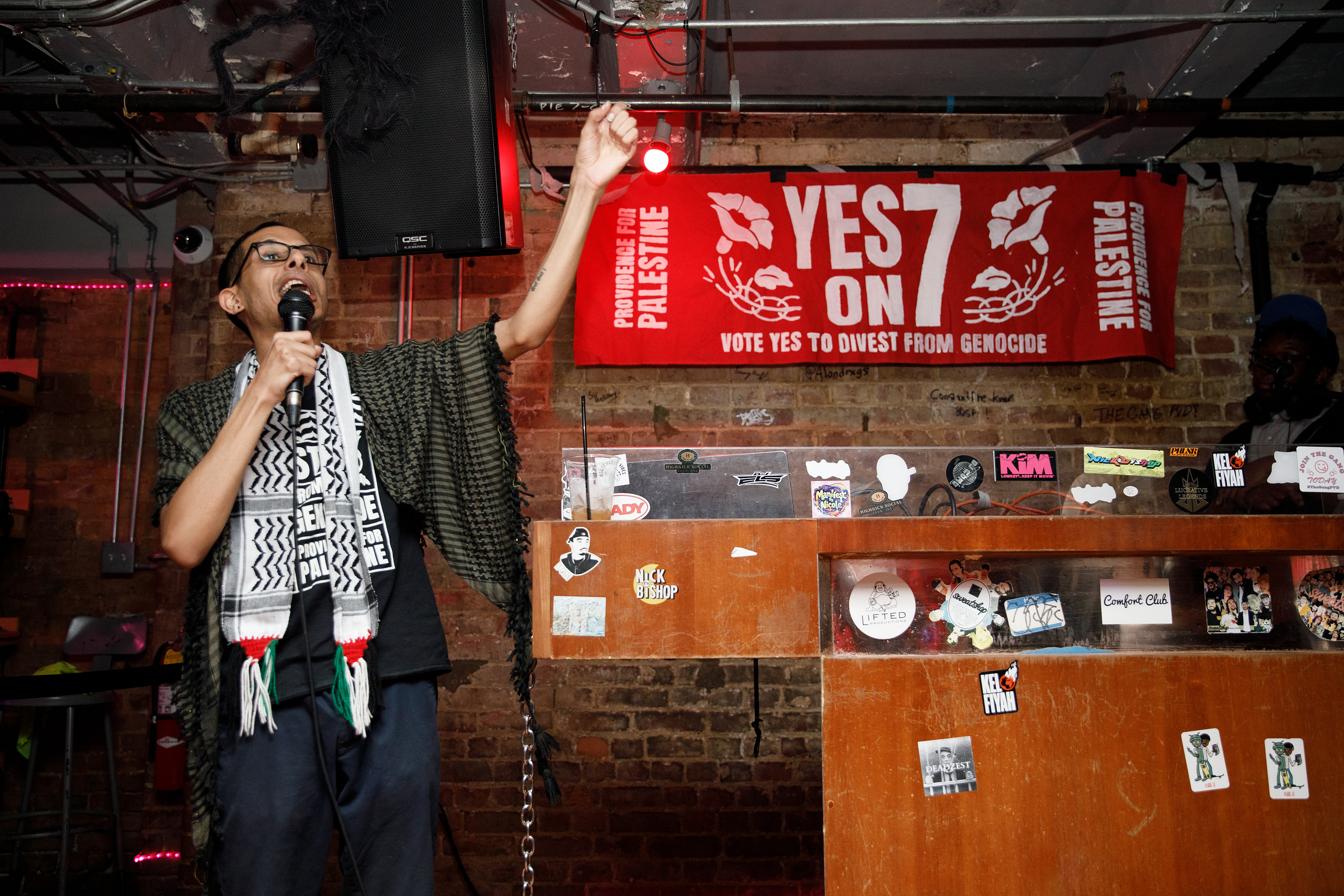
When allied city councilors introduced a divestment ordinance earlier this year, it stalled in the face of opposition from outgoing Mayor Brett Smiley, a Democrat and staunch supporter of Israel. What happened instead came directly from the voters: on Tuesday, 74.99 percent of Providence residents approved Question 7, a binding ordinance requiring the city to divest from companies and countries profiting from genocide, apartheid, ethnic cleansing, and prolonged military occupation. Truthout reported that the measure makes Providence the largest U.S. city to vote to divest from Israel and the first to pass such a binding municipal law through popular vote rather than council action.
This wasn’t a narrow victory. The ordinance passed by nearly three-to-one margins after a months-long grassroots campaign that collected more than 10,000 signatures—more than double what city charter rules required to force a ballot referendum.
How 10,000 Signatures Forced a Public Vote
The path to the ballot ran through specific provisions in Providence’s city charter, which allow residents to put an ordinance before the council with 1,000 signatures and then force a public vote with roughly 5,000 more if the council refuses to pass it. The Providence for Palestine Coalition—which includes Jewish Voice for Peace-Rhode Island, the Democratic Socialists of America-RI, AFT Local 6516, American Muslims for Palestine MA/RI, and Reclaim RI—decided to skip the lobbying phase entirely after the council version stalled and go straight to the people.
The Global Army of Decency in Action, a New Dawn has Broken 🌼 “Providence Becomes Largest U. S. City to Divest From Israel in Landmark Vote: Harretz Philissa Cramer 05:25 AM • November 04 2026 IST Residents of Rhode Island city widely backed a ballot initiative that requires… pic.twitter.com/3InKGh0XC3”
Jackie Goldman, a Jewish Voice for Peace organizer and newly elected city councilor, described the shift as a fundamental transfer of power from City Hall to residents. “It was regular people who said, ‘we are going to create this ordinance, we are going to get enough signatures to get this on the ballot, we are not waiting for our elected officials to do something, we are going to do that work ourselves to make it happen,'” Goldman told Truthout while canvassing on election day.
Goldman, who is also the first openly trans person elected to the Providence City Council, emphasized that the model is replicable across the country. Organizers studied a similar ballot referendum in Pittsburgh and examined Providence’s charter rules, then applied lessons from Somerville, Massachusetts, which last year became the first U.S. city to vote to divest from Israel.
Providence voters have backed a measure that could lead the city to divest public funds from investments linked to Israel. The proposal received around 75% support, but its implementation may face legal challenges. #Israel #Providence #RhodeIsland pic.twitter.com/W6aCaqCDPn
From Stalled Council Chambers to the Streets
The divestment push didn’t exist in isolation. It dovetailed with a parallel citywide mobilization for rent stabilization—both policy priorities that the outgoing administration had blocked from becoming law. That convergence helped elect a wave of progressive candidates in the primaries, including David Morales, a 28-year-old democratic socialist who won the mayoral race and will become Providence’s youngest mayor.
“This time, we have a majority city council as well as a mayor who are on board with divesting, which means that we will actually enforce this legislation,” Goldman said.
Providence, Rhode Island, has approved a ballot measure that could lead to the city divesting public funds from Israel, according to local media cited by Andrew Lapin/JTA. The ballot language does not name Israel. Pro-Palestinian groups backed the initiative, including the local…
“So often in the U.S., we’re told that the only way to make our voices heard is to ask elected leaders, and to beg them to abide by some semblance of a moral code. And so the fact that 10,000 people in Providence, if not more, could take it all into their own hands, and say, ‘we’re going to reclaim our power’ — to me, I think it’s emblematic of how democracy should be.” — Adit Sabnis, graduate student organizer at Brown University in AFT Local 6516
Sabnis, who helped coordinate campus efforts, said the signature drive revealed a deep hunger for tangible action among residents who felt paralyzed by events in Gaza. People were “so happy and so thankful that we were organizing around this, but also just thrilled that they could actually do something meaningful,” he told Truthout.
What the City Invests In
The financial stakes are concrete. Jewish Voice for Peace-Rhode Island noted in a press release that millions of dollars in Providence city funds are invested in companies facilitating military operations in Gaza and the occupied West Bank, alongside a 20-year history of purchasing Israel Bonds—financial instruments that function as direct, no-strings-attached loans to the Israeli government and military.
Critics of the measure, including the outgoing mayor, had opposed divestment, but Tuesday’s result suggests that position represented a distinct minority of the electorate. The ordinance’s language is deliberately broad, targeting any country or company profiting from the listed violations, which leaves room for the city to apply the standard beyond Israel depending on future determinations.
Palestinian community organizer Reem Said-Awad, a member of American Muslims for Palestine, connected the local win to broader national movements, noting that Providence activists tied Palestine solidarity to Black Lives Matter and resistance to Immigration and Customs Enforcement. Over the past three years, even mainstream mobilizations like No Kings began speaking about Palestine. “Things do change, if you are persistent,” she told Truthout. “Even though we don’t have as many people on the streets right now, people are actively doing things behind the scenes.”
A Template for Direct Democracy
What makes this vote distinct from previous municipal actions is its binding legal force and its origin in a constituent-led ballot initiative rather than a council resolution. While Somerville set an earlier precedent, Providence’s population size and the nearly 75 percent margin give the result outsized symbolic and practical weight.
For other cities watching closely, the mechanics matter as much as the outcome. The coalition demonstrated that charter provisions allowing direct democracy can be activated by residents when traditional channels fail, a dynamic that could inspire similar campaigns in municipalities where elected officials resist divestment pressures. Goldman noted that many city charters contain similar mechanisms waiting to be used.
The question now shifts to how Providence will implement the divestment ordinance—and whether other major American cities will follow its lead.
Related reading
Utah voters approve Amendment A in preliminary results, ending newspaper requirement for constitutional amendments
SALT LAKE CITY — Early returns suggest Utah voters are on track to approve Amendment A, a constitutional...

Texas Democrats Topple Abbott and Paxton in Midterm Sweep
Texas Democrats captured the state’s top offices on Tuesday in a sweeping electoral reversal that unseated Republican Gov....
Montpelier Clinic Explains How TMS Works for Mental Health
TMS, or transcranial magnetic stimulation, treats depression, anxiety, PTSD, OCD, and ADHD by resting a small coil against...
Tennessee Supreme Court Upholds Law Capping Metro Nashville Council at 20 Members
Twenty. The Tennessee Supreme Court on Monday upheld a 2023 state law capping the Metro Nashville Council at...