Russian President Vladimir Putin rejected a proposed moratorium on energy and maritime strikes Thursday, declaring “there will be no agreements” after Ukraine hit the Kerch Bridge for the third time in a week.
The announcement came during a summit in Shenzhen with U.S. President Donald Trump, Russian President Vladimir Putin, and Chinese President Xi Jinping.
The 19-kilometer crossing, inaugurated by Putin in 2018 at a cost of $3.6 billion, lost a 227-meter section of its road deck Tuesday following a coordinated missile and drone assault that Ukrainian sources said was timed to embarrass the Russian leader before the three-way meeting. A follow-up strike overnight Wednesday damaged the rail span, briefly halting train traffic, the Kremlin-appointed governor of Crimea, Sergei Aksyonov, told The Guardian.
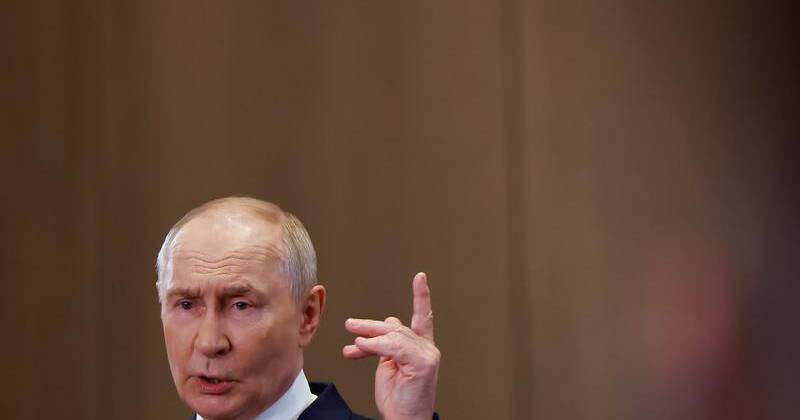
“But after the strikes on the Crimean Bridge, there will be no agreements. We will respond to these strikes,” he said. “And I want everyone to know this: I believe our response will be far more painful than what the Kyiv regime did to the bridge.”
The Russian leader insisted the bridge serves exclusively civilian purposes and has not transported military equipment or petroleum for a long time, contradicting Kyiv’s assertion that it is a legitimate military target supplying forces in southern Ukraine. The Canberra Times reported Putin made the remarks visibly angry after meeting Trump and Xi.
Neptune strikes a symbol: Kerch Bridge railway track damaged During the night of 19 November, explosions rang out over the Kerch Strait once again. Missile troops – specifically, Neptune coastal missile systems of the Ukrainian Navy – carried out a missile strike on the… pic.twitter.com/H83pJbd1OD
Kyiv Claims ‘Unprecedented’ Operation Using Domestic Weapons
President Volodymyr Zelenskyy hailed Tuesday’s attack as the culmination of a weeks-long campaign involving domestically produced Flamingo FP-5 cruise missiles and Palianytsia drones, which struck the central road arch, while Neptune missiles and Dutch-made Ruta drones targeted the rail section. “Logistically speaking, Crimea is turning into an island,” Kyiv-based analyst Igar Tyshkevych told Al Jazeera.
A Ukrainian military source told The Guardian the strikes were designed to signal to Trump and Xi that “Putin is not as strong as he pretends.” The bridge has been attacked three times previously—in October 2022 by truck bomb, July 2023 by sea drones, and June 2025 in an underwater operation Russia claimed failed.
Russia's attacks on Kyiv have once again damaged a diplomatic mission. The Embassy of the Netherlands in Ukraine has sustained minor damage. Fortunately, no one was injured. We urge the international community to condemn in the strongest terms Russia's attacks on foreign… pic.twitter.com/JNVsWmMqlJ
Simultaneous Strikes Paralyze Kyiv Bridges
As the Kerch crossing burned, Russia launched what Ukrainian officials described as a massive retaliatory wave. Moscow fired 1,441 drones across 22 regions overnight, surpassing the previous single-night record of 1,336 set days earlier, according to the Russian Defence Ministry cited by ABC News.
Strikes hit Kyiv’s North and South bridges, threatening collapse of the Northern Bridge, while energy infrastructure in eight Ukrainian regions—including Dnipropetrovsk, Donetsk, and Odesa—was damaged, Deputy Energy Minister Artem Nekrasov said.
Russia’s Defence Ministry confirmed hitting transport, military, and energy facilities in Kyiv, Zaporizhzhia, Cherkasy, and Dnipropetrovsk, along with port infrastructure and a cargo ship. Both sides deny deliberately targeting civilians, ABC News reported.
Land Corridor Partially Offsets Bridge Loss, Analysts Say
The land corridor Russia seized in 2022—linking Crimea to Rostov region via occupied southern Ukraine—has reduced but not eliminated dependence on the bridge, according to analyst Seskuria cited by France 24. The rail link remains a critical lifeline for Russian troops stationed in Crimea and the peninsula’s civilian population. Repairing the 227-meter road span could take more than a year, an unnamed engineer told The Canberra Times.
The Kerch Bridge spans the Kerch Strait between Russia’s Taman Peninsula and Crimea’s Kerch Peninsula. At 19 km it is the longest bridge in Europe and the longest ever built by Russia, completed after the 2014 annexation at a cost of ₽227.92 billion (€3.23 billion).
The road deck opened in May 2018 and the rail link followed in December 2019; a record 36,393 cars crossed in a single day in August 2020. The United Nations General Assembly condemned its construction in 2018 for facilitating the further militarization of Crimea.
Ukraine is slated to receive 10 F-16s, two Mirage 2000s, and additional air-defense systems by year’s end, EUobserver reported, potentially expanding its deep-strike capacity as the bridge war enters a new phase.
"This train terminates here." On the night of November 19, Ukrainian Neptune missiles struck the railway section of the Crimean Bridge, with hits recorded near the arch and on the tracks. The extent of the damage is still being assessed, but train traffic has stopped. Now a… pic.twitter.com/ytZOeQCzvG
More on Kerch Bridge
Worth a look
- Prime Minister Andy Burnham Said the Public Has Heard Enough From Russell Brand
- South Africa Rescues Five Baobabs After Illegal Export Attempt Blocked
- Immacolata Bridge 2026: Up to Four Days Off School, Dates Vary by Region (archyde.com)
- Trump meets Xi and Putin in China for nuclear arms and Ukraine talks (newsarchyuk.com)

Prime Minister Andy Burnham Said the Public Has Heard Enough From Russell Brand
Andy Burnham said the public has heard enough from Russell Brand after the convicted rapist's wife broadcast a...

South Africa Rescues Five Baobabs After Illegal Export Attempt Blocked
“A baobab isn’t just part of an ecosystem, it is an ecosystem in itself,” said Wambui Ippolito, a...

White House Seizes Press Phones in Shenzhen, Fueling Speculation of North Korea Detour
White House officials seized the phones of reporters aboard Air Force One in Shenzhen on Thursday evening, an...

Snap Releases Easy Lens CLI for AI Lens Creation
Snapchat moved Lens creation into the AI coding tools developers already use, rolling out Easy Lens CLI on...