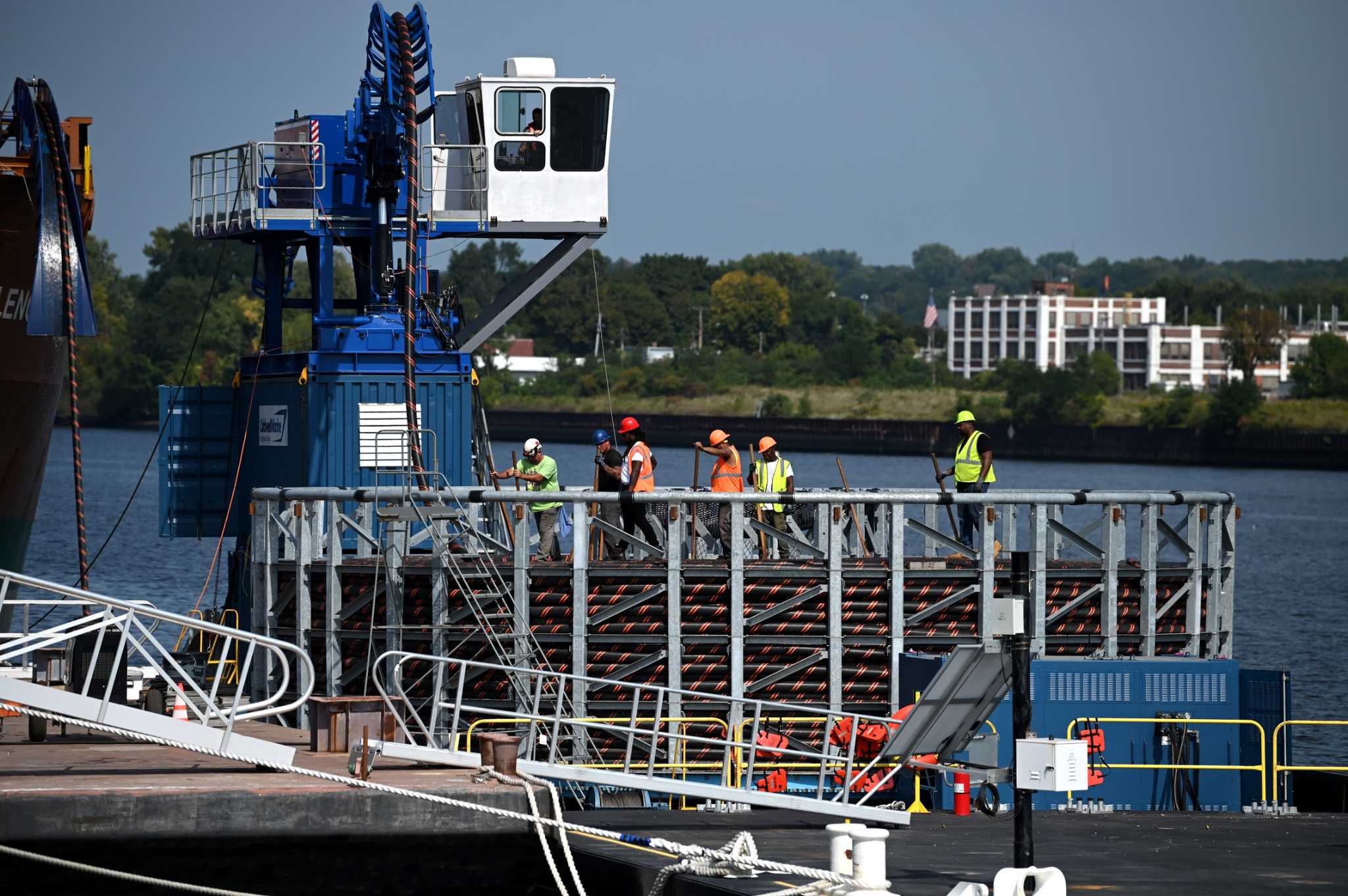
According to Ken Girardin, a Manhattan Institute fellow who studies the state’s grid, the Champlain Hudson Power Express has enabled New York to replace greenhouse gas emissions in New York City with greenhouse gas emissions upstate.
Upstate fossil fuel plants ran about 38% more in 2025 than in 2021, a shift energy experts partly attribute to Quebec’s increased reliance on New York’s grid during a four-year drought, Times Union reported. On Nov. 17, roughly half of the electricity Hydro-Quebec imported from New York came from natural gas facilities, according to data reviewed by the Times Union.
Lynn St-Laurent, a spokesperson for Hydro-Quebec, challenged the claim that the province has driven up fossil fuel plant usage upstate. “Hydro-Quebec has imported more electricity from external markets in recent years, including from New York,” St-Laurent said. “However, those imports cannot be characterized as purchases of fossil-fuel electricity. Electricity purchased through the (New York Independent System Operator) wholesale market is not sourced from a specific generating facility or fuel type, but rather from the generation mix (sic) available in upstate New York.”
She said that upstate New York generation is approximately 90% low-emission, mainly hydropower and nuclear. Tim Ennis, a market analyst for Grid Status, said nuclear and hydro stations run nearly nonstop, but added demand from Quebec largely forces gas facilities to ramp up.
The $6 billion, 339-mile Champlain Hudson Power Express line delivered roughly 18% of its expected supply between June and October, according to data from Grid Status.
“Despite these challenges, deliveries since June have saved New York $1 billion in wholesale capacity costs and displaced 400,000 tons of (carbon dioxide),” said Peter Rose, a Hydro-Quebec spokesperson.
The line needs to send up to 40% of its full capacity to comply with its New York contract, though a ramp-up period has not ended. “There is no requirement in the contract for Hydro-Quebec to provide continuous power on a daily basis,” said Deanna Cohen, a New York State Energy Research and Development Authority spokesperson. The contract provides “short-term energy delivery flexibility to reflect natural fluctuations in precipitation that impact Hydro-Quebec’s generation portfolio.”
Hydro-Quebec has said it is not economically motivated to deliver the line’s full capability because compensation is based on power prices in Astoria, Queens, which are consistently lower than the city’s overall average.
Normand Mousseau, a physics professor at the University of Montreal, said meeting both the New York and New England contracts while relying less on U.S. imports “will be tense, especially if the drought persists.”
Last week, the New York Independent System Operator cautioned for the first time that absent significantly more energy development, the state will not have enough electricity to meet its demands by 2033.
Keep reading

No. 3 Nebraska Wrestling Shuts Out No. 24 Penn 36-0 at The Palestra for 39th Program Shutout
No. 3 Nebraska wrestling shut out No. 24 Penn 36-0 Saturday at The Palestra in Philadelphia, the program's...
Private Schools Feature in Six of Eight IHSA Football Finals
Seven of the 16 teams playing for Illinois football state championships this weekend at Hancock Stadium in Normal...

BMW of Bridgeport Lists 2027 740 xDrive Sedan, Stock B19364
BMW of Bridgeport is listing a 2027 BMW 7 Series 740 xDrive sedan, stock number B19364, equipped with...

RRCA Level I Coaching Certification Earns Praise for Online Format
Participants in the Road Runners Club of America Level I coaching certification praised the online format and instruction...