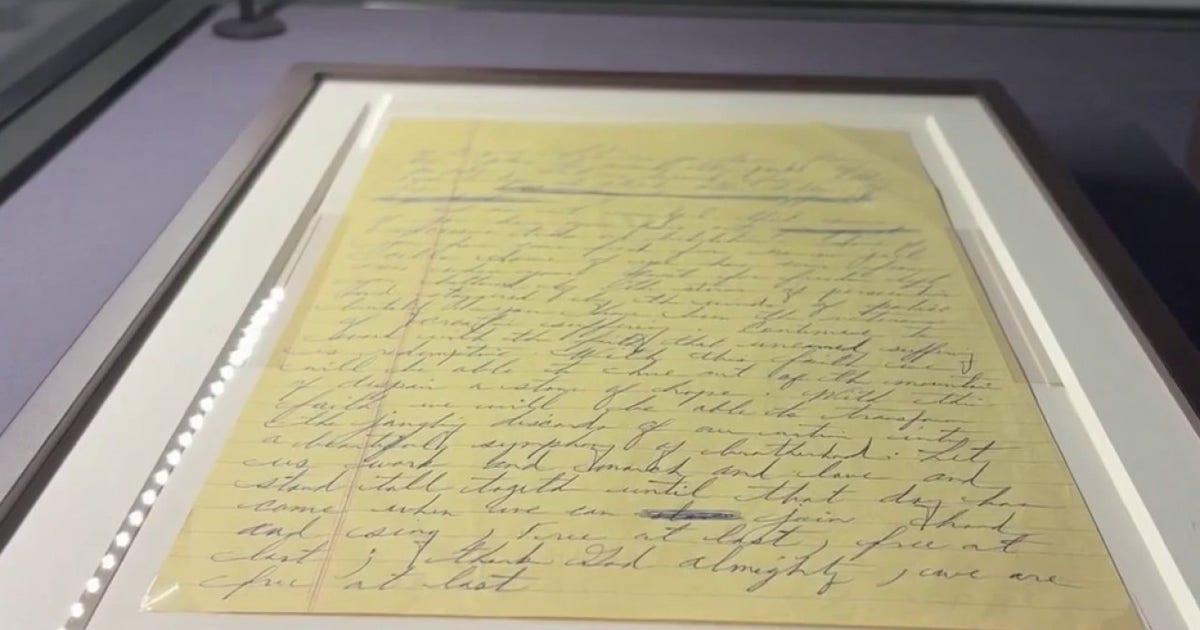
Martin Luther King Jr.’s handwritten final draft of his “I Have a Dream” speech is currently on display at the National Center for Civil and Human Rights in downtown Atlanta.
The seven-page document, penned in blue ink on yellow legal paper, offers a rare, intimate look at the evolution of one of the most significant pieces of rhetoric in American history.
The manuscript is available for public viewing for seven days before it heads to auction at Christie’s in New York. FOX 5 Atlanta reported that the pages reveal the specific edits and deletions King made during the early morning hours while stationed at the Willard Hotel in Washington, D.C.
The draft serves as a physical record of King’s effort to articulate a vision that would compel the nation to confront its own stated ideals of equality and justice. According to FOX 5 Atlanta, the pages were preserved for decades in a desk drawer belonging to Edward T. Clayton, a trusted adviser to King and the late husband of journalist Xernona Clayton.
The display in Atlanta marks the beginning of a rare tour for the manuscript. While the document is currently drawing public attention in King’s hometown, its future path is already set. ArtDaily reported that The Book of Miracles is slated to lead Christie’s Valuable Books & Manuscripts sale in London on 10 December 2026, as part of the house’s Classic Week programme.
The transition of such a seminal document from a private collection to the auction block highlights the complex reality of historical preservation. For the public, the seven days in Atlanta provide a chance to see the corrections King made in real-time as he refined his message.

While the National Center for Civil and Human Rights allows visitors to engage with the physical evidence of King’s labor, the impending sale at Christie’s confirms that the document will eventually return to private hands. The question of whether such pieces of foundational history should remain in public institutions or circulate through private auctions remains an open debate among historians and archivists.
For now, the focus remains on the text itself. The handwritten pages capture the urgency of a leader working through the night to define the moral stakes of a movement that would reshape the American social landscape. Visitors in Atlanta have until the end of the seven-day window to view the draft, after which it will continue its journey toward the December auction.
Related reading

Shenandoah Valley Couple Starts Moveology to Help With Back Pain
Michael and Hannah Bower started a new business called Moveology in Fishersville, Virginia, drawing from their own experiences...

LOSFA Expands Access to Registered Apprenticeship Programs
The Louisiana Office of Student Financial Assistance (LOSFA) is scaling its efforts to connect residents with structured career...

Sacramento Republic FC to Host Louisville City FC for 2026 USL Final
Sacramento Republic FC will host Louisville City FC for the 2026 USL Championship Final at Heart Health Park...

Topeka Weather Forecast Predicts Strong Winds and Weekend Cooling
Topeka residents are facing a week of volatile wind conditions as a warming trend takes hold across north-central...