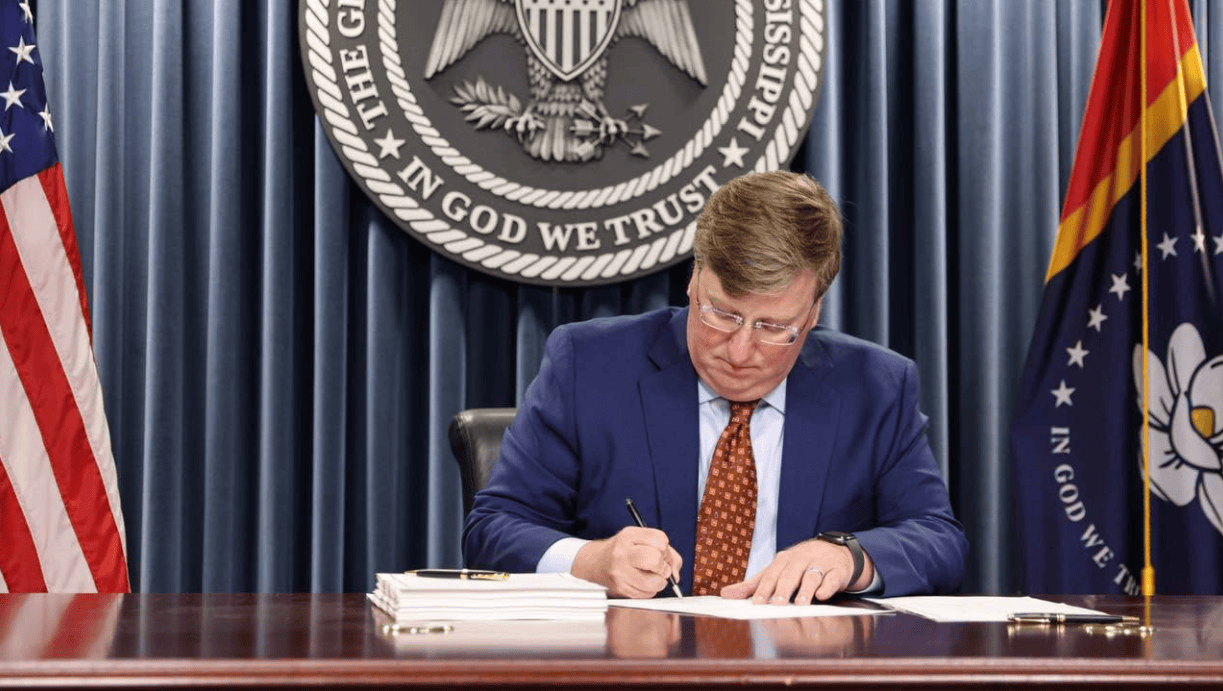
Mississippi Gov. Tate Reeves wants lawmakers to invest millions in the state’s child welfare and youth court systems when they return to Jackson in January, proposing targeted investments he says will end the costly practice of shipping foster children out of state.
The recommendations arrived Tuesday in his Executive Budget Recommendation for fiscal year 2028, a document that also seeks to reshape energy infrastructure, tighten election deadlines, and redirect education dollars away from what he calls administrative bloat.
The centerpiece of the child welfare push is a request for an additional $5.05 million to finish renovating a facility that could eventually house foster children currently placed outside Mississippi, Lawmakers previously appropriated $5 million to renovate the property. Reeves argues that once the campus is fully operational, the savings from bringing those children home will cover the recurring operating costs.
The budget also asks for $6.25 million for the Family First Prevention Services program, a figure the administration says will unlock a 77 percent federal match and yield a total $25 million investment aimed at keeping families intact through mental health and substance abuse support.
“Once the facility becomes fully operational, the cost savings from moving children from out-of-state placements to the Mississippi-based facility will cover recurring operating costs,” the recommendation said.
The youth court overhaul — mandated by the Youth Court Reform Act of 2026 — includes a proposed $9.8 million for new youth court chancellors and staff. Reeves is asking for $9.8 million to fund nine new youth court chancellors and $2.5 million for additional intake officers through the Administrative Office of Courts.
The Mississippi Department of Child Protection Services would receive $1.2 million to hire ten attorneys, a move the governor says could qualify the state for more federal Title IV-E dollars. WLOX and WDAM both highlighted the attorney funding as a critical piece of the new uniform youth court system.
Reeves wants $20 million in capital expense funds designated by the Mississippi Development Authority for use at selected sites. Another $20 million in capital expense funds would go to the Mississippi Development Authority for site preparation, and $3 million would launch an energy innovation program. The governor’s office frames the moves as essential to keeping the billions in announced economic development projects on schedule.
Reeves proposes eliminating the 3 percent per-pupil allocation that flows to the Mississippi Charter School Authorizer Board — roughly $1 million he labeled “administrative bloat” — and redirecting it to students.
He also flagged a 20 percent rise in public school administrative positions over the last six years against an 8 percent drop in student enrollment, arguing that teachers should have advancement paths that do not require leaving the classroom. The budget also seeks to codify the state’s participation in the federal Scholarship Granting Organization tax credit program.
A proposed $2 million would boost the Early Intervention program to identify disabilities in children under three. Two vacant intermediate care facilities in the northern part of the state would be converted into 10-bed group homes for patients stepping down from the state psychiatric hospital, a $2.5 million ask the governor says will relieve pressure on jails and emergency rooms.
And to secure a promised $50 million in federal Veterans Administration money for a new nursing home in Rankin County, the budget puts up $41 million in state matching funds.
Public safety technology gets a line item, too: $500,000 to build the Mississippi Public Safety Intelligence Platform, an AI-driven analytics tool meant to link law enforcement agencies for multi-jurisdictional investigations. The Supreme Court and Court of Appeals would receive $730,318 and $818,839 respectively for law clerks and staff, while $127,000 would fund an online directory connecting families, officers, and courts to support services.
Reeves, born in 1974 in Florence, became Mississippi’s first Republican state treasurer in 2004 at age 29, the youngest official elected statewide in modern history. He served two terms before winning the lieutenant governorship in 2012 and 2015, then captured the governor’s office in 2019 and won reelection in 2023.
Lawmakers will take up the recommendations when the 2027 session convenes in January.
Keep reading

Georgia Center Drew Bobo Questionable vs. South Carolina; LaNorris Sellers Off Injury Report
Georgia released its first SEC availability report Wednesday with only two names on it, and the one that...

New Free Tools Let Rhode Islanders Compare Nursing Home and Assisted Living Inspection Records, Staffing, and Ownership
The tools consolidate public records that have long existed but were nearly impossible for a family to use....

AGD Webinar: Elite Dental Photography with Todd C. Snyder, Dec. 3
The Academy of General Dentistry will host a live webinar on elite dental photography led by Todd C....

Ohio State USG President Chris Cade Named 2026 Emerging Leader at Who’s Who in Black Columbus 20th Anniversary
Ohio State undergraduate student government president Chris Cade was honored as a 2026 Emerging Leader at the Who’s...