Researchers have obtained haplotype-resolved chromosome-level genomes of the fish Megaleporinus macrocephalus and Leporinus friderici through trio binning of an interspecific hybrid.
The study provides genetic data for these Teleostei and Characoidei species, detailing methods conducted in Brazil and sequencing efforts carried out in the United States.
The study was conducted in strict accordance with the recommendations of the National Council for Control of Animal Experimentation (CONCEA) of the Brazilian Ministry of Science, Technology, and Innovation, and was approved by the Ethics Committee on Animal Use under CEUA number 8213/22 at the Faculty of Agricultural and Veterinary Sciences, UNESP, Jaboticabal Campus, São Paulo, Brazil.
Hybrid progeny of a female Megaleporinus macrocephalus and a male Leporinus friderici were produced through artificial reproduction at the Center for Aquaculture (CAUNESP), UNESP Jaboticabal Campus. A female dam and male sire were used to ensure the transmission of the heteromorphic W chromosome of M. macrocephalus to the hybrid offspring. Induced spawning used carp pituitary extract in a 0.9% sodium chloride solution.
Females received two doses of 0.6 and 5.4 milligrams per kilogram at a 12-hour interval, while males received a single dose of 1.5 milligrams per kilogram concurrently with the second female injection. Larvae hatched in 20-liter conical fiberglass incubators and were reared in 1-cubic-meter fiberglass tanks under open circulation, external aeration, and a constant temperature of 30 degrees Celsius until tissue collection.

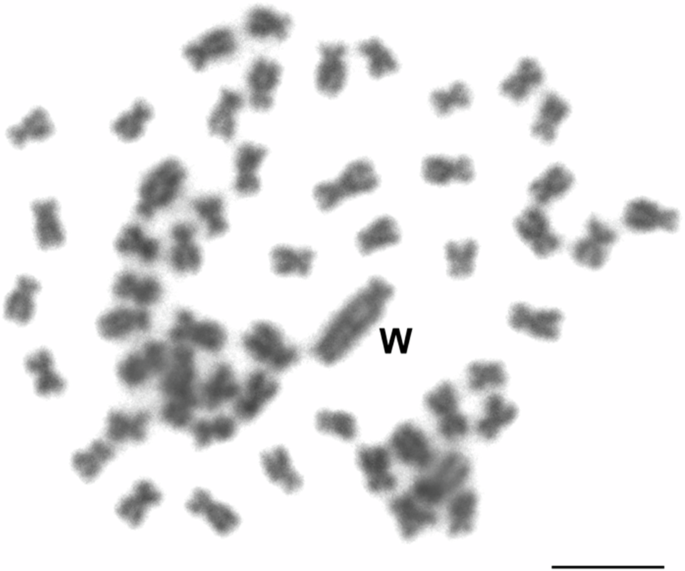
Sex was determined during sample collection by cytogenetic analysis of metaphase spreads. Female M. macrocephalus possess a large W chromosome that represents the largest element of the karyotype, markedly exceeding the size of all other chromosomes with a scale bar of 10 micrometers.
Although Mendelian segregation predicted W-bearing individuals among the hybrid offspring, cytogenetic analysis of all 40 examined hybrids revealed a complete absence of W-bearing progeny. A Z-bearing hybrid individual was selected for whole-genome sequencing based on this result.
Blood samples from the Z-bearing hybrid were flash frozen in liquid nitrogen and stored in an ultra-low temperature freezer at negative 80 degrees Celsius for high-fidelity sequencing. High-molecular-weight DNA extraction, library preparation, and Pacific Biosciences sequencing were performed by the Arizona Genomics Institute in Arizona, United States.
Library construction used DNA fragments with an average length of 22 kilobases, and sequencing took place on the PacBio Revio platform using a single SMRT Cell. This generated 2,097,873 high-fidelity reads with a mean read length of 20,513 base pairs, yielding approximately 43 gigabases of sequence data totaling 43,034,631,206 base pairs. After quality control using Cutadapt version 5.0, 44 reads containing adapter sequences were removed, leaving 2,097,829 high-fidelity reads for downstream analyses.
Hi-C sequencing utilized blood samples from the same hybrid individual. Hi-C libraries were prepared using the Arima Capture Hi-C kit from Arima Genomics in California, United States, and sequenced on the Illumina NovaSeq X platform with paired-end 150-base-pair reads, yielding approximately 55 gigabases of data consisting of 183,887,854 paired reads.
Short-read sequencing used blood samples collected from the parental individuals belonging to the breeding stock maintained by the Laboratory of Genetics in Aquaculture and Conservation at CAUNESP, São Paulo State University. Genomic DNA was extracted using the Promega Wizard Genomic DNA Purification Kit following the manufacturer instructions.
Keep reading
USDA Seeks Comments on West Virginia SNAP Soda Ban Proposal for 2027
West Virginia asked federal regulators to approve a new demonstration project excluding sugar-sweetened beverages from Supplemental Nutrition Assistance...

180,000 Rhode Island Kids Qualify for New Federal Investment Accounts in 2026
About 180,000 Rhode Island children qualify for newly minted federal child investment accounts in 2026, putting local families...

France Protests Draw Tens of Thousands for Sixth Weekend
Tens of thousands of people took to the streets across France on November 21 for the sixth consecutive...

Florida Gators Defeat Florida State 26-10 to End 2026 Season 8-4
No. 20 Florida defeated the Florida State Seminoles 26-10 in Doak Campbell Stadium on Friday night, closing the...