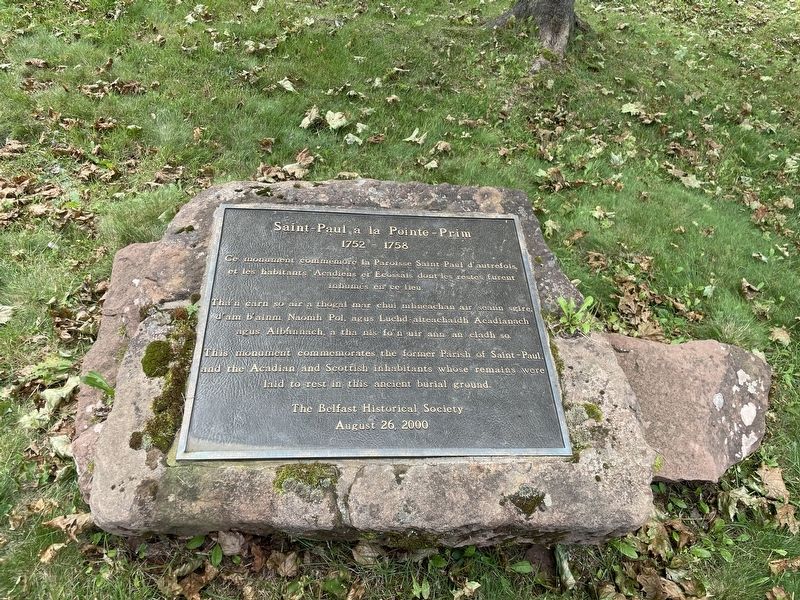
A historical marker in Belfast, Prince Edward Island, preserves the memory of the former Parish of Saint-Paul and the Acadian and Scottish inhabitants buried there between 1752 and 1758.
According to the Historical Marker Database, the monument serves as a permanent record for those whose remains lie within this ancient burial ground.
The site, located on Selkirk Park Road, represents a specific era of settlement in the Maritimes. The marker was erected in 2000 by The Belfast Historical Society to ensure the diverse cultural roots of the region remain visible to modern residents and visitors.
The inscription on the monument is multilingual, featuring English, French, and Gaelic to reflect the specific demographics of the mid-18th-century settlement. This linguistic choice acknowledges the Acadian and Scottish populations that defined the Saint-Paul a la Pointe-Prim area during its most active years.
The geography of the site places it within a dense cluster of historical significance. Travelers heading north on Selkirk Park Road will find the marker on the left, situated near several other significant commemorative points. The Historical Marker Database notes that at least eight other markers are within walking distance, including sites dedicated to the Acadian Departure, the Selkirk Settlement, and the legacy of Thomas Douglas Selkirk.
This concentration of markers provides a physical timeline of how colonial settlements changed in Atlantic Canada. The area once sat at the intersection of the British colony and the Viceroyalty of New France, a period marked by demographic changes and the movement of various ethnic groups across the North American continent.
While the marker primarily focuses on the parish and its inhabitants, the surrounding area tells a broader story of migration and settlement. The proximity of the Acadian Settlement and Acadian Departure markers highlights the complex history of displacement and re-establishment that characterized the mid-1700s in the region.

The historical significance of the 1752 to 1758 period coincides with a volatile era in North American colonial history. During these years, the interplay between French and British interests frequently dictated the movement and survival of local populations, making the preservation of such burial grounds essential for understanding the human cost of these geopolitical shifts.
The monument remains a focal point for those studying the religious and settlement patterns of early Prince Edward Island. By identifying the former Parish of Saint-Paul, the marker connects the land to the spiritual and social structures that governed the lives of the Acadian and Scottish settlers.

Governor Hochul Expands Benefits and Support for New York Veterans
Governor Kathy Hochul signed legislation to expand benefits and reduce barriers for veterans and active-duty service members on...

Prince Concert Film 3121 Las Vegas Live Arrives in Theaters in December
Prince fans will see a full-length concert film on the big screen starting December 3. The film, titled...

Katie Zolnikov Becomes Montana’s First Female House Speaker
Republican Representative Katie Zolnikov of Billings was elected the first female Speaker of the Montana House of Representatives...

Two Arrested After 6-Week-Old Girl Taken From Lebanon Store
A 6-week-old girl was reunited with her mother Tuesday after being taken from a store in Lebanon, Missouri....