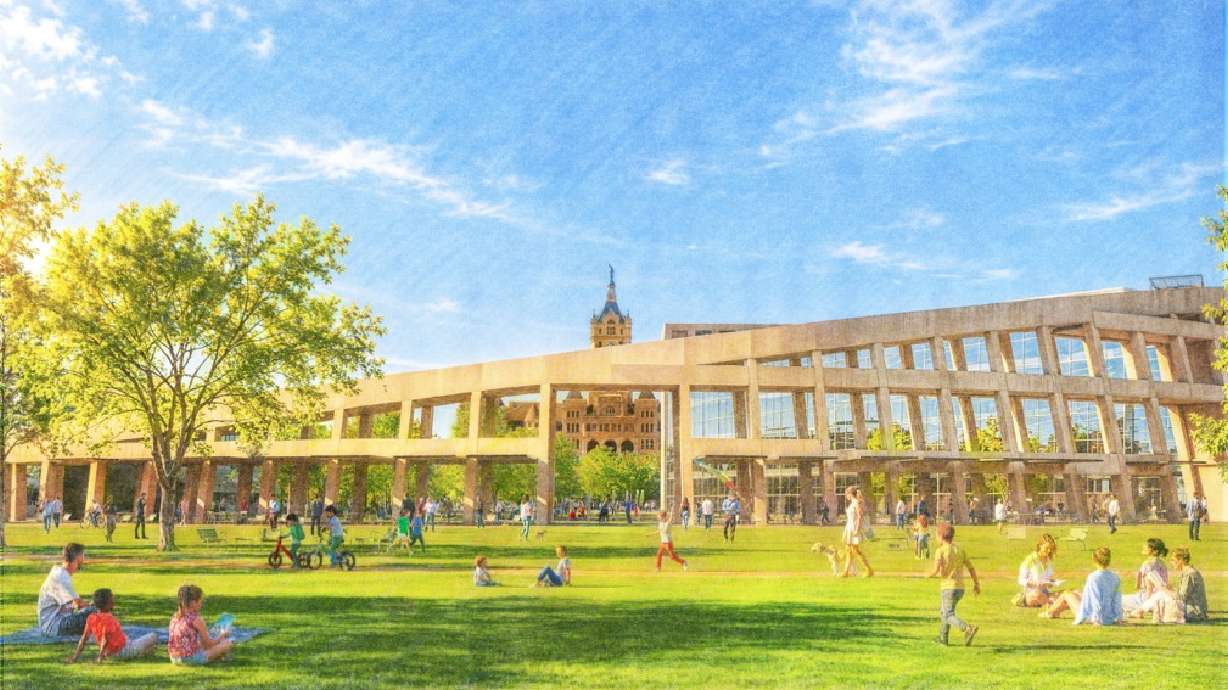
Mayor Erin Mendenhall stood on a wind-swept plaza between the Salt Lake City-County Building and the main library on a Wednesday afternoon in November, pointing to sinking pavers and empty storefronts as proof that the city’s civic heart had stopped beating.
“Almost no one’s here. There are almost never children here,” she told KSL.com, framing a $58 million overhaul not as a cosmetic upgrade but as a rescue mission for a space that has become a thoroughfare rather than a destination.
The block, bounded by 400 South, 500 South, State Street, and 200 East, has suffered from what officials describe as deferred maintenance exacerbated by land movement over an underground parking garage. The city’s response, now in the 40% design phase, proposes replacing the “sea of pavers” with over seven acres of new green space, a skate park, an all-abilities playground, a dog park, and hundreds of trees.
The goal is to flatten the artificial grade changes that currently fragment the block, creating a contiguous lawn capable of hosting 36,000 people — triple the capacity of the current configuration.
The competition that could power the park
Layered onto this municipal reconstruction is an international design contest that could give the project its signature landmark. The Land Art Generator Initiative (LAGI), founded in 2010 with a focus on Abu Dhabi, selected Salt Lake City for its 2027 competition, tasking global teams of artists, engineers, and architects with designing a public artwork that doubles as clean energy infrastructure.
The winning structure, planned for the east end of the library block, would provide shade while generating electricity for the site, potentially using geothermal energy for heating and cooling elements.
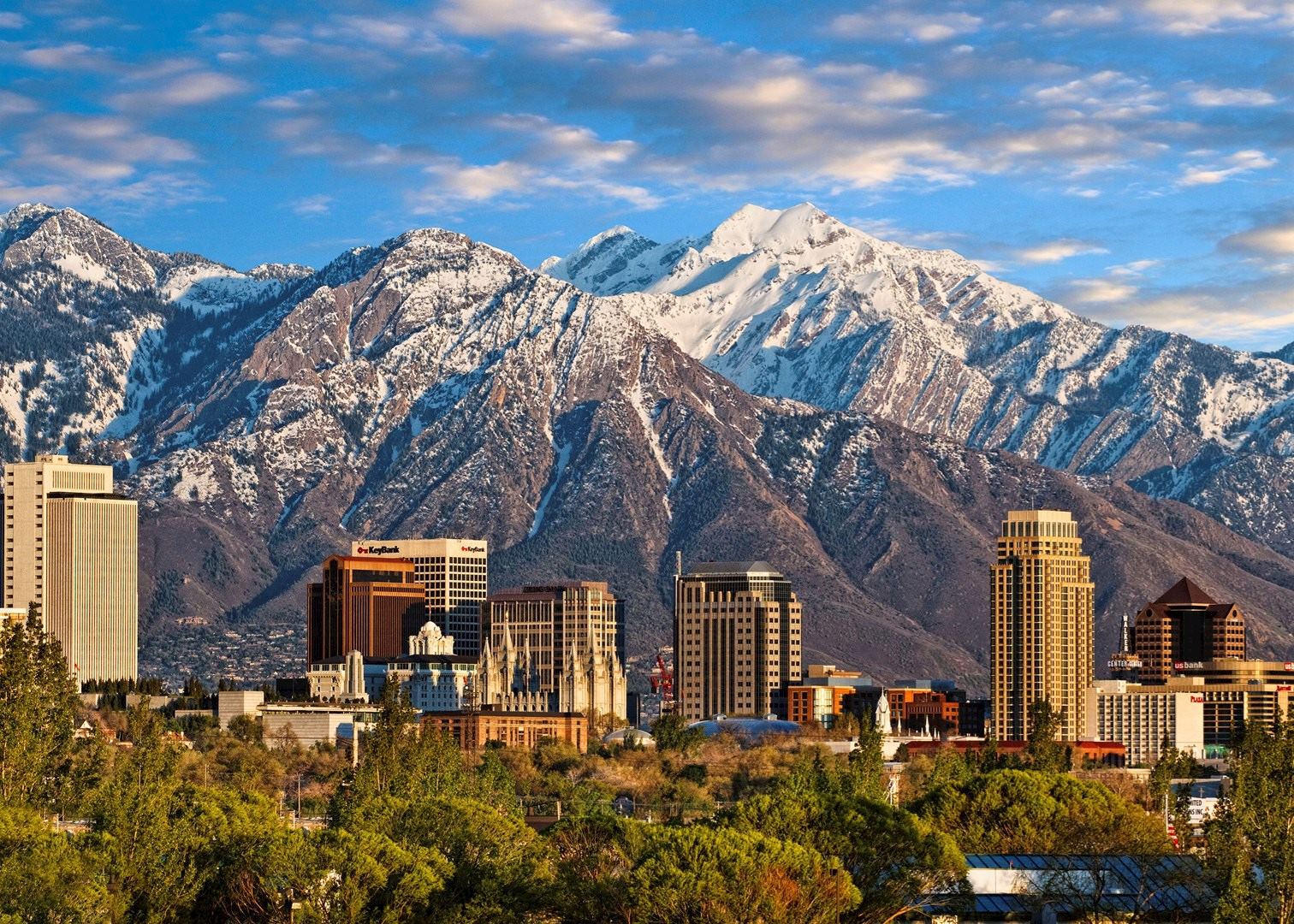
“A civic artwork that produces clean energy for the city every day is the kind of investment that keeps paying back for generations … that says we can meet the challenges of the 21st century.”
said Robert Ferry, LAGI co-founder, in remarks reported by KSL.com. His partner, Elizabeth Monoian, added that the aim is to make “often overlooked resources tangible through experiences of wonder and curiosity that only art can inspire.”
The competition opens for submissions on Jan. 5, 2027, closing April 12. A local jury of artists, engineers, renewable energy experts, and residents will select three finalists by October 2027, each receiving $50,000 to develop their proposals. A single winner will be chosen by year’s end.
The $150,000 in prize money is covered by a major donation, while the city intends to pursue public-private partnerships to fund the construction of the winning design — costs not included in the $58 million baseline budget.
Funding the vision in phases
Money has begun to move. The city’s Community Reinvestment Agency allocated $2.2 million in August, closing a $3.2 million gap to advance the design to its current stage. Salt Lake County contributed $3.1 million for the all-abilities playground, drawn from a $128 million parks bond voters approved this month. Mendenhall told KSL.com the city has “real skin in the game” and is actively courting philanthropic and private capital.
The 2034 Winter Olympics and Paralympics loom as a hard deadline and a funding catalyst. City officials envision the renovated Civic Center as a primary community gathering site during the Games. Construction phasing reflects that urgency: Phase one, east of the library, could break ground by late 2027, with phase two following in late 2028 or early 2029.
The target for full completion is approximately 2031. Phasing is also designed to keep the block programmable for existing festivals — Living Traditions, Illuminate, the Twilight Concert Series — which have historically struggled with the site’s walls and odd geometry.
The stakes of a downtown “living room”
Blake Thomas, the city’s senior advisor on real estate and capital projects, put the operational goal plainly: “Our whole goal is to have the block activated seven days a week.”
That means office workers eating lunch on Tuesday, not just festival crowds on Saturday. The economic argument rests on the premise that a functional, beautiful civic space anchors downtown recovery, increasing foot traffic for adjacent businesses and improving quality-of-life metrics that drive residential retention.
Skeptics might note that Salt Lake City has no shortage of signature downtown parks — Liberty Park, Pioneer Park, the Gallivan Center — and ask whether a $58 million-plus investment in a block that has resisted activation for decades is the highest use of limited capital.
The counter-argument, voiced by Mendenhall and Thomas, is that the Civic Center’s location at the intersection of government, transit, and the library system makes it uniquely positioned to serve as the connective tissue downtown currently lacks. The LAGI competition sweetens the pot: if it yields a world-class energy artwork, the city gains a tourist draw akin to the Spiral Jetty, but embedded in the urban grid.
What remains unresolved is the final price tag for the art installation itself, the structure of the public-private partnerships, and whether the construction timeline can survive the inevitable surprises of building over a parking garage on shifting ground. The next milestone is the January 2027 competition launch. After that, the renderings become contracts, and the “sea of pavers” either becomes a park — or stays a warning.
Keep reading

Winter Storm Forces School Closures, Delays and State Office Late Start Across Western Nevada
A winter storm rolling through the Sierra and western Nevada has forced a cascade of school closures and...
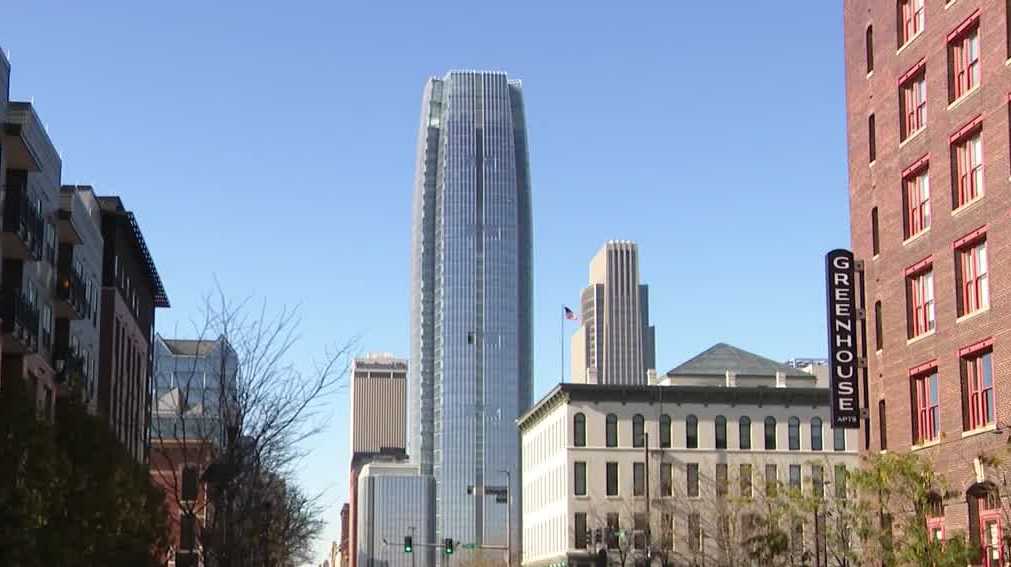
Mutual of Omaha Opens 677-Foot Tower, Tallest Between Denver and Chicago
Mutual of Omaha cut the ribbon Wednesday on a 677-foot tower that rewrites the city's skyline and declares...

Montana AG Takes Over Billings Senior High Stabbing Review From City Attorney
"The absence of formal felony charges does not ease the pain or provide the clear resolution our community...

KMBC’s Johnny Rowlands, Kansas City’s First Airborne Traffic Reporter, Retires Nov. 25
Johnny Rowlands, the pilot and reporter who put Kansas City in the sky for more than three decades,...