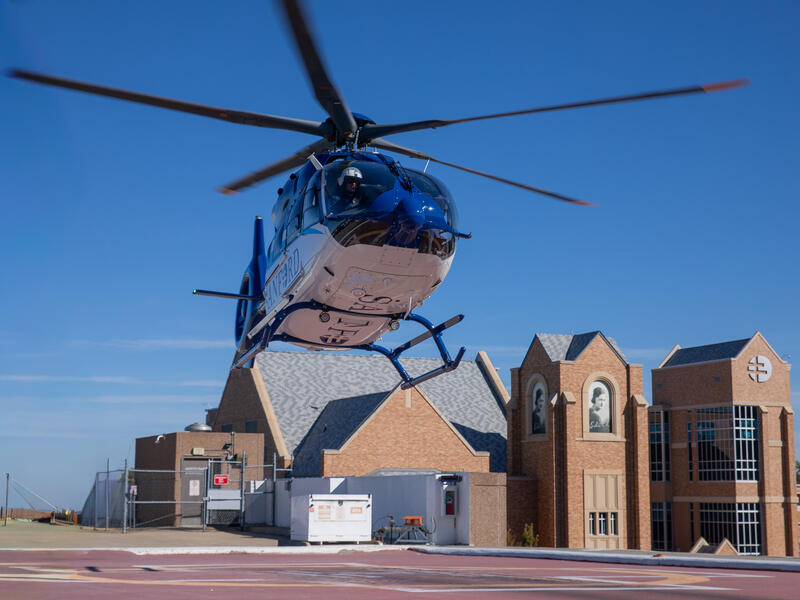
Sanford AirMed added a new Airbus H145 D3 helicopter to its Sioux Falls fleet Friday, the first of three replacements planned through 2028.
The $13 million aircraft replaces a 2010 model that logged one of the highest operating times in the nation, according to Mike Christianson, vice president of air transportation. A second helicopter is scheduled for Fargo in 2027 and a third for Bemidji in 2028, Sanford Health News reported.
“As aircraft age, they require more out-of-service time for maintenance,” Christianson said. “It was time to replace it with the newer version of the same helicopter we have.”
“It’s a significant investment in our footprint and to the patients that really need to be transported,” Christianson said.
The H145 D3 adds payload capacity, improved engine performance and a four-axis autopilot that reduces pilot workload, said Matt Horn, director of operations and a pilot for the program. A health and usage monitoring system tracks component vibrations to predict maintenance needs before failures occur.
“We’re able to replace those components before we actually have something break or fail, and that’s going to decrease our out-of-service time and allow us to be more available for requests,” Horn said.
“It’s really a very technologically advanced aircraft, extremely safe, high quality,” Christianson added. “It gives our clinicians a lot of space to care for the patients that we transport – and we do a lot of patient transports.”
AirMed runs more than 5,000 transports per year across a footprint that includes Sioux Falls, Bemidji, Fargo, Bismarck and Dickinson. The program operates five helicopters and five fixed-wing aircraft, with a helicopter radius of about 100 miles around Sioux Falls and typical launch times of 15 minutes or less.
“Our helicopter radius is about 100 miles around Sioux Falls,” said Mike Christianson, vice president of air transportation. “We usually launch within 15 minutes or less for a response on a call.”
“I think we’ve seen a community healthcare that, they don’t have as many resources as they used to, so the need for air medicine is even greater than it has been previously,” Christianson said.
The program began in 1977 under a federal grant to reduce infant mortality in South Dakota. Its first flight in 1977 carried a newborn with a life-threatening heart condition from Gettysburg. The first helicopter joined the fleet in 1986.
“Whether it be a stroke, a heart attack, a car accident, all of our treatments are going to match up with what’s going happen here (at the hospital),” said Greg Vandenberg, clinical manager.
Roughly 60 pilots, more than 200 clinicians, 15 mechanics and 10 communication specialists staff the operation.
“It’s a passion because you get to really go out and see a lot of different patients and help them in that worst moment, take care of them and make a difference,” Vandenberg said.
Worth a look
- Speed Skaters Gather in Lexington for Kentucky Thoroughbred Classic
- Holiday Events and Parades Kick Off Across Lower Delaware
- New Zealand's ruling coalition falls one seat short of majority in final election count (newsarchyuk.com)
- RBA's Fifth Hike Adds About A$94 a Month on A$600,000; Three Voted to Hold (daybreakwire.com)

Speed Skaters Gather in Lexington for Kentucky Thoroughbred Classic
Speed skaters from across the United States gathered in Lexington this weekend for the ninth annual Kentucky Thoroughbred...

Holiday Events and Parades Kick Off Across Lower Delaware
Holiday events open across Lower Delaware on Friday with tree lightings in Middletown and Rehoboth Beach, Bay to...

Sacramento Firefighters Handle Cooking Fires During 48-Hour Thanksgiving Shift
Sacramento firefighters at Station 2 answered multiple cooking fires while working a 48-hour shift on Thanksgiving Day. The...

Metro Phoenix Holiday Light Guide 2026: 7 Major Displays Open for Season
Metro Phoenix holiday light displays opened Friday night across seven major venues, with Glendale Glitters and the Arizona...