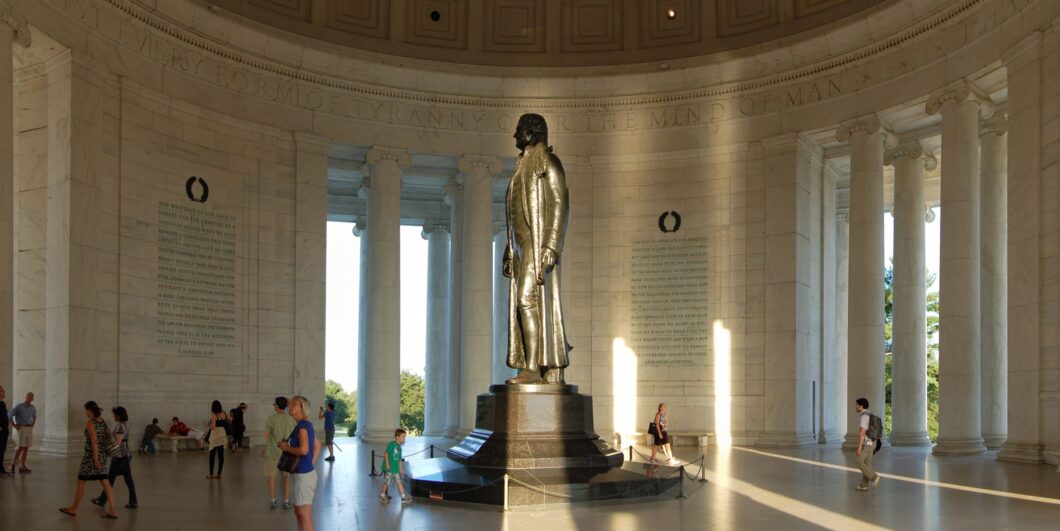
James Parton declared in 1874 that Jefferson and America stood or fell together, a claim that has polarized every generation since.
“If Jefferson was wrong, America is wrong,” Parton wrote, “and if America is right, Jefferson was right.” The formulation appeared after the Civil War, when Jefferson’s stock had fallen because his 1798 Kentucky Resolutions were invoked by proponents of nullification and secession.
Jefferson’s reputation has risen and fallen with partisan politics, sectional conflict and international entanglements. Both opponents and supporters of slavery cited his legacy before the Civil War. He declined after the war, revived in the 1920s as a champion of religious liberty, and was invoked by President Franklin Roosevelt during World War II as the embodiment of Allied principles.

His standing fell again during the civil‑rights era because he enslaved more than six hundred people and had children with Sally Hemings. In 2017 President Trump cited Jefferson after white‑supremacist violence in Charlottesville killed Heather Heyer. In 2021 the New York City Council voted to remove a Jefferson statue from its chamber.
The contrast with George Washington is striking. Washington was eulogized as “first in war, first in peace, and first in the hearts of his countrymen,” and Jefferson himself called him “our first and greatest revolutionary character” in his first inaugural address.
Washington’s story was already written; Jefferson told the nation “I shall often go wrong through defect of judgment” and “when right, I shall often be thought wrong by those whose positions will not command a view of the whole ground.”
Jefferson framed his party’s victory in 1800 as “the Revolution of 1800” and believed many such revolutions would be necessary for the republic to survive. “The earth belongs to the living,” he told James Madison in 1789, describing a generational trust that could be “as easily betrayed and lost as preserved and passed on.”
Jefferson did not “invent” America; rather, “successive generations invented ‘Jefferson,’ invoking him because he recognized in them the ultimate source of legitimate authority.” The semiquincentennial of the Declaration has renewed public and scholarly focus on that generational sovereignty.
Parton’s hope was that as long as the nation survived and each generation added fresh chapters to “the volume” of its “faithful history,” Jefferson would be vindicated. “What we call democracy emerged from the existential crisis Jefferson’s generation confronted,” the authors conclude.

Muschamp Calls Texas Move His Last; Linked to Georgia DC Opening
Texas Longhorns defensive coordinator Will Muschamp is being linked to the defensive coordinator opening at Georgia following the...
Massachusetts State Trooper Charged with OUI After Crash, Had Prior Drunken Driving Discipline
Massachusetts State Police Trooper Carol Leurini was placed on restricted duty this week after a Nov. 13 crash...

NOAA Forecasts Major Nor’easter Wednesday Through Thanksgiving
"Coastal flooding will be the biggest concern," the Weather Prediction Center said in a forecast released Nov. 24....

No. 21 Nebraska Hosts Southern in Lincoln
No. 21 Nebraska (6-0) hosts Southern (1-5) on Wednesday in Lincoln, Neb., CBS Sports reported. The Cornhuskers have...