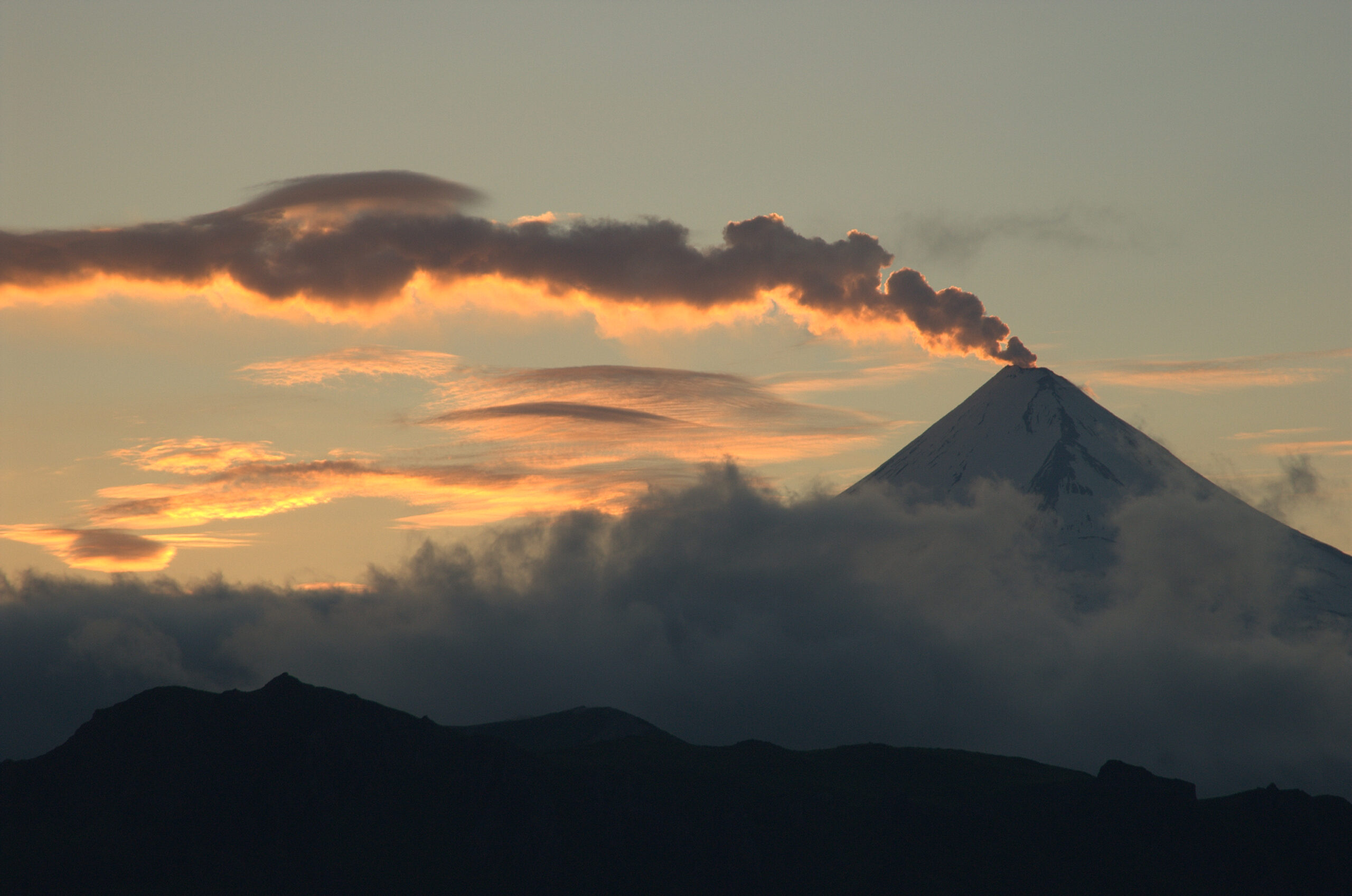
Pressure waves from Shishaldin Volcano’s September 25, 2023 eruption have revealed its mass eruption rate, reaching a peak of 2.25 × 10⁷ kg/s. The study, which used a novel acoustic-gravity wave method, produced a total erupted mass estimate nearly identical to one from satellite ash-plume modeling.
Scientists have calculated the explosive power of a major Alaskan volcano by analyzing the pressure waves it generated, offering a new way to measure eruptions. A study of the September 25, 2023, paroxysm at Shishaldin Volcano used low-frequency atmospheric signals to determine the volcano injected mass into the atmosphere at a peak rate of 2.25 × 10⁷ kg/s, The Watchers reported. The eleventh major explosive event in a sequence that began on July 14, the September 25 paroxysm was one of the largest explosions of the 2023 period. The study marks the shift to its primary paroxysmal phase as occurring at approximately 13:35 UTC on September 25.
The Alaska Volcano Observatory said that a significant ash cloud developed not long after and ascended to 14 km (8.7 miles) above sea level, which led to a RED Aviation Color Code and WARNING Volcano Alert Level. AVO later reported that the eruption caused ashfall in several communities and flight cancellations in the region. The analysis focused on pressure waves detected by two local infrasound sensors.
The SSLS station, 5.5 km (3.4 miles) from the summit, recorded an initial pressure decrease to about -60 Pa (-0.0087 psi), followed by a compression to approximately +60 Pa (+0.0087 psi). The full pressure change exceeded 120 Pa (0.017 psi). Spectral analysis identified a strong peak at 1.5 mHz, corresponding to an oscillation period of about 11 minutes. These are acoustic-gravity waves, which propagate more slowly than ordinary sound due to the influence of buoyancy.
According to the researchers, acoustic-gravity waves are pressure waves in the atmosphere where, close to the volcanic source, the acoustic, gravity and Lamb-wave components are not cleanly separated.
The researchers used the pressure signals to model the eruption as a point source. Their preferred model placed the effective source at 4.1 km (2.5 miles) above sea level, about 1.2 km (0.75 miles) above the volcano’s summit and 500 m (1,640 feet) north-northeast of the crater. This resulted in a total modeled erupted mass of 7.9 × 10⁹ kg (1.74 × 10¹⁰ lb) during the paroxysmal phase.
This acoustic-gravity inversion result was checked against independent estimates. A satellite ash-plume calculation produced a total mass of 7.91 × 10⁹ kg (1.74 × 10¹⁰ lb), essentially identical to the acoustic-gravity result. Estimates based on satellite SO₂ measurements and ash-plume modeling were two to three times larger.
The study attributes the spread to factors like plume density and how fine ash content affects detection.
A separate USGS analysis of the entire 2023 eruption sequence said that Shishaldin, a “dry” explosive basaltic volcano, produced 13 major events. It showed that seven plumes reached 10–14 km above sea level and used satellite and lightning data to find peak eruption rates of 10⁴–10⁷ kg·s⁻¹ and a total erupted volume of ~ 0.05 km³.
The USGS also found that despite its intensity, automated satellite detection algorithms generally failed to detect the volcanic ash, which they attribute to the eruption’s fines-poor grain size distribution. The eruption also generated 491 volcanic lightning flashes, though at modest rates compared to “wet” eruptions.
Shishaldin Volcano is one of the most active volcanoes in the Aleutian Islands, with 40 confirmed Holocene eruptions ranging from 0–3 on the Volcano Explosivity Index (VEI), the majority of which were VEI 2 events. In 1999, it produced a sub-Plinian (VEI 3) eruption, one of its most significant in recorded history.
The volcano, which rises to 9,373 ft (2,857 m) above sea level, is a highly symmetrical basaltic cone frequently producing ash clouds that rise tens of kilometers into the atmosphere, though lava flows are occasional.
Related reading

Cheyenne Council Passes Farm Code Clarification, Rejects Animal and Right-of-Way Measures
Cheyenne City Council approved an ordinance clarifying agricultural rules in the city’s Unified Development Code but rejected two...

Woodruff Plans to Pitch in 2027, Talks With Multiple Teams Including Brewers
Milwaukee Brewers pitcher Brandon Woodruff said Wednesday he plans to pitch in 2027 after winning a World Series...

Michigan State Visits Rutgers With Last-Place Finish on the Line
Michigan State (3-8, 1-7 Big Ten) visits Rutgers (3-8, 2-6) on Saturday with the loser finishing alone in...

Illinois Towns Have Home Prices Below $319,900 Median
The median listing price for a home in Illinois reached $319,900 in October 2026, according to Realtor.com. Danville's...