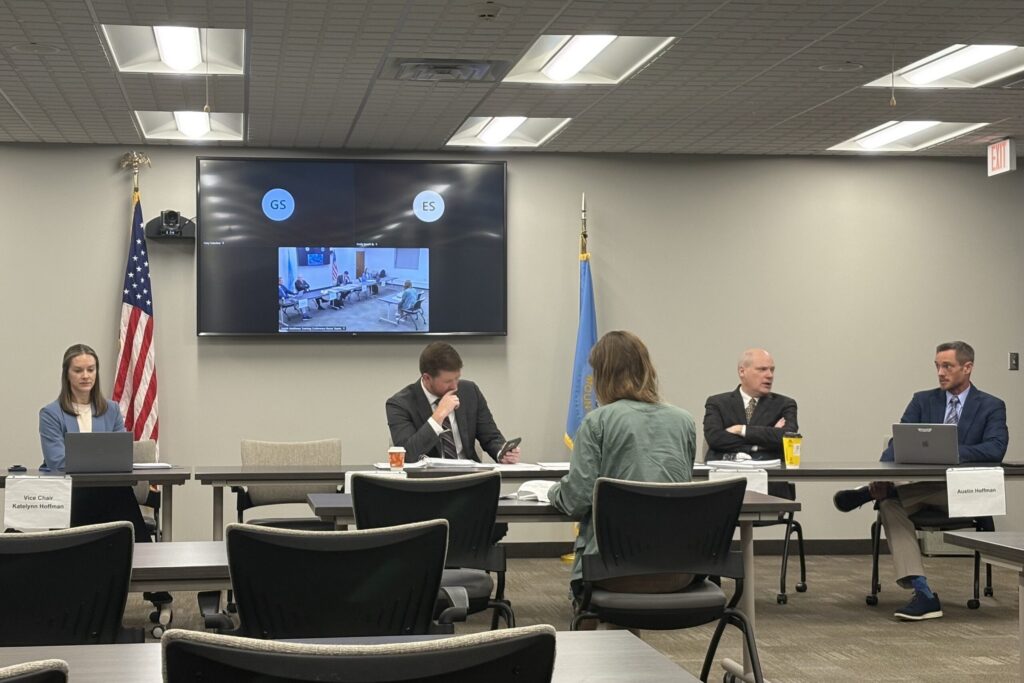
The South Dakota Open Meetings Commission unanimously dismissed a complaint that a city finance officer’s eavesdropping on a closed council meeting violated state open-meetings law, ruling that no statute addresses a third party overhearing an executive session. In the same meeting Monday in Pierre, the commission reprimanded the Tripp City Council for twice failing to cite the specific legal authority required to close its doors to the public.
The commission, whose five members are county prosecutors appointed by the state attorney general, considered a complaint from Gary resident Rachel Hinsvark. She alleged the city’s finance officer “positioned herself directly outside the executive session room, in the hallway between the library and city office — close enough to hear the ongoing discussion,” according to News From The States.
Hinsvark also argued the council included city employees in the executive session without a vote approving their presence. “There must be procedures in place that do not rely solely on trust” for meeting attendees to vacate an executive session, Hinsvark told commissioners. “It’s about public trust, accountability and ensuring the rules governing public bodies mean something.”
“What statute would’ve she specifically violated?” commission member Austin Hoffman said of the finance officer. “I’m not certain there’s anything directly pertaining to that situation.” Commission members also found nothing in state law requiring a vote about who may attend an executive session, and voted unanimously to dismiss the complaint.
Commissioners determined that South Dakota’s open-meetings laws govern whether public bodies properly notify the public and lawfully enter closed sessions, not whether a third party overhears them, according to Newzly.

In a separate case, the commission unanimously reprimanded the Tripp City Council for a July meeting in which members entered executive session without stating a purpose. “I don’t think there’s any way to defend the violation,” Commission Chair Michael Smith said. State law requires a motion to enter executive session to state the specific law containing a justifiable reason.
Commission reprimands Tripp council for executive-session flaws
Smith cast the lone no vote, saying he did not expect laypeople to recite statutes, while Hoffman agreed with that concern but voted for the reprimand based on existing law.
Hinsvark urges safeguards beyond trust for closed sessions
She added, “This is not simply about an employee sitting at the door,” framing the issue as one of public trust and accountability.
Commission members found nothing in state law requiring such a vote, and Hoffman said he was not certain any statute directly addressed the finance officer’s alleged eavesdropping.
For an August meeting in which the council cited only the general descriptions “personnel & legal” and minutes did not cite specific statutory sections, the commission voted 4-1 to reprimand. Smith cast the lone no vote. “I felt like it was improper, and I still do, that we’re asking laypeople to cite the statute,” Smith said.
“I mean, while we as legal counsel need to ensure that what they’re going into executive session for is defensible legally, I don’t expect a farmer or a retired individual to have that state law recitable.” Hoffman agreed with that sentiment but voted for the reprimand based on existing law. “I’m not saying I think it’s right. I think there needs to be broader language there,” Hoffman said.
Worth a look

FAA Orders Brief Ground Stop at O’Hare Over Staffing Constraints
The ground stop began at 10:40 a.m. Central and was lifted by about 12:15 p.m., according to the...

Pacers Beat Thunder 125-120 as Bench Outscores Reserves 52-27
Indiana's bench outscored Oklahoma City's reserves 52–27 as the Pacers beat the Thunder 125–120 on Monday at Gainbridge...

Alaska Energy Authority Approves $4.9M Loan for Red Dog Mine Solar Farm
The Alaska Energy Authority on Tuesday approved a $4.9 million loan to build a solar farm at the...

Wisconsin Bowl Projections: 5 Potential Destinations, Opponents for Badgers’ First Bid in Three Seasons
Wisconsin (7-4, 5-3 Big Ten) is assured of a bowl bid for the first time in three seasons...