
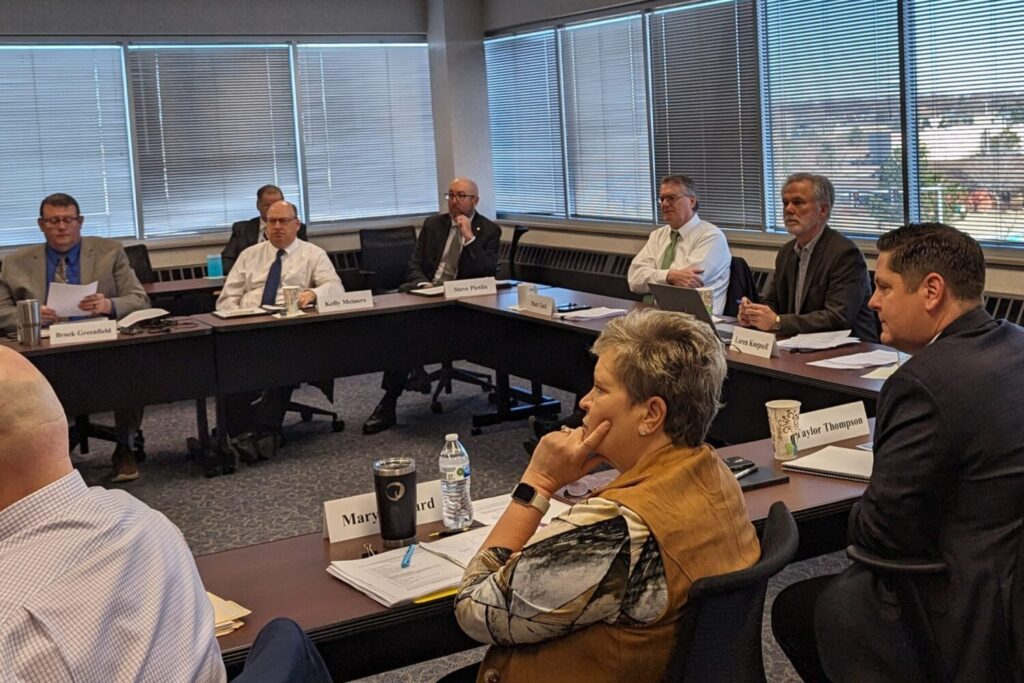
South Dakota’s retirement system missed its 20-year benchmark for the first time in the system’s 53-year history, the South Dakota Investment Council disclosed at its meeting on Nov. 17.
The $16.4 billion fund returned about 11% in fiscal year 2026, while its benchmark gained 18%, South Dakota Searchlight reported. The shortfall extends a three-year stretch of underperformance that State Investment Officer Matt Clark acknowledged has clustered recently.
"It’s been really good more often than really bad," Clark told Searchlight. "But the really bad’s been clustered in the last three years."
The council oversees more than $21 billion across the retirement system and trust funds for schools, healthcare and the state budget. The retirement system serves roughly 107,000 members — state workers, teachers, police officers and other public employees — who contribute at least 6% of salary matched by the state for a guaranteed pension. Retirees have received cost-of-living adjustments below inflation since 2021.
Clark’s team employs a contrarian strategy: reducing stock exposure when prices are high and buying more when they dip. The approach aims to buffer the system against severe downturns. An analysis shared with the council shows the fund would remain 95% funded in a 2008-level crisis; a benchmark-mimicking portfolio would fall to 85%, risking benefit cuts.
"The goal is to keep it 100% funded," Clark said.
The strategy paid off after 2008. South Dakota granted retirees cost-of-living adjustments at or above inflation — hitting the then-maximum 3.5% in 2014, 2015 and 2016 when inflation ran 1.6%, 0.1% and 1.3% respectively — while many states borrowed to shore up pensions or raised contributions. A 2021 Pew Charitable Trusts report estimated state systems overall were 80% funded "for the first time since 2008."
Portfolio manager Jarrod Edelen told Searchlight that the situation with other states being underfunded started in a big way in 2008 when the market dropped and their funded status fell sharply. "They were stuck with that lack of recovery, but we got an enormous recovery."
This time, real estate and private equity dragged returns. Real estate partnerships — 10- and 15-year arrangements — suffered a "slow-motion unraveling" as investors bet rates would stay low forever, Clark said. Private equity returned less than hoped, though not negative. "We’ve never had them all do bad at the same time before," Clark said.
Trust funds also trailed the 16.2% benchmark:
| Fund | Value | FY 2026 Return |
|---|---|---|
| School and Public Lands Trust | $487 million | 9% |
| Dakota Cement Plant Trust | $392.3 million | 8.2% |
| Education Enhancement Trust | $842.5 million | 8.7% |
| Health Care Trust | $241 million | 9.3% |
Transfers to the state general fund fell to $136.8 million from $150.6 million a year earlier.
In April, three members of the Legislature’s Executive Board voted against a raise and incentive-based bonus for Clark. Rep. Scott Odenbach, R-Spearfish, said lawmakers are bound to get questions from retirees: "are you doing your job to make sure we’re getting the returns?"
Early fiscal year 2027 returns offer a glimmer. The retirement system gained 1.27% in the first few months of fiscal year 2027, while the benchmark lost 0.75%.
State Investment Officer Matt Clark, who has led the South Dakota Investment Council since January 2005 after joining the agency in 1984 and serving as Deputy Investment Officer from 2000, oversees the contrarian strategy that reduced equity exposure near market peaks.
"I guess it shows that contrarian strategies can eventually work out if you’re patient enough," Clark told the council. "But you have to be very patient. Fortunately, I think you know that’s something we can do."
Keep reading

NWS: Huntsville Cold Front Tuesday, High Near 52, Frost Risk; Sun Wed, Rain Thu
A cold front will drop temperatures across the Huntsville forecast area Tuesday, with a high near 52 degrees...
Four Westside Atlanta Churches Feed 13,000 via Thanksgiving Meal Bundles
Four Westside Atlanta churches distributed 1,000 Thanksgiving meal bundles on Saturday, feeding an estimated 13,000 residents through the...

Broncos Activate Tyler Badie From IR for Friday’s Game
The Denver Broncos designated running back Tyler Badie for return from injured reserve Tuesday, opening a 21-day practice...

Jacksonville Pharmacy Tech Gets 7 Years for Stealing, Selling Pills; 2 Suspects Still Wanted
A Jacksonville pharmacy technician was sentenced in October to seven years in prison for stealing hundreds of oxycodone...