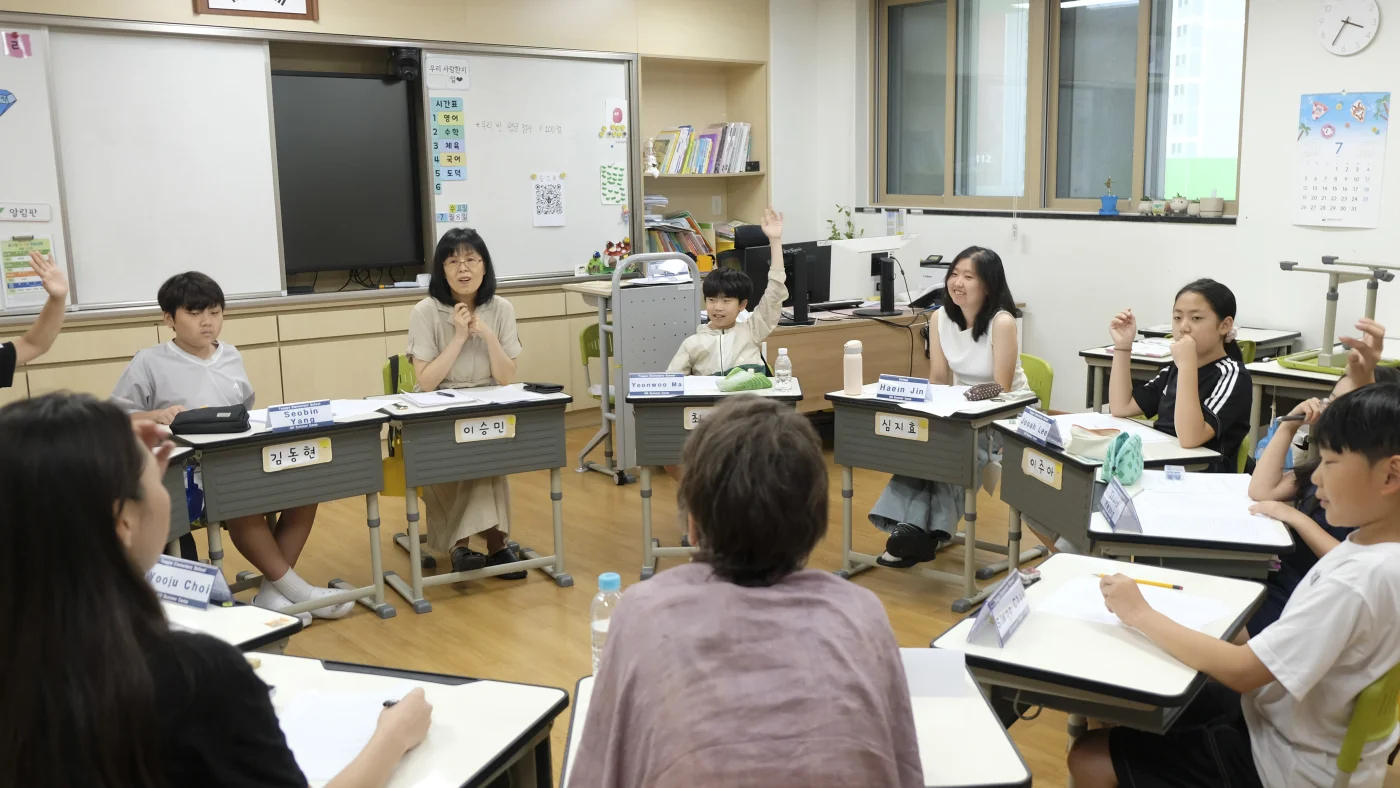
The city of Chuncheon, South Korea, has launched an educational initiative aimed at curbing reliance on artificial intelligence and reversing a decline in student reading skills.
By adopting the “Great Books” model used by St. John’s College in Annapolis, Maryland, local educators are moving away from rote memorization and toward intense, text-based debate. This transition comes as South Korean students face a dual pressure of intense academic competition and a growing dependence on AI tools for study.
The Shift Toward Critical Inquiry
At the Toegye public elementary school, located approximately 50 miles east of Seoul, students engage in seminars where teachers act as guides rather than lecturers. In these sessions, participants do not turn to the internet or outside sources for answers. Instead, they rely on assigned readings, personal reasoning, and peer-to-peer discussion. For students like Ma Yeonwoo, the format encourages a diversity of thought that traditional lectures lack. During a summer camp seminar discussing Mary Shelley’s novel Frankenstein, Ma suggested the creature could be considered a human being without a soul.
The discussion then moved to whether artificial intelligence is human, with Ma arguing that AI lacks creativity because humans created it. If only the teacher talks we can have one idea, but if we all debate together, like, we can get many ideas together,
Ma said.
The program aims to foster independent thinking, a skill proponents argue is essential for students to effectively judge the quality of information generated by AI.
🔴 South Korea adopts St. John's College 'Great Books' model to counter AI reliance in schools Chuncheon city established an academic partnership with St. John's College last year to introduce the "Great Books" educational model, which uses seminar-style discussion instead of… pic.twitter.com/zz2NBKEPxM
Addressing Systemic Educational Challenges
The push for a new philosophy follows concerning data regarding South Korean student performance. International tests, including those from the OECD, have indicated a post-COVID decline in reading proficiency.
OECD figures show that 51% of South Korean students report using AI chatbots for study at least once a week. Korean students are even losing their old capacity to memorize facts because they collect facts and ideas mainly from A.I.,
Lee said.

Establishing a New Academic Path
Chuncheon Mayor Yook Dong-han spearheaded the partnership with St. John’s College, seeking to provide an alternative to the country’s high-pressure testing culture. When I became mayor, I wanted to introduce a different kind of education and a distinct educational philosophy to the city of Chuncheon,
Yook said.
The current system often leaves students with little time for deep thought, as they focus heavily on preparation for college entrance exams. While the city has formalized this academic partnership to implement the Great Books curriculum, the extent of these methods' integration across the region and whether they will alter the long-standing reliance on traditional, test-focused cram schools is unclear.
Related reading

Challenging Emergency Removal and Interim Suspension Under Title IX in New York
Yes, an Albany-area college can sometimes suspend or remove you before a Title IX hearing begins, but federal...

New York State Allocates $14 Million for Three Brooklyn Cultural Projects
New York State is pumping $14 million into three distinct cultural fixtures across Brooklyn, targeting major infrastructure overhauls...

Concord Women’s Basketball Opens 2026-27 Season Against Ferrum
Concord Opens 2026-27 Season Against Ferrum The Concord University women's basketball team kicks off its 2026-27 campaign inside...

Route 66 Burque Battle Showcases Lowrider Culture in Albuquerque
“My grandpa completely built this bike for us when we were little boys and we’ve been showing,” said...