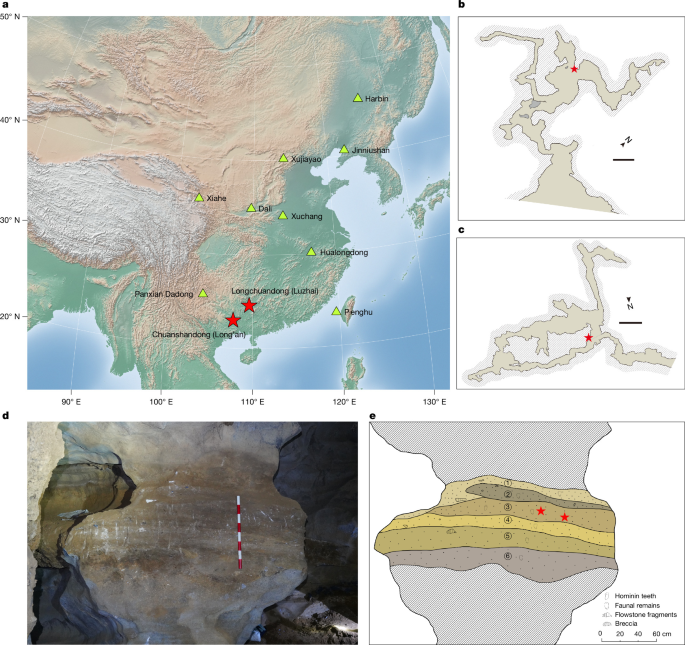
Fossil teeth from two southern Chinese caves push Homo erectus survival in the region past 184,000 years ago, Nature reported.
Researchers analyzed nine hominin teeth from Chuanshandong and Longchuandong caves using micro-CT scanning, geometric morphometrics, U-series and luminescence dating, and palaeoproteomics. The specimens date between 184,000 and 324,000 years old, filling a gap in the East Asian record that largely disappears around 400,000 years ago, according to the study published in Nature.
Eight of the nine teeth show a combination of crown and root features typical of Homo erectus, the team found. Proteomic analysis of five teeth returned a protein pattern linked to Homo erectus in four specimens, though a small difference led researchers to identify a previously unsampled population.
The fifth tooth matched neither H. erectus, Neanderthals, nor modern humans in morphology or protein profile; the authors say it could represent a Denisovan, though only one reference genome exists for that group.
Carbon isotopes in the enamel indicate the individuals consumed vegetation from dense tropical forests, the researchers found. Associated mammal fossils — more than 18,000 specimens — confirm rainforest dominated the local environment at the time. Strontium isotope ratios suggest some individuals may have traveled up to 250 kilometers, reaching what is now northern Vietnam.
U-series laser ablation on the hominin teeth and associated mammalian teeth, combined with optical dating of fossil-bearing sediments, provided the minimum age range. Sediment samples were collected in light-proof tubes and measured for quartz OSL using a single-aliquot regenerative-dose protocol. Cosmic dose contributions were calculated from a burial depth beneath roughly 30 meters of cave roof.
More than 18,000 mammal fossils were recovered from the two cave sites, Baxian and Naxian, researchers reported. The assemblage indicates that dense tropical forest dominated the local environment when the hominins lived there.
A second team studied carbon isotopes in the hominin enamel and found the values came mostly from vegetation typical of closed-canopy rainforest.
Sediment samples were collected in light-proof tubes and measured for quartz OSL using a single-aliquot regenerative-dose protocol with blue LED stimulation at 470 ± 30 nm and Hoya U-340 filters.
Grain-size distributions were measured on a Malvern Mastersizer 3000 particle analyser with analytical precision better than 1%, the authors noted.
After desalting with C18 ZipTips, peptides were eluted into 0.1% trifluoroacetic acid in 80% acetonitrile for mass-spectrometry analysis.
The outlier tooth leaves the taxonomic picture unresolved. Its protein sequence does not match the sole available Denisovan reference, and the authors caution that the specimen could represent an as-yet-unidentified Homo population in Middle–Late Pleistocene southern China.

Go Kyung-pyo Faces Drunk Driving Charges As Past Designated Driver Tip Revealed
Actor Go Kyung-pyo appeared at Seoul's Mapo Police Station on November 23, nine days after crashing into a...

South Korean Biotech AMINOLAB Expands Exports to Egypt, Japan
South Korean biotechnology company AMINOLAB announced on November 25 that it is expanding international sales of amino acid...

Sunrise on the Reaping Opens to $120M Domestic Debut
The “Hunger Games: Sunrise on the Reaping debuted to $120 million domestically and $225 million globally over the...

Farage and Banks Launch ‘Keep Britain Out’ Campaign Warning EU Rejoining Is the Risk
Nigel Farage and Arron Banks launched the Keep Britain Out campaign in Westminster on Wednesday, warning that rejoining...