Industrial real estate in Wilmington is outgrowing the era of the generalist broker.
As the region’s logistics and manufacturing footprint expands, the demand for niche expertise is reshaping how commercial property is bought, sold, and leased.
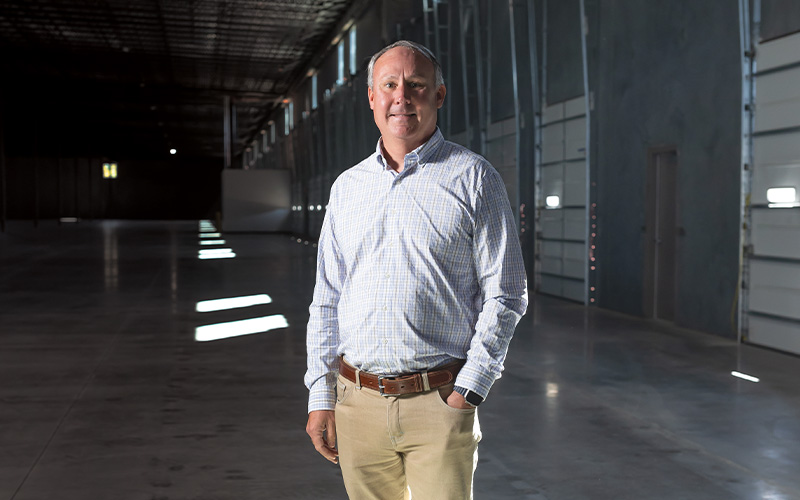
Will Leonard, a senior vice president with Cape Fear Commercial, has emerged as a specialist in a market that traditionally required brokers to juggle office, retail, and industrial assets simultaneously. According to WilmingtonBiz, Leonard is one of the few professionals in the area who focuses almost exclusively on the industrial sector.
“There are other brokers that do a lot of industrial, but Will is the only guy that only does industrial,” Chris Norvell, a principal with Wilmington Trade Center developer Edgewater Ventures, told WilmingtonBiz.
For decades, the local commercial market was too small to support a dedicated industrial specialist. Most brokers “dabbled” in various property types to maintain a steady workflow, but the increasing scale of regional development has changed that math.
The arrival of modern tilt-up construction
The transition from small-scale flex spaces to massive, modern distribution hubs began in earnest around 2019. This shift was marked by the arrival of what Leonard calls the “next frontier” of regional development.
That frontier arrived when Chris Ramm, a manager with the Winston-Salem-based Taylor Development Group, submitted plans for the area’s first modern, tilt-up concrete building located in Pender Commerce Park, WilmingtonBiz reported.

“It’s just an underserved market, and so we were … involved with other industrial projects in the Triad, and just saw a big void,” and “thought it was a risk worth taking,” Ramm told WilmingtonBiz.
Ramm said that the decision to move into the Wilmington market was driven by the community’s steady population and business growth, which created a logistical demand for high-spec industrial space.
Leonard played a central role in that specific project, handling the land purchase negotiations and the subsequent leasing of the 127,000-square-foot facility. He admitted that the scale of the project was a learning curve because Wilmington had not previously seen buildings of that specific modern configuration.
Infrastructure drives the I-140 corridor
The geography of Wilmington’s industrial boom is not random; it is dictated by highway access. Development is increasingly clustering around the Interstate 140 corridor, which serves as the backbone for heavy logistics.
“I can’t underscore how important I-140 has been to the industrial market,” Leonard said, noting that nearly every large existing or planned building sits within close proximity to the highway.
While New Hanover County remains a primary hub, the scarcity of available industrial land is pushing activity toward neighboring areas. Current projects and developments are spreading across several key locations:
- The Wilmington Trade Center master-planned park on U.S. 421.
- The International Logistics Park in Brunswick County, led by Cameron Management and Windsor Commercial.
- Newly completed industrial buildings on Cedar Hill Road in Navassa, involving Greensboro-based Samet.
- The Leland Innovation Park, where Leonard is leading lease-up efforts for Canvasback Capital’s small bay project.
- Various developments including First Flight Business Park, Wrightsboro Business Park, and Blue Clay Business Park.
Despite this expansion, the market faces a unique ceiling. While Brunswick County is seeing significant activity, Leonard suggested that the region has not yet fully proven it can support the same scale of large-scale industrial projects seen in New Hanover County.
A market defined by local momentum
The rapid buildout of industrial space has created a high barrier to entry for new competitors. As local developers secure land and expand their existing holdings, the “momentum” of established players makes it difficult for outsiders to break in.
“You’re not going to see a whole lot of new players in the market,” Leonard said, citing the expansion capabilities of developers who already control significant acreage.
This concentration of activity has kept specialists like Leonard busier than in previous decades. While the profession has moved from generalist real estate to specialized logistics brokerage, the players involved remain deeply rooted in the local economy.
“What’s pretty cool about Will is he stays under the radar and does a lot of business,” Ramm told WilmingtonBiz.
Related reading
WDMCS Outlines Employee Guidelines for Severe Weather Cancellations
West Des Moines Community Schools employees must follow specific protocols regarding pay and work locations when severe weather...

KC Current Goalkeeper Lorena Called Up to Brazil National Team
KC Current goalkeeper Lorena has been named to the 26-player roster for the Brazilian National Team’s final fixtures...

Deadly Death Cap Mushrooms Spotted Along Boise Greenbelt
Poisonous death cap mushrooms have been identified along the Boise and Garden City greenbelts, according to The Arbiter....
State Attorney Subpoenas JTA for Records Involving Executives
The 4th Circuit State Attorney’s Office has issued a subpoena to the Jacksonville Transportation Authority (JTA) for records...