
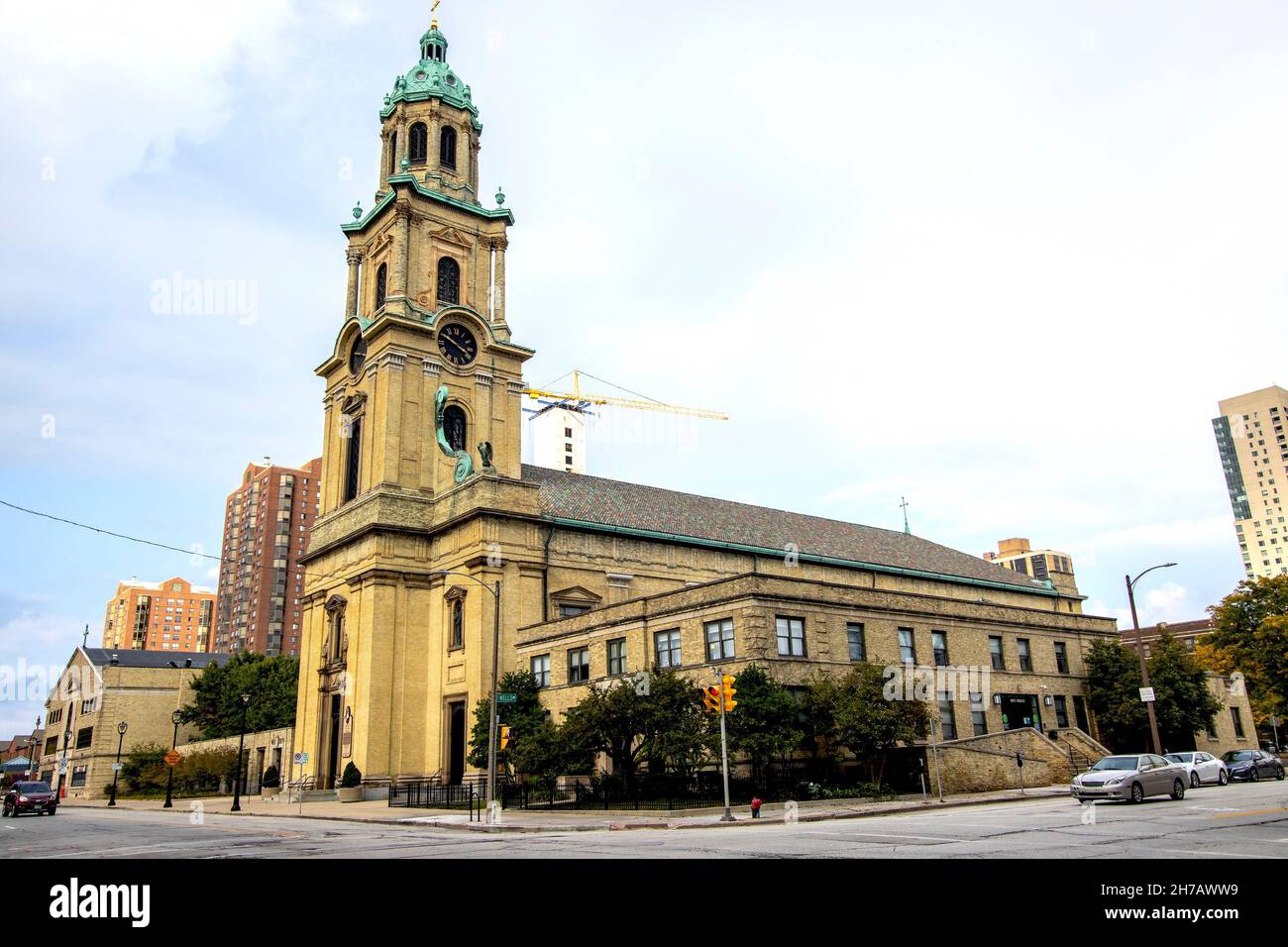
St. John the Baptist Church in Milwaukee marked its 85th anniversary Sunday with a volunteer appreciation luncheon honoring a year that brought two diocesan gatherings to Wisconsin for the first time.
The parish hosted the Diocesan Clergy Conference and the Diocesan Assembly this spring, drawing hundreds of Armenians from across the United States to a city many had never visited.
Those events and the annual Armenian Fest relied on volunteers from the congregation and the wider community.
Pastor Fr. Guregh Hambardzumyan opened the anniversary morning with a requiem service for two dozen clergy connected to St. John, along with dozens of godfathers, benefactors and members. “St. John is a spiritual home where faith, family and friendship has been strengthened,” Fr. Guregh said during the luncheon. “Each event of the past year required cooperation and commitment, time, energy and enthusiasm.”
Parish council chair Lyle Dadian echoed that sentiment. “As our parents taught us, for anything good in life, you have to work for it and nurture it,” Dadian said. “That goes for this community. The light that was established here by Genocide survivors is still burning bright. Our responsibility is to pass that light on to new generations.”
Ramelann Kalagian, speaking for the hospitality committee, cited St. Peter’s epistle on using one’s gifts to serve others. “This year we truly understood that phrase,” she said, singling out the Diocesan Assembly Committee, the parish council and the Armenian Fest committee, and noting Fr. Guregh’s central role.
The celebration concluded with a presentation by Adam Kablanian, an Armenian American entrepreneur who in 2017 shifted focus to reviving wine production in Armenia. His company, Alexandrea Wines, operates from vineyards in three provinces. According to Kablanian, Armenia sits inside the “Golden Parallel,” a band of terrain whose soil, climate and sunlight are tailor‑made for viticulture. Armenia was one of the earliest sites for wine production in the ancient world.
During the Soviet era, central planners channeled Armenia’s grape harvest into cognac while assigning wine production to Georgia. Since Armenia’s independence, wine production has flourished once again. Kablanian’s approach was to grow native Armenian grapes such as Voskehat, Areni, and Sireni together with internationally recognized varieties including Chardonnay, Pinot Noir, Riesling, Muscat, Cabernet Sauvignon, Cabernet Franc, Petit Verdot, Merlot, Malbec, and Syrah.
Oscar Tatosian, Honorary Consul of the Armenian Republic in Chicago, helped facilitate Kablanian’s presentation and the wine-tasting that followed.
- Mavericks vs Nuggets: Tied Teams Meet for NBA Cup Group A Edge on NBC, Peacock
- William P. Plunkett Jr., 66, of Mechanicville, Dies After Brief Illness
- Global Rights Groups Urge Pakistan to Free Idris Khattak on Seventh Anniversary of Detention (world-today-news.com)
- Manchester study finds nine per cent of volunteers had silent heart attacks (newsarchyuk.com)
Mavericks vs Nuggets: Tied Teams Meet for NBA Cup Group A Edge on NBC, Peacock
The Dallas Mavericks and Denver Nuggets meet Tuesday at Ball Arena with the NBA Cup West Group A...

William P. Plunkett Jr., 66, of Mechanicville, Dies After Brief Illness
William P. Plunkett, Jr., 66, of Mechanicville, died Friday, November 20, 2026, after a brief illness, New Comer...
Alabama Singer Ingrid Felts Returns With All-Star Studio Team on New Single “Widen The Lens”
“Ooh, she’s disgustingly talented!” Ingrid Felts said of mixer Trina Shoemaker. The Huntsville singer-songwriter releases “Widen The Lens”...

Scholars Examine Jefferson’s Legacy and Generational Sovereignty
James Parton declared in 1874 that Jefferson and America stood or fell together, a claim that has polarized...