
That persistent ache in your lower back might have less to do with how many crunches you skip and more to do with the ratio of muscle to fat tucked behind your abdominal wall, according to a massive imaging study published Wednesday in PLOS Digital Health.
Researchers at Stanford University used a deep-learning model to analyze more than 33,500 routine abdominal CT scans from 23,508 patients, creating what is likely the largest investigation of its kind. They found that people diagnosed with low back pain had virtually the same total abdominal muscle volume as matched controls without pain — but a statistically lower ratio of muscle to total abdominal fat.
“We were surprised that our low back pain group did not have less overall muscle than the controls,” said Kathryn Marusich, a mechanical engineer at Stanford University and lead author of the study. “This finding doesn’t dismiss muscle as unimportant, but it does underscore the complexity of low back pain and how any differences in muscle size may be more localized.”
The results upend a common clinical assumption: that weak or atrophied core muscles are a primary driver of back pain, and that bulking them up is the fix. Instead, the data suggest body composition — specifically the balance between muscle and adipose tissue in the abdomen — may be a more relevant marker than muscle mass alone.
The research team, which included scientists from Stanford's Department of Orthopaedic Surgery, used a dataset of patients who underwent clinical CT scans for unrelated reasons — a method known as opportunistic screening. From that pool, they identified 2,622 patients with a low back pain diagnosis in their electronic health records and matched them with 2,577 controls by age, sex, and body mass index.
Using a validated deep-learning algorithm, the model segmented skeletal muscle, visceral adipose tissue (fat surrounding organs), and subcutaneous adipose tissue (fat under the skin) at the L3 vertebral level. The muscle cross-sectional area normalized to height squared showed no significant difference between groups: 45.9 cm²/m² for the low back pain cohort versus 46.2 cm²/m² for controls (p=0.0865). The ratio of visceral to subcutaneous fat also did not differ (p=0.792).
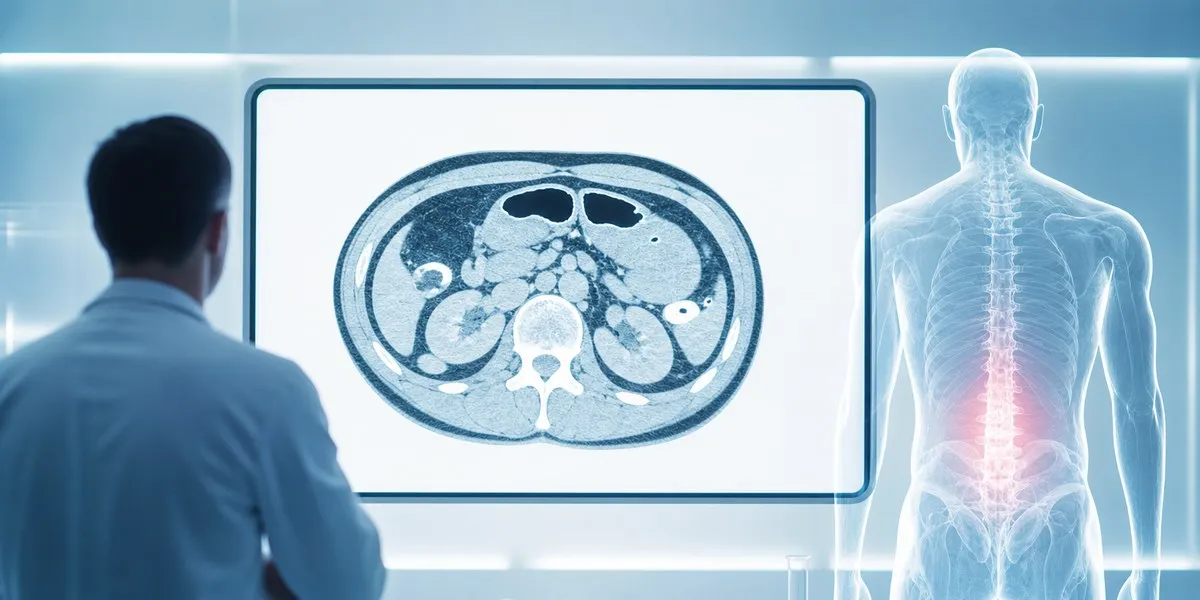
But the ratio of muscle to total abdominal fat told a different story. The low back pain group averaged 0.353 compared to 0.376 in controls — a statistically significant gap (p<0.0001), though the effect size remained small (eta squared = 0.004).
Headlines linking “beer bellies” to back pain risk oversimplify the findings. The study matched participants by BMI, meaning the low back pain group wasn’t heavier overall — they simply carried a different distribution of tissue within the abdomen. As ScienceAlert put it, even at the same BMI, participants with back pain “may not have had the same muscle-to-fat ratio in their abdomen.”
That distinction matters. The study found no difference in the visceral-to-subcutaneous ratio between groups, suggesting the total adipose burden relative to muscle — not its specific depot — correlates with pain status.
The study authors wrote in their discussion that body composition may be more important for lower back pain than the sheer strength of the core, emphasizing that CT scans capture quantity, not quality or neuromuscular control of muscle.
Low back pain is the leading cause of disability worldwide, affecting up to two-thirds of adults at some point, according to Cleveland Clinic data cited by ScienceAlert. As many as 90 percent of cases have no identifiable structural cause — no fracture, infection, or acute strain — making treatment notoriously difficult.
Current guidelines often prescribe core stabilization exercises on the premise that stronger deep trunk muscles protect the spine. But if bulk muscle volume doesn’t differentiate pain sufferers from pain-free individuals, the rationale for generic strengthening programs weakens. The authors argue future research should examine individual muscles — the multifidus, psoas, transversus abdominis — and regional changes rather than aggregate volume.

“On average, the low back pain group had a significantly lower ratio of muscle to abdominal fat,” the authors concluded in the paper.
The study’s cross-sectional design cannot determine directionality. Does a lower muscle-to-fat ratio predispose someone to back pain? Does chronic pain lead to metabolic changes that shift body composition? Or do both stem from a third factor — sedentary behavior, systemic inflammation, or genetic predisposition?
The researchers acknowledge the limitation. “CT scans do not provide a complete assessment of muscle strength,” the authors cautioned. “The results indicate that greater abdominal muscle volume does not guarantee protection against pain,” researchers said.
What the study does provide is a methodological proof of concept: deep learning can extract population-level body composition metrics from routine scans at a scale 25 times larger than prior imaging studies. That opens the door to longitudinal tracking — watching how muscle and fat ratios shift over years in the same patients, and whether those trajectories predict pain onset or resolution.
Stanford University, founded in 1885 by railroad magnate Leland Stanford and his wife Jane in memory of their son, admitted its first students in 1891 as a coeducational, non-denominational institution. Provost Frederick Terman catalyzed an entrepreneurial culture after World War II that helped give rise to Silicon Valley, and in 1951 the university established Stanford Research Park, the world’s first university research park.
Classified among “R1: Doctoral Universities – Very high research activity,” Stanford operates seven schools on an 8,180-acre campus, one of the largest in the nation, and houses the Hoover Institution, a public policy think tank. As of 2021, the university employed 2,288 tenure-line faculty, senior fellows, center fellows, and medical faculty.
The paper, “Deep learning reveals relationships between muscle and adipose tissue and their associations with age, body mass index, and low back pain: A cross-sectional study in 10,835 subjects,” was published November 19 in PLOS Digital Health.

Warren Spector Calls GTA 6 Model Unsustainable, Cites $1B Cost
Deus Ex creator Warren Spector called Grand Theft Auto 6 a landmark achievement for the medium — then...

GTA 6 Breaks Records as Sales Top $2bn
Take-Two Interactive's Grand Theft Auto 6 generated an estimated $2.36 billion in revenue on its first day, according...
Study: Creatine Use Nearly Doubles Among U.S. College Students
A new study tracking nearly 40,000 U.S. college students found that lifetime use of creatine supplements nearly doubled...

Indonesia Stands to Add $15 Billion in New Investment Pledges on Friday
Indonesia stands to add $15 billion in new investment pledges on Friday, pushing the total commitments secured at...