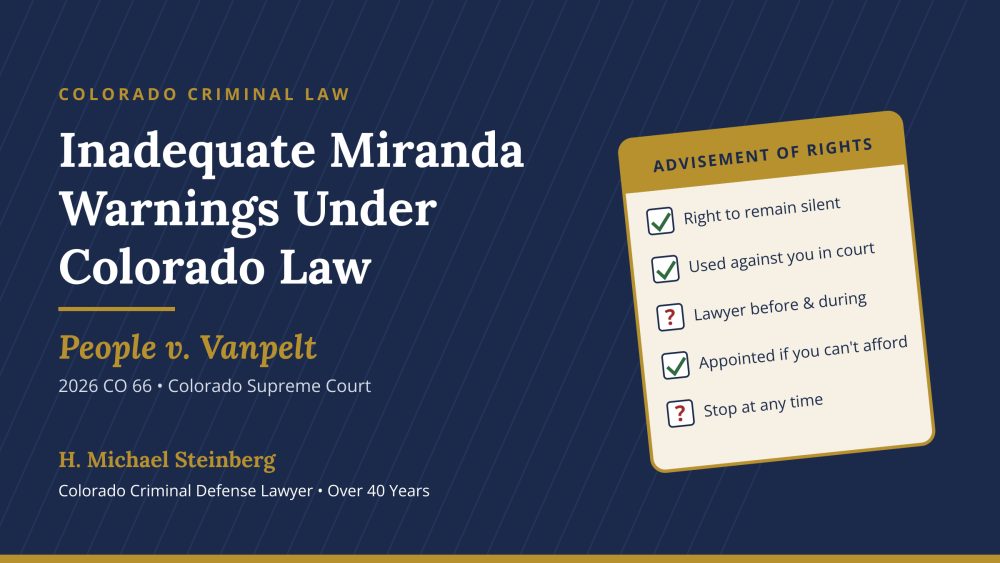
An inadequate Miranda warning does not automatically lead to the suppression of a statement in a Colorado court under People v. Vanpelt, according to legal analysis published by Colorado criminal defense lawyer H. Michael Steinberg.
In the October 12, 2026 decision in People v. Vanpelt, 2026 CO 66, the Colorado Supreme Court held that statements and a written apology letter given during a 75-minute jail interrogation remained voluntary even though the prosecution conceded a Miranda violation.
When evaluating statements made to law enforcement, a Colorado judge works through a four-question framework: whether the suspect was in custody, whether there was an interrogation, whether the warning was legally adequate, and whether the statement was voluntary. According to Steinberg, a “no” at each step leads to a different result, and a Miranda violation is distinct from a coerced confession.
“The police never read me my rights,” Colorado criminal defense lawyer H. Michael Steinberg said.
If the answers to the first three questions establish a yes-yes-no pattern, the prosecution generally cannot use the statement in its case-in-chief. However, if the statement was voluntary, prosecutors may still use it to impeach a defendant who testifies at trial. Only an involuntary, coerced statement is barred from use for every purpose under the law.
The Fifth Amendment guarantees that no person shall be compelled in any criminal case to be a witness against himself, a principle supported by the procedural safeguards established in Miranda v. Arizona (1966) and affirmed as a constitutional rule in Dickerson v. United States (2000).
Furthermore, the Colorado General Assembly passed House Bill 23-1155 in 2023, codified at C.R.S. § 16-3-406, which embeds five specific Miranda advisements into state law and places the burden on the prosecution to prove a valid waiver.

P2P Cheyenne Shootout Youth Wrestling Tournament Set for Dec. 5 in Wyoming
Youth wrestlers will hit the mats in Wyoming on Saturday, December 5, 2026, for the P2P – Cheyenne...
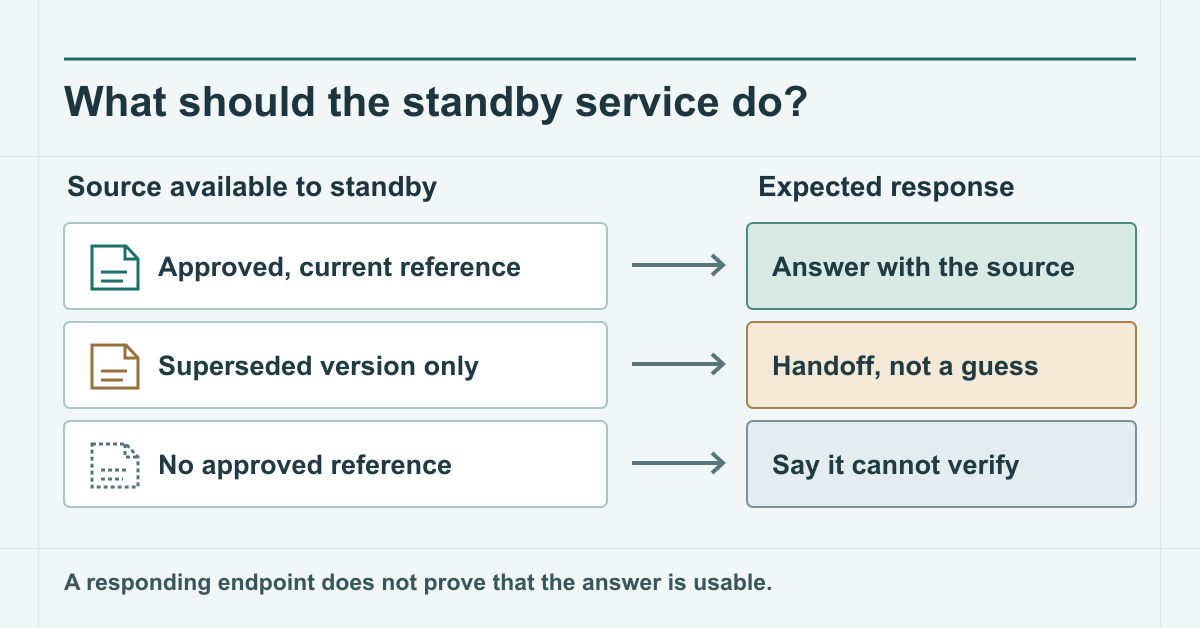
Percepture: Testing Standby AI Inference Requires Validating Answers, Not Just Endpoints
Organizations testing standby AI inference services can discover that functional endpoint responses often mask underlying failures, such as...

Puro.earth Issues 280,449 CO₂ Removal Certificates to ADM for Nebraska CCS Project
Helsinki-based carbon crediting platform Puro.earth issued 280,449 CO₂ Removal Certificates to agricultural processor ADM for its Columbus CCS...

Aubameyang Relishes Barcelona Reunion, Says He Likes High Defensive Lines
Pierre-Erik Aubameyang is relishing a sentimental yet high-stakes reunion with his former club Barcelona this weekend at the...