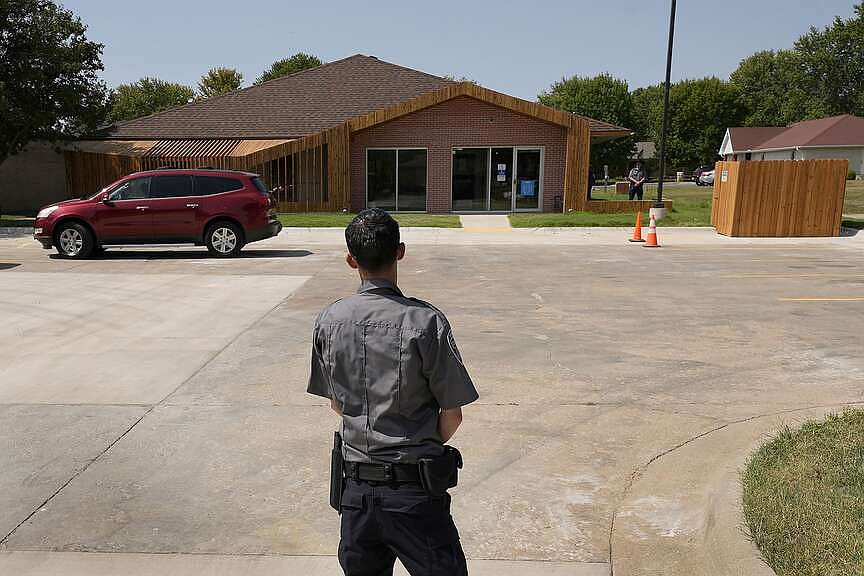
“That’s not how healthcare should work,” said Emily Wales, president and CEO of Planned Parenthood Great Plains.
A lawsuit challenging Arkansas’ near-total abortion ban advanced this month after a Pulaski County judge refused to dismiss claims against the attorney general, state medical board members and three prosecutors, NWAonline reported. Emily Waldorf was 17 weeks pregnant in September 2024 when she was diagnosed with cervical insufficiency. Her water broke after four days in the hospital. She asked to be induced but was told the ban allowed only observation until she was sick enough for the life-of-the-mother exception to apply, she said. She never requested an abortion. After retaining an attorney and calling the governor’s office — which told her to get a lawyer — she was transferred to Kansas City. There she was induced, hemorrhaged and her baby did not survive. She blames the delay. Theresa Van learned at her 20-week scan in 2023 that her daughter Cielle would not survive. With no amniotic fluid, she was told she must carry the pregnancy seven more weeks because nothing could be done in Arkansas, and the lawsuit states the hardest part was grieving Cielle while she was still moving and living inside her. Pulaski County Circuit Judge Cara Connors dismissed Gov. Sarah Sanders and the state as defendants but let the case proceed against the remaining parties. Attorney General Tim Griffin filed a notice of appeal to the Arkansas Supreme Court seeking dismissal. On Nov. 19, defendants sought a stay pending that appeal, arguing qualified immunity. Plaintiffs argue the law is unconstitutionally vague. During a September hearing, Connors said it seemed “impossible to know” whether certain medical decisions would be legal. State Solicitor General Autumn Patterson pointed to Act 387 of 2025, which amended the ban to define a medical emergency using the “reasonable medical judgement” of a “reasonably prudent, qualified physician,” and Connors noted the standard could ultimately be weighed by “a jury full of people, not medical professionals.”
The key finding, she said, is that broad, medically inaccurate language in the laws is affecting evidence-based care for pregnant women. “There are these collateral impacts that the bans are having beyond just stopping someone from going to a clinic because they’re seeking abortion care,” White said. The March of Dimes gave Arkansas an F for its 2025 preterm birth rate of 11.9%, nearly two points above the national average. The 2024 infant mortality rate was 8.3% versus a national 5.5%, with 293 babies dying before their first birthday. Pulaski County’s preterm rate was 14.1%; Sebastian County’s was 10.7%. Benton County earned an A-minus at 8.1%; Washington County a B-plus at 9%. Gov. Sanders’ spokesman Sam Dubke did not answer emailed questions about the ban’s impact on complicated pregnancies.
He repeated a prior statement highlighting the Arkansas Strategic Committee for Maternal Health, established March 2024, and the Healthy Moms, Healthy Babies Act signed February 2025, which directs $45 million annually to maternal and infant health including presumptive Medicaid eligibility, doula reimbursement, remote monitoring, unbundled pregnancy payments and a 70% increase in delivery reimbursements. According to the Guttmacher Institute, 7,570 Arkansans traveled out of state for abortion services from 2023 through 2025, with 65% going to Illinois and 30% to Kansas. Planned Parenthood clinics in Little Rock and Rogers still provide contraception, STI testing, wellness visits and pregnancy consultations.
“Partisan politics has tried to put abortion in the crosshairs and say that it’s a hugely divisive issue,” Wales said. “And people do have nuanced opinions about abortion, but one thing that seems to be pretty universal is that folks want to make those decisions on their own without being told by the government when care is OK and when it’s not. That should be left to providers and patients and nobody else.”
Keep reading
Witten Leads 4-0 Finish; Venables Declines to Name Him OC
Oklahoma rallied from a 20-0 first-half deficit to beat No. 23 Missouri 34-31 on Saturday in Columbia, completing...

UCF Knights, Colorado Buffaloes Meet in Regular-Season Finale at Folsom Field
Colorado Buffaloes host UCF Knights at Folsom Field on Saturday in the final regular-season game for both teams,...
Gold Boom Fuels Tuberculosis Outbreaks Across Three Continents
There's a TB boom as well as a gold boom, said Chris Kuksa, a nurse in a Papua...

Supreme Court to Hear Challenge to State AR-15 Bans Dec. 2
The Supreme Court will hear arguments Dec. 2 in a pair of cases challenging state bans on AR-15-style...