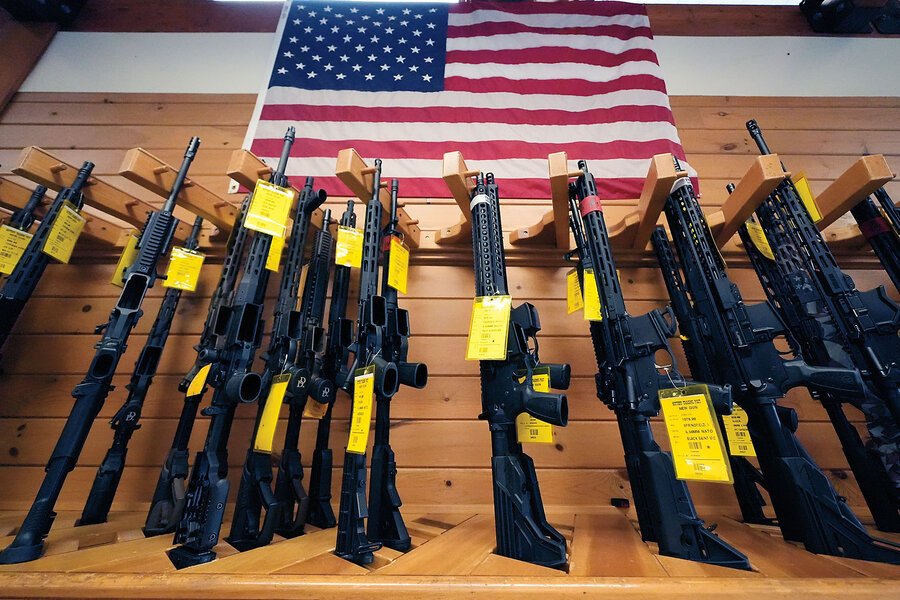
The Supreme Court will hear arguments Dec. 2 in a pair of cases challenging state bans on AR-15-style rifles, a ruling expected in June 2027 that could reshape gun laws nationwide. The cases test whether Connecticut’s ban, expanded after the 2012 Sandy Hook shooting, and a similar Cook County, Illinois law violate the Second Amendment under the court’s new historical-analogue standard.
Members of the Connecticut Citizens Defense League gathered at a Veterans of Foreign Wars hall in New Britain this week to plan a “listening party” for the Dec. 2 arguments.
The group’s case, Grant v. Higgins, argues the state’s assault weapons ban is unconstitutional. President Holly Sullivan framed the stakes: “At what point does public safety outweigh the constitutional rights of citizens? How much power does the state feel it has over you?”
Historical analogue test
The Supreme Court now requires new gun laws to be grounded in “historical analogue,” including America’s history and tradition of firearms regulations. That standard, set by the 2022 Bruen ruling, makes finding regulatory precedents from the musket era a tall order for states defending bans on modern semiautomatic rifles.
“If we’re only looking at the laws in the 1700s and 1800s, it’s going to be hard to find an analogy,” said Adam Winkler, a gun policy expert at UCLA School of Law.
The Justice Department has backed the CCDL challenge, and a government lawyer will argue in support of the plaintiffs before the Supreme Court. “By some miracle, the Supreme Court chose us,” Sullivan said. “Now we are in the fight of our lives.”
Weapons at issue
AR-15s and similar rifles are semiautomatic, firing one shot per trigger pull. While machine guns discharge multiple rounds per trigger pull and face heavy regulation, AR-15s remain broadly accessible across much of the nation and are compatible with large-capacity magazines. By industry estimates, as many as 30 million AR-15-style rifles have been produced for the U.S. market since 1990. In at least 10 of the 17 deadliest mass shootings since 2012, such rifles were used, including at Sandy Hook, where a shooter fired 154 bullets in about five minutes, killing 26 people, most of them children.
Research released in September showed assault-style weapons accounted for 36% of mass public shootings in the 2010s and 60% so far this decade, up from roughly 20% in earlier decades.
Robert Spitzer, author of “Guns Across America,” said the rifles “are the increasingly favored weapons of people who commit mass shootings; they are more likely to be used to kill law enforcement; and they are special favorites of extremist groups, political groups, and drug-gang types.”

Shifting public opinion
A November Gallup poll found 54% of Americans favor an assault-style rifle ban, down from 61% in 2019. “Firearms and rifles have always been part of the American psyche,” said Grant Reeher, a political scientist at Syracuse University’s Maxwell School of Citizenship and Public Affairs.
“The AR-15 is the newest version of that.”
Meanwhile, U.S. gun violence has declined, with homicide rates falling sharply since 2021, including a record 18% drop between 2024 and 2025, a trend that has continued this year.
Connecticut’s evolution
Connecticut embodies the national divide. The Hartford skyline features a blue dome from the historic Colt weapons factory; Smith & Wesson, Winchester, and Remington also manufactured arms in the state. On Dec. 13, 2012, then-Gov. Dannel Malloy celebrated the legacy of Hartford’s Colt firearms factory and local preservation efforts. In Hartford,” he told a crowd. Malloy later vowed to expand the assault weapons ban: “I’m a big believer in hunting rights, a big believer in supporting the Second Amendment. But there is a reality that this stuff has gone too far and is too easy to own.”
Today, thick gates protect the new Sandy Hook Elementary School. A memorial etched with victims’ names surrounds a pool near the site.
Nicole Hockley, whose son Dylan died in the shooting and who co-founded Sandy Hook Promise, said: “The question is whether the bulk of Americans think that protecting their right to own a weapon is more important than protecting their own child. This is not about taking away guns. It’s purely talking about weapons accessibility, meaningful regulation, and honoring states’ rights.”
President Holly Sullivan said the organization’s tens of thousands of members view the case as “the fight of our lives,” noting the Justice Department has backed the challenge and a government lawyer will argue in support of the plaintiffs.
The Connecticut Citizens Defense League has a litigation history spanning more than a decade: it filed Shew v. Malloy in 2013 immediately after Connecticut passed SB1160, petitioned the Supreme Court in 2016 after losing in the Second Circuit, and refiled as Grant v. Lamont (later Grant v.
Federalism as middle ground?
Spitzer suggested the court may seek a middle ground: “One remedy would be to let federalism be federalism. It’s also true that courts have upheld bans on other unusually dangerous weapons, including Bowie knives, which could serve as precedents for modern gun laws.”
More on Supreme Court

Nevada Voters Approve Voter ID Amendment as California Rejects Similar Measure
Nevada voters approved a constitutional amendment requiring photo identification for in-person voting, while California voters rejected a similar...

2025 Vermont Climate Assessment Warns of Increasing Flood Risks and Vulnerability
The University of Vermont's Gund Institute for Environment published the 2025 Vermont Climate Assessment in October, warning that...

Yamada Makes BSO Debut With Ravel, Gershwin, Respighi at Symphony Hall
Japanese conductor Kazuki Yamada made his Boston Symphony Orchestra debut Friday at Symphony Hall, leading a program of...

Action Network: Arsenal Host Man City With Six-Point Lead, -105 Moneyline
Arsenal host Manchester City at Emirates Stadium today at 11:30 a.m. EST with a six-point Premier League lead...