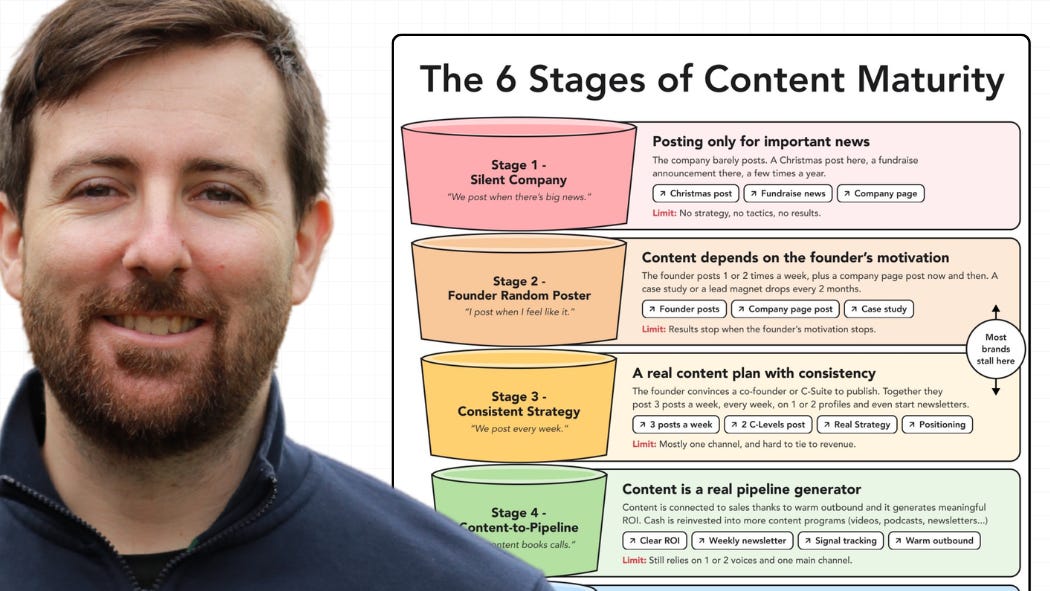
Content maturity for B2B brands often stalls because companies rely on sporadic, founder-led updates rather than a systemic distribution engine. According to Pierre Hérubel’s content guides, most organizations remain trapped at early stages by failing to connect their creative output to a measurable sales pipeline or a sustainable production workflow.
The Trap of Occasional Publishing
Many businesses treat content like a seasonal event rather than a continuous business function. This “Stage 1” approach typically involves a company page that only wakes up for major announcements—a fundraise, a holiday greeting, or a new project launch. Because these posts happen in isolation, they rarely build an audience or a consistent feedback loop.
Hérubel notes that the primary bottleneck here is a lack of strategy. When a company waits for “big news” to speak, it fails to educate the market on the problems it solves. To move past this, businesses must shift from sporadic company-page updates to consistent, founder-led publishing. Posting one or two times a week on a personal profile creates the habit necessary to build authority, moving the brand out of the silence of occasional updates.
The Dependency on Individual Motivation
Once a founder begins posting consistently, they often hit a second barrier: the “motivation trap.” In this stage, content volume is tied entirely to one person’s calendar and mood. When the founder gets busy or loses interest, the content stream dries up.
This creates a volatile cycle where a company might post twice a week for a month and then disappear for three weeks. To fix this, firms need to build a “minimum viable system.” This involves moving beyond raw motivation by establishing a structured content plan that prioritizes strategy over the chase for viral hits. Adding a second person to the content workflow is often the most effective way to ensure longevity, as it introduces accountability and provides a source of inspiration for long-form content that can be repurposed into shorter posts.
Connecting Content to Revenue Streams
Even when a company manages to get C-level executives to post weekly, they often remain stuck because the content is not integrated with their sales system. Without a clear link between posts and revenue, it becomes impossible to justify the investment in higher-quality production.
At this stage, the goal is to bridge the gap between engagement and conversion. When a brand can track how content facilitates calls or warms up prospects for outbound outreach, it gains the internal data required to scale. Scaling, however, requires more than just volume; it requires a system for ideation. As Hérubel observes, relying on a single person to create every piece of content from scratch is a ceiling that eventually forces a plateau in quality and creativity.
Moving Toward a Media-Company Model
The final stages of maturity involve moving from simple distribution to a full-scale content engine. By the time a brand reaches Stage 5 and Stage 6, it is no longer just producing posts; it is operating like a media company. This involves centralized distribution, where a single idea is repurposed across newsletters, podcasts, and video channels to maximize reach.
This level of maturity is characterized by a “creative cell”—a team or a structured process dedicated to testing new formats constantly. It is the point where a company’s content is so well-integrated that it becomes a primary driver of business growth. However, this structure remains fragile. Even at the top, the risk of regression is constant. If a company stops investing in new formats or fails to maintain the rigor of its distribution, it can easily slide back into the inefficiencies of the earlier stages.
The transition from a hesitant, sporadic publisher to a category leader depends entirely on whether the organization can treat content as a core business infrastructure rather than an afterthought.
Related reading

Iowa 2026 Election Analysis: Rob Sand and Josh Turek Lead Democratic Wave
Iowa’s Political Map Shifts as Democrats Break the Trifecta The Iowa political landscape underwent a seismic transformation this...

Convicted Former Senator Nicole Mitchell Wins Woodbury City Council Seat
Nicole Mitchell Wins Woodbury City Council Seat Following Felony Conviction Former Minnesota state senator Nicole Mitchell has secured...

SCAQMD Air Pollution Control Rules and Regulations Guide
Updating the Regulatory Blueprint for California Air Quality When it comes to the complex machinery of environmental oversight...

Jalen Brunson Makes Law & Order SVU Cameo as Detective Madison
Jalen Brunson Trades the Hardwood for the Precinct in SVU Cameo New York Knicks star Jalen Brunson made...