When the Ladies Rode at Boucher’s Woods
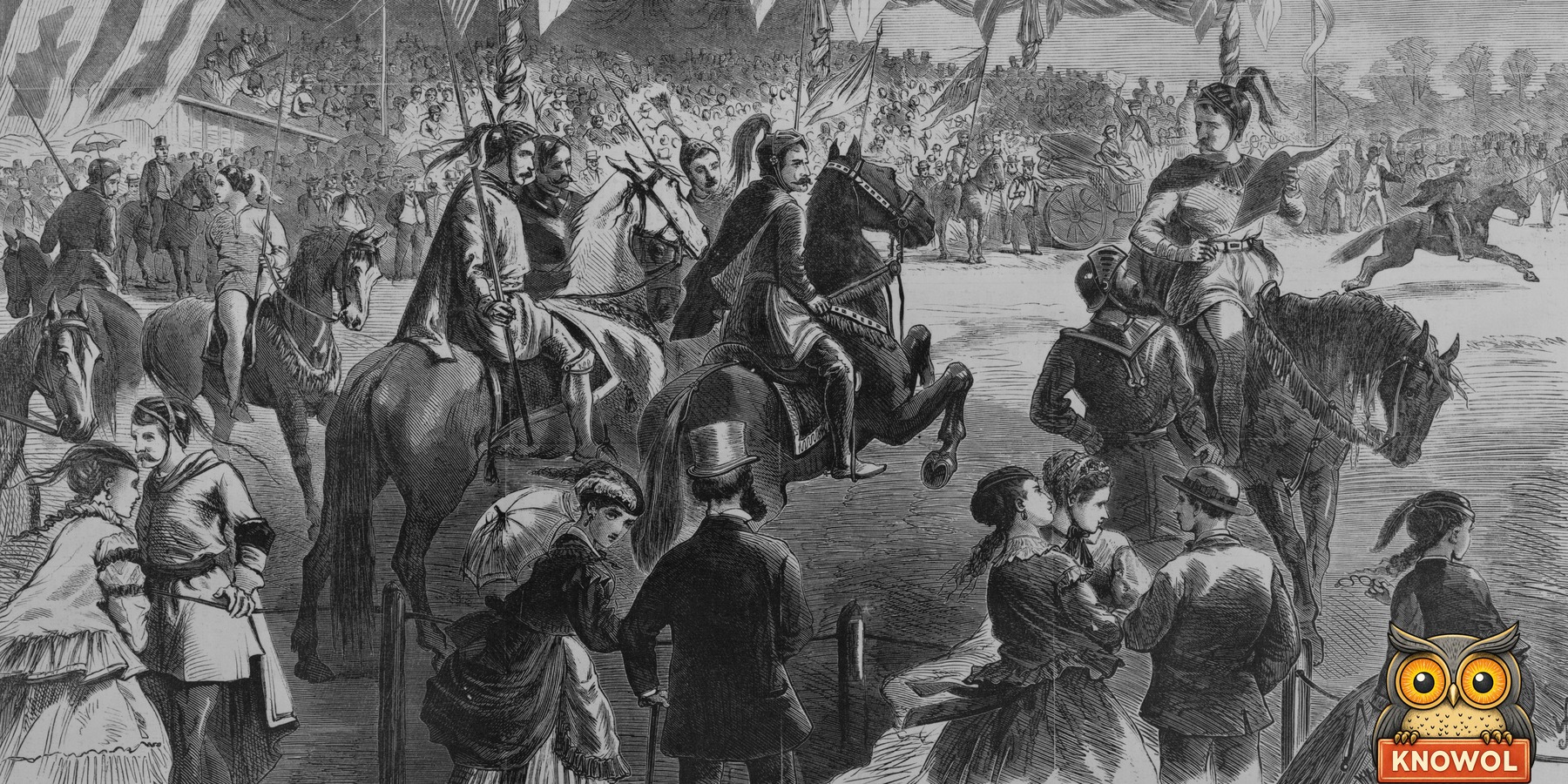
Shortly after ten o’clock on the morning of Monday, October 23, 1905, Sheriff Samuel B. Hardy shouted a command across Boucher’s woodland in Annapolis, Maryland, and the first rider galloped off with his lance. It was the start of the Elks’ big tournament, a regional spectacle that drew crowds out onto the shell roads and down to the grounds at Boucher’s-on-the-Spa. That afternoon, The Evening Capital reported that gallant men rode to the call of Chief Marshall Hardy, but a few local women did much more than simply look on from the sidelines.
A Maryland tournament wasn’t a fight. Each rider, called a knight, took a name and galloped down a course marked by decorated arches from which hung rings to be lanced. The Maryland ring tournament opened its ranks to women that autumn. Drawing from The Evening Capital archives preserved by the Library of Congress in Chronicling America.
The stakes were modest. While top professional men competed for cash prizes of $15, $10, and $5, the prizes for the ladies would be a riding whip, riding bridle and riding hat. Admission to the grounds cost 25 cents, and the community turned out in force to watch the spectacle unfold beneath arches draped in the colors of the Star-Spangled Banner and the yellow and black of the Maryland flag.

From Davidsonville to Annapolis
The path to the Annapolis tournament began weeks earlier in Davidsonville, where a Modern Woodmen fundraiser featured an afternoon of riding for local women. Organizers advertised a full day of country dining with oysters, cake, ice cream, a baseball game that ran until dark, and a fortune wheel. While local reports detailed the men’s outcomes that day, they left the women’s results unrecorded.
That omission was corrected when the Annapolis Elks, Lodge No. 622, planned its own tournament for October. A contingent of women from Davidsonville agreed to enter the contest. On October 17, The Evening Capital named three competitors and their chosen monikers:
- Miss Ethel E. Duckett, “Knight of Hiawatha”
- Miss Miriam Beall, “Knight of Blue Bell”
- Miss Pearl F. Duckett, “Knight of Dixie Girl”
By tournament morning, public anticipation had shifted decisively toward the afternoon events. The paper reported that interest centered squarely on the lady riders, many of whom were widely regarded as experts in the saddle. When the men finished their morning runs—highlighted by Charles E. Myers, the Knight of Cherry Grove, who swept his course without missing a single ring—the afternoon belonged entirely to the women.
The Results of the Ring Course
Only three women ultimately contested the ladies’ class, yet The Evening Capital labeled it the greatest attraction of the day’s sport. Competitors galloped their horses down a marked course through three decorated arches, attempting to spear rings with a long lance. When the dust settled, Miss Ethel E. Duckett, Lady of Hiawatha, was first among the lady riders, with three rings out of the nine. Miss Mary Stallings, the Lady of Navajo, matched her but was defeated in the ride-off, and Pearl Duckett, the Lady of Dixie Girl, took two.
One notable change marked the day’s official schedule. The crowning of the queens was dropped, decided that afternoon just before the coronation speech, with local newspapers offering no explanation for the cancellation. Despite the sudden adjustment, the evening dance at Boucher’s proceeded as planned with more than 300 people in attendance.
An Era of Twenty-Five Cent Entertainment
The tournaments offered accessible recreation during an era when daily goods and amusements carried remarkably different price points. A quarter covered admission to the grounds, matching the cost of a dozen fresh country eggs or a pound of Elgin creamery butter down at the City Market House, where the Grand Union Tea Company had recently opened a stand. Sugar sold for 5½ cents a pound, and patrons at the Colonial Theatre—managed by W. A. Hollebaugh, one of the men who ran the Elks’ tournament—could watch Biograph moving pictures for 10, 20 or 30 cents a seat.
In 1962, Maryland made jousting its official state sport. Yet long before state designation or modern revivals, three women saddled their horses on an October afternoon in Annapolis, rode down a course hung with bunting, and proved their skill before a cheering town.
Worth a look

Jeffery Simmons Arrival Fails to Fix Chicago Bears Secondary Flaws
The Chicago Bears are sitting at 5-2, and general manager Ryan Poles has just acquired Jeffery Simmons to...
Adrian Martinez Arrested After Threatening Deputies in Idaho Falls
Adrian Martinez Arrested After Basement Standoff in Idaho Falls An early morning call to an Idaho Falls home...

Minot State defeats Hawaii Pacific 71-70 in tournament semifinal
The Minot State men's basketball team erased an 11-point halftime deficit to defeat Hawaii Pacific 71-70 at McCabe...

Will Packer Starts Rattler Freedom Fund to Support Florida A&M
“I’m in a unique position because I work in Hollywood. I’m not in front of the camera, but...