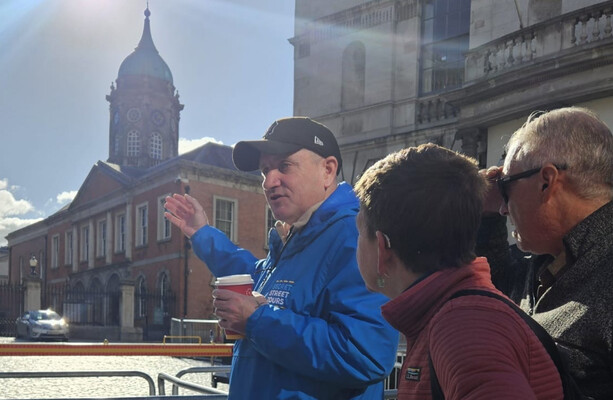
Kenny Eivers, a recovering addict and former homeless resident of Dublin, leads “Secret Street Tours” to reveal the city’s hidden layers of addiction and poverty alongside its famous landmarks. These tours shift the narrative of homelessness by employing guides who have lived experience in the city’s hostels and clinics, offering tourists a raw counter-narrative to the polished facade of Irish tourism.
The tension here is classic Dublin: the juxtaposition of high-culture prestige and systemic struggle. On any given Sunday, you’ll find tourists sipping croissants at Chez Max near Dublin Castle while, just a few yards away, the architecture of survival—methadone clinics and emergency hostels—sits in plain sight. For the American traveler, this isn’t just a walking tour; it’s a lesson in the “patchwork city,” where the legacy of the Guinness family and the literary ghosts of Jonathan Swift coexist with the modern reality of the opioid crisis.
The Business of Narrative Control
Secret Street Tours was founded in late 2018 by Tom Austin, a Trinity College Dublin graduate who drew inspiration from similar models in Vienna. The operational goal is precise: to provide guides with a mechanism to reclaim their own stories while creating a commercial channel for the public to engage with social issues. In the world of experience-based tourism, this is a pivot from passive sightseeing to active social commentary.
The financial stakes for the guides are personal. For Eivers, the transition from stealing cars to fund an addiction to leading educational tours represents a total brand pivot of the self. He began his first tour just before the Covid-19 pandemic paralyzed the live entertainment and tourism sectors, only to resume his work once lockdowns lifted. Now, his demographic quadrants include everyone from international tourists to secondary school students.
“I’m living proof that people can change,” Eivers says, as he begins his tour, which will take us around various locations on the south side of Dublin.
Dublin’s Architecture of Contrast
The tour operates as a living map of a life in recovery. Eivers doesn’t just point out the Gaiety Theatre or St Patrick’s Cathedral; he anchors the city’s history in his own rock bottom. A stop at a nondescript red brick building on the corner of Castle Street and Werburgh Street isn’t for the architecture—it’s the site of his former methadone clinic.
This creates a jarring, necessary rhythm for the visitor. One moment, the group is discussing the 1916 Rising in Stephen’s Green; the next, they are standing before the York House Hostel on Longford Street Little, where Eivers lived for nearly five years. It is a visceral reminder that the city’s struggling population often lives as “ghosts,” hiding in plain sight within the same blocks as high-end retail and government offices.

The Friction Between Art and Commerce
There is an inherent tension in commodifying the experience of homelessness for a paying audience. However, the model suggests that the exchange of capital for storytelling provides a dignity and agency that traditional charity does not. By turning his past into a professional asset, Eivers transforms his history of overdose and incarceration into a tool for advocacy.
The tour concludes at the statue of Sir Arthur Edward Guinness, a symbol of Dublin’s industrial wealth. It is a fitting end-point—a reminder that the city is built on both immense fortune and profound loss. As Eivers notes, while he cannot erase his past, he can use the current structure of the city to do good moving forward.
Related reading

James Gunn names Superman, Batman and Wonder Woman as DCU diamonds
James Gunn has confirmed that Superman, Batman, and Wonder Woman serve as the "diamond characters" of the new...

Barbara Barrie, Oscar-Nominated Breaking Away Actress, Dies at 95
Barbara Barrie, the Oscar-nominated actress whose career spanned Broadway, the Cannes Film Festival, and American television, has died...

Denise Fox learns Amy Mitchell was groomed by police officer
Denise Fox has finally learned the truth about Amy Mitchell's disappearance, discovering that her stepdaughter has been groomed...

Hannah Fry Explores AI Risks in The Future on BBC Two
Hannah Fry is returning to BBC Two with a second series of The Future with Hannah Fry, where...