
The Trump administration proposed new tariffs Wednesday on China, the European Union and 12 other trading partners, targeting what officials call excess manufacturing capacity fueled by foreign subsidies, The Washington Post reported. The duties, issued under Section 301 of the Trade Act of 1974, would replace sweeping tariffs the Supreme Court struck down in February.
The proposal covers China, the 27-member EU, Japan, South Korea, Taiwan, Vietnam, India, Indonesia, Thailand, Malaysia, Singapore, Bangladesh, Cambodia and Switzerland, according to the Office of the U.S. Trade Representative. Brazil was also singled out for higher sugar tariffs and a new 10 percent duty on aircraft that would hit Embraer, AP News reported. Mexico and Norway remain under investigation but were not included in Wednesday’s release.
What tariff rates are proposed
China faces a 20 percent rate that would stack atop existing 25 percent tariffs on certain tech and industrial goods from 2018, pushing the total to 45 percent on some products, The Washington Post and AP News reported.
The EU starting rate is 15 percent, capped under a 2025 bilateral deal, while other partners range from 10 to 18 percent, AP News said. If the U.S.-China trade truce expires on Jan. 10, 2027, the China rate could rise to 40 percent, a senior White House official told CNN.
| Trading partner | Proposed rate | Notes |
|---|---|---|
| China | 20% (up to 40%) | Stacks on 25% existing duties; total up to 45% on some goods |
| European Union | 15% (cap) | Capped under 2025 framework deal |
| Vietnam | 20% (pending talks) | Rate may adjust with negotiation |
| Japan, South Korea, Taiwan, others | 10–18% | Varies by country |
| Brazil | Higher sugar duties; 10% on aircraft | Targets Embraer; talks stalled |
Legal basis and process
The duties stem from a Section 301 investigation launched in March by U.S. Trade Representative Jamieson Greer into subsidies and other policies that create excess capacity, The Washington Post reported. Section 301 allows tariffs for four years, renewable after review. Before taking effect, the administration must complete a public notice-and-comment period and hold hearings, a senior official told CNN. The earliest effective date is January.
“When it all nets out, it really will just top up a few percentage points,” Greer said on CNBC, adding that rates would not exceed caps in existing bilateral deals, NBC News reported.
The forced-labor Section 301 tariffs of 10–12.5 percent on 60 countries remain in place unless the new excess-capacity rate is higher, The Washington Post noted. A legal challenge to those forced-labor duties is pending before the U.S. Court of International Trade.
Exemptions and carve-outs
The proposal exempts energy products such as oil and gas, food that cannot be grown in the U.S., critical minerals, fertilizers, and certain semiconductor chips and pharmaceuticals, The Washington Post reported. Existing duties on automobiles, steel and aluminum would not stack with the new rates, CNN reported.
Trading partners push back
China’s Commerce Ministry rejected the premise overnight. “So-called ‘overcapacity’ is a false proposition,” a spokesperson said. “China opposes using it as a pretext for political manipulation,” NBC News reported.
The European Commission said members “strongly reject the premise that Europe is a source of structural overcapacity” and regretted “the lack of joint action” with Washington, NBC News reported. Canada, not on Wednesday’s list, has traded barbs with the administration since talks collapsed in August, NBC News noted.
Political context after the midterms
The announcement comes three weeks after Democrats won House and Senate majorities in midterms where about two-thirds of voters said Trump’s policies made the economy worse, AP News reported, citing the AP Voter Poll. Inflation hit 3.7 percent in September, driven by energy and goods prices, NBC News reported. Democrats pledged to overturn the tariffs, but a veto-proof majority — 290 House votes and 67 Senate votes — would be needed to curb presidential trade authority, The Washington Post reported.
“This latest wave of tariffs will not lower costs, bring jobs home, or jumpstart production in the U.S. — but it will be another source of uncertainty for an economy that is already wobbling,” said Alex Jacquez, chief of policy and advocacy at the Groundwork Collaborative, in a statement to The Washington Post.
Some Republicans have also broken ranks. “Our tariff policy must be tied to clear objectives focused on protecting America’s economic and national security,” Sen. Todd Young posted on X after the election, CNN reported. Sen. Ted Cruz has also raised public concerns, CNN noted.
The Office of the U.S. Trade Representative, part of the Executive Office of the President and headed by a Cabinet-level ambassador, is the federal agency responsible for developing and promoting U.S. foreign trade policies and serving as the president’s primary trade advisor and negotiator.
With more than two hundred employees across offices in Washington, D.C., Geneva, and Brussels, it coordinates trade policy through interagency committees and leads negotiations at bilateral and multilateral levels, including at the World Trade Organization.
What happens next
USTR will publish the Federal Register notice, opening the comment period and scheduling hearings. Greer said he expects “a broad” negotiation with trading partners and does not believe any duties would take effect earlier than a couple of months from now, NBC News reported.
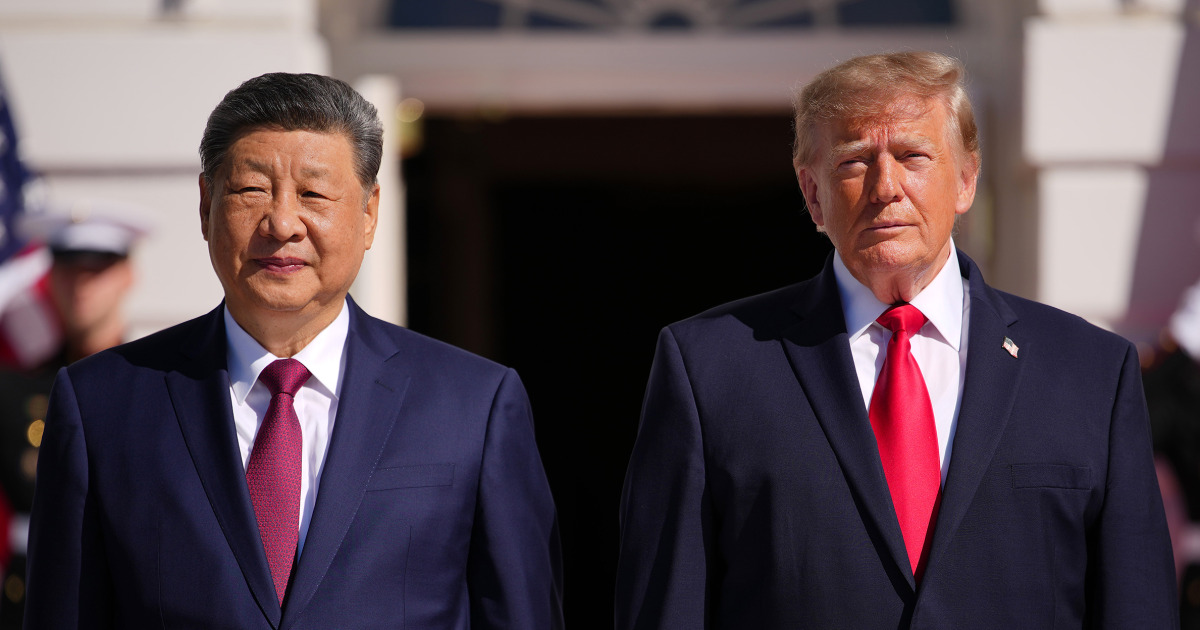
The U.S.-China trade truce expires Jan. 10, 2027. Trump plans to host Xi Jinping at the G-20 summit in Florida next month, where rare earths and agricultural purchases may be discussed again, AP News reported.
BREAKING: President Trump is preparing to impose "sweeping" new tariffs on China, the European Union and 14 other economies, per WSJ. The proposed tariffs will cover most imported products with the EU, Japan and South Korea set to face tariffs of 15% or less. China, Vietnam,…
Worth a look
- Kelvin Wave, King Tides and Storm Drive Record Coastal Flooding in California
- Wyoming Trans Woman Pleads to Misdemeanor, Keeps Gun Rights in Plea Deal
- Trump's Beef Quota Filled About 37% in Month One; Ground Beef Fell 13 Cents (daybreakwire.com)
- State Sen. Bob Hall Proposes Bill to End Tolls on Paid Roads, Ban New Toll Projects (archyde.com)

Kelvin Wave, King Tides and Storm Drive Record Coastal Flooding in California
"We're experiencing a very rare convergence of extreme astronomical, oceanographic and meteorological conditions," said Patrick Barnard, research geologist...

Wyoming Trans Woman Pleads to Misdemeanor, Keeps Gun Rights in Plea Deal
Rihanna Kelver, a transgender woman in Laramie, Wyoming, pleaded no contest Tuesday to a misdemeanor charge of reckless...

Newport Fugitive Asher Cottrell Arrested in Vineyard Haven Raid
Tisbury Police and Newport, Rhode Island officers arrested Asher C. Cottrell on Friday, Nov. 20, executing a “high-risk”...
Cubs’ Crow-Armstrong, Bears’ Williams, Bulls’ Buzelis Unite at Wrigley Field
Chicago Cubs outfielder Pete Crow-Armstrong and Bears quarterback Caleb Williams sat behind the home dugout at Wrigley Field...