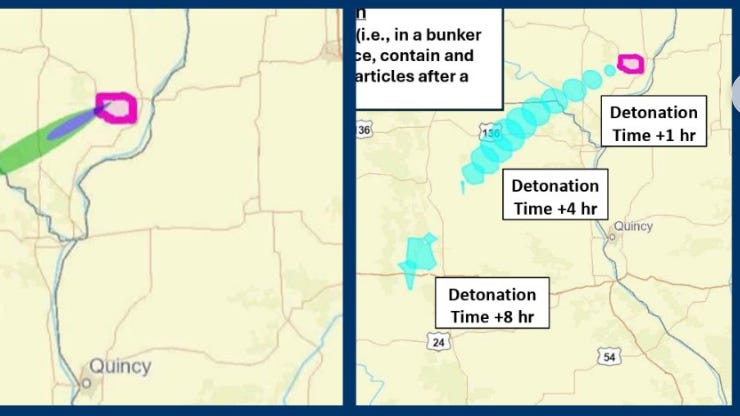
The U.S. Army will detonate roughly 9,500 pounds of unstable lead azide today near Middletown, Iowa, sending a plume of lead dust across southeast Iowa and into Missouri.
Your Local Epidemiologist reported that the explosive recrystallized in storage, becoming too unstable to move or treat, leaving open-air detonation as the only option. Lead is a neurotoxin with no safe exposure level; children absorb more than adults and face permanent harm to brain development, while prenatal exposure can cause miscarriage.
Communication failures
Residents near the storage site learned of degraded barrels in March. The Army held an open house in October with maps and engineers, but the predicted plume covers a far wider area. Lead dust could settle most heavily across 40 miles, while finer particles may spread to nearly 100 miles.
Models reversed direction days before the blast; maps issued November 24 showed the plume heading southwest into Missouri, contradicting earlier projections.
Many in the larger risk zone only learned of the threat when EPA permits arrived November 13. An evacuation notice followed two days later. The Iowa Department of Health and Human Services said in a fact sheet it learned of the issue only recently.
Risk context missing
Official communications offered expected lower limits for airborne lead — such as 0.18 µg/m³ — without context for what those numbers mean. Science communicators on social media compared the levels to a nearby fireworks display or an airport.
Derek Lowe, an organic and medical chemist, wrote that groundwater risk is minimal because lead binds tightly to soil and does not migrate to aquifers.
Corn and grain carry minimal risk; plants absorb little lead, and kernels tested below EU animal-feed limits even in highly contaminated soil. Root vegetables pose higher risk. Surface dust on yards and porches presents the most risk, especially for children and outdoor workers.
Cleanup standards unclear
The EPA plans to test air, water, and soil before, during, and after detonation and post results. It has not stated in plain language what level triggers a cleanup for families and schools, whether private yards will be sampled, or which standard applies. EPA’s screening level for lead in soil is 200 mg/kg; California uses 80 mg/kg. Scientists reanalyzing data after a recent natural disaster recommended 55 mg/kg.
“This isn’t an isolated incident,” Your Local Epidemiologist wrote. At least 306 chemical incidents have been reported in media so far in 2026. Communities near industrial and military sites have spent decades seeking timely information and protection, while successive administrations have rolled back federal environmental protections and environmental justice efforts.
If you are in the evacuation zone, leave, then clean surfaces when you return. A Yale School of Public Health post shows how to do this with different surfaces.
More on Your Local Epidemiologist
In the coming days, as people test soil for lead in Iowa and Missouri, this question will come up. EPA’s screening level for lead in soil is 200, California’s is more stringent at 80, but we re-analyzed this recently and recommend 55. https://t.co/foHqwkNcmt
‼️The Army will set off two controlled detonations at the Iowa Army Ammunition Plant near Middletown on Friday, Nov. 20, to dispose of an old cache of lead azide. The Army found 68 barrels of the explosive that had been stored at the plant for more than 20 years. Lead azide… pic.twitter.com/BMWV9huBQ0
The U. S. Army is urging residents of Middletown, Iowa, to evacuate Friday ahead of the planned detonation of 68 drums of deteriorating explosives at the nearby Iowa Army Ammunition Plant. The blasts are expected to release a plume of toxic lead-contaminated dust that could drift… pic.twitter.com/H2SID0ghnu

Newark Public Schools Launches $250K Docuseries to Recruit Students, Teachers
Newark Public Schools has launched a three-episode docuseries called “Newark Wonder” to recruit students and teachers, investing $250,540...

Kentucky Bourbon Output Falls 30% in 2025, Aging Stocks Hit Record 17.5M Barrels
Kentucky Bourbon producers cut output by nearly 30% in 2025, yet aging stocks hit a record 17.5 million...
Justice Jay Jorgensen Invested to Utah Supreme Court; Justice Alito Administers Oath
Justice Jay T. Jorgensen was formally welcomed to the Utah Supreme Court on Monday during an investiture ceremony...

Opinion: NH Faces Mass Police Suspensions Over Fitness Tests; Drye Urges Job-Specific Reform
Drye, an EMT and former state representative from Plainfield, writes that 499 officers have not completed the required...