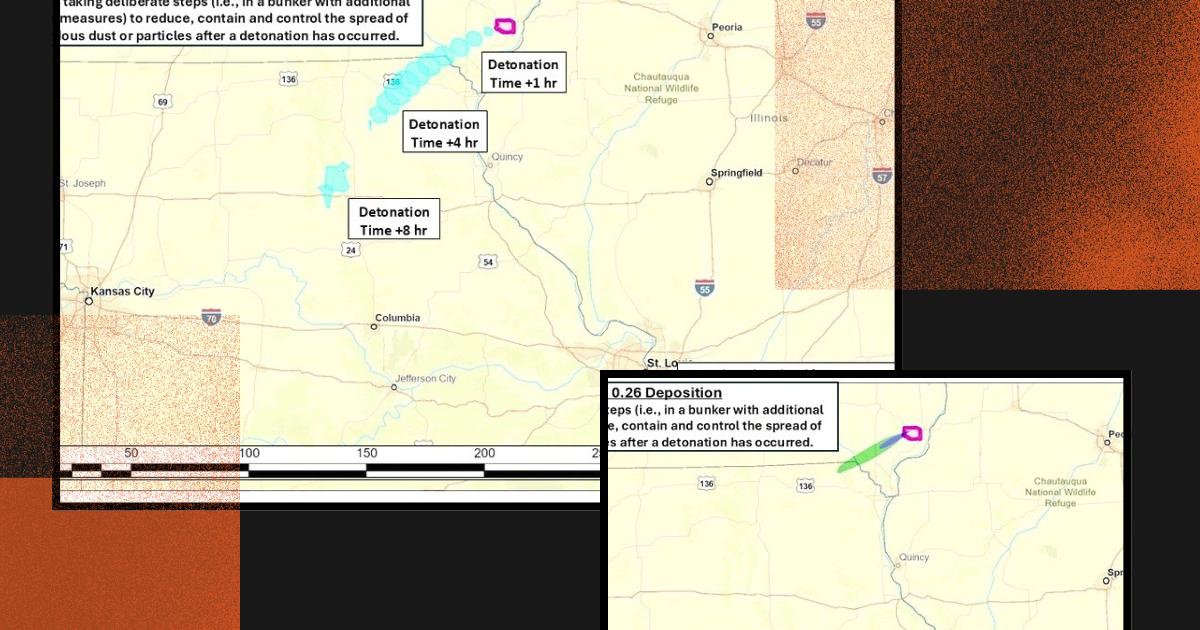
The U.S. Army plans to detonate about 5 tons of degraded lead azide Wednesday morning at the Iowa Army Ammunition Plant in Middletown, releasing maps that show a lead dust plume drifting southwest into northeast Missouri over an eight-hour window.
Plume maps and deposition levels
The Army released two maps. A dispersion map models airborne lead particles moving southwest over an eight-hour timeline. A surface deposition map shows two scenarios: a lighter coating of 5 micrograms per square foot and a heavier coating of 100 micrograms per square foot concentrated closer to the plant.
CBS News reported the shaded area stretches from near Burlington toward Macon, Missouri, by noon, with wind arrows pointing southwest. Illinois officials said NOAA’s latest model showed no Illinois counties would be affected, though Gov. JB Pritzker directed state agencies to remain on alert.
Court allows detonation to proceed Wednesday
The operation was first planned for Nov. 20, then delayed three times amid lawsuits and political pressure. On Monday, the 8th U.S. Circuit Court of Appeals declined to block the detonation, saying environmental groups had not shown they were likely to succeed and that the degraded explosives risk an uncontrolled blast without the permit’s safety measures. The blast is set for approximately 9:00 a.m. CST Wednesday.
“Inaction is no longer an option,” Maj. Gen. Eric Shirley said during Tuesday’s press conference. “It would be irresponsible for us to not take the determined, consensus-based course of action moving forward that has been selected.”
Why the Army says it must act
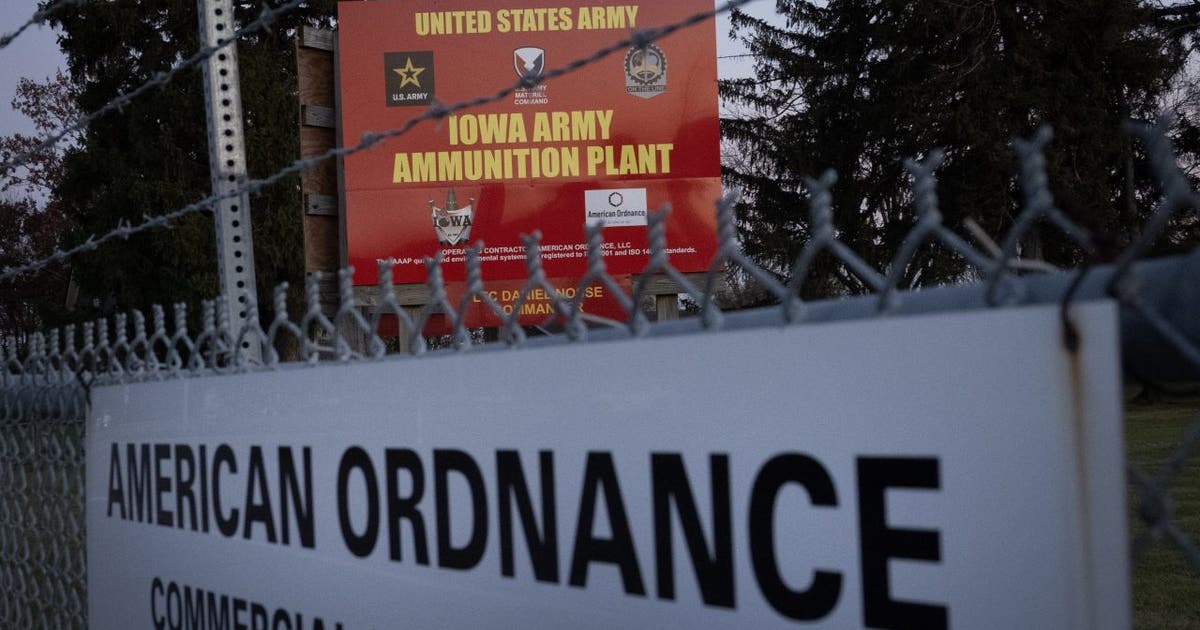
The lead azide has been stored for more than 20 years in earthen-covered containers, submerged in ethanol and water. A routine check this year found water had evaporated, causing the material to recrystallize into irregular shapes that are highly sensitive to friction, shock and static electricity. Army officials say moving the barrels now risks setting them off and that danger grows in cold weather.
To limit dust, the barrels are surrounded by concrete, soil and sand barriers about two stories high. The Army plans to spray the ground with water and mist the air. The EPA issued an emergency permit Nov. 13.
Iowa officials outline farm guidance and monitoring
“There’s a lot of things that’ll have to be determined after we see the impact and what kind of levels we see,” Iowa Secretary of Agriculture Mike Naig said. He said Iowa State University’s Veterinary Diagnostic Laboratory may assist with long-term monitoring.
Communication criticism
Naig said the delayed timeline helped agencies coordinate but that the situation “could have been handled differently.”
He added, “It’s unfortunate that we’ve come to this situation where the detonation is the only option, and I think there’s a lot of questions that’ll need to be answered, ultimately about how did we get here. And certainly, there’s been some frustration about the lack of communication or how late that communication came to the state.”
Sen. Tammy Duckworth, an Illinois Democrat, called the rollout a “failure of leadership of epic proportions,” CBS News reported. President Trump said Monday the government would not proceed until the appeals court ruled and unless Iowa Gov.-elect Rob Sand signed off, though the governor-elect’s input is not technically required.
Farmers brace for plume impact
The USDA estimates roughly 350 farms lie in the projected plume path for a Wednesday detonation, according to Undersecretary Richard Fordyce on Tuesday’s press call. Fordyce said the department is coordinating with the agriculture secretaries in Iowa and Missouri to deliver guidance and resources to affected producers, and said that USDA and FDA protocols are in place to keep lead out of the food supply.
IDALS guidance urges producers to move feed, hay and portable water tanks indoors or cover them with tarps, and to keep livestock inside or at an alternate site until the Army issues an all-clear.
Plume maps detail dust reach
Illinois officials said NOAA’s latest model showed no Illinois counties would be affected, though Gov. JB Pritzker directed state agencies to remain on alert.
Army to release updated plume forecasts
The Army Sustainment Command said it will release updated plume forecasts six hours before the detonation and hourly thereafter until it is finished. After the blast, the Army will issue a final estimate of the affected area. Soil, air and water near the site are being tested before and after the detonation.
Keep reading

Reggae Rise Up Texas Returns to Auditorium Shores April 18, 2027
Reggae Rise Up Texas Festival will return to Auditorium Shores Park in Austin on April 18, 2027, for...

Fall River Man Gets 90 Months for Straw Purchase Scheme; Co-Conspirator Got 2 Years
A Fall River man was sentenced Tuesday to 90 months in federal prison for a scheme that moved...

University of Michigan Misses Nine Deadlines to Release Sherrone Moore Records
The University of Michigan has missed nine deadlines to release public records about former football coach Sherrone Moore,...
Wethersfield Man Indicted on Heroin Charge in Federal Court
A federal grand jury in New Haven returned an indictment on Nov. 17 charging Rubin Diaz Sanchez, 51,...