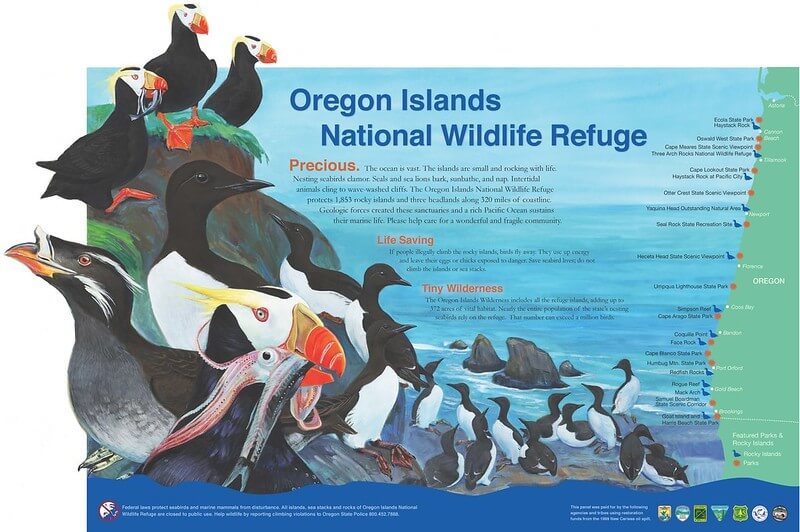
Seabirds find refuge across 1,853 rocks, reefs, and islands stretching from Tillamook Head to the California border, according to the U.S. Fish & Wildlife Service.
These offshore formations serve as the backbone of the Oregon Islands National Wildlife Refuge, a massive conservation network that has been operational since May 6, 1935. While the rugged sea stacks and crashing Pacific waves offer iconic scenery for mainland observers, the real story lies in the sheer scale of biological productivity occurring just offshore.
The refuge provides essential nesting habitat for an estimated 1.2 million seabirds. This concentration makes the area a primary seabird conservation site in North America. Beyond the birds, the islands act as critical resting and molting grounds for harbor seals, Steller sea lions, California sea lions, and northern elephant seals.
Most of these maritime features are shielded by the Oregon Islands Wilderness. Congress designated this protection in 1970, later expanding the boundaries to encompass more than 593 acres of offshore habitat. By maintaining these areas under the National Wilderness Preservation System, the refuge ensures that natural processes remain largely unhindered by human development.
For many species, this isolation is a biological necessity. The wilderness designation provides the space and freedom from disturbance required during the sensitive nesting season. This protection is a primary reason why the ecosystem has remained largely unchanged for generations.
The refuge also manages several mainland units to provide conservation buffers and public access points:
- Coquille Point: A 19-acre unit near Bandon featuring a paved trail for viewing offshore seals and birds.
- Crook Point: A 134-acre area south of Gold Beach that protects rare coastal habitats and serves as a buffer for Mack Reef.
- Whale Cove: A 14-acre site near Depoe Bay that joined the refuge in 2014 and surrounds Oregon’s oldest marine reserve.
The refuge functions as a living laboratory where researchers track how changing ocean conditions impact survival rates. Scientists focus heavily on the tufted puffin, a species identified by its orange bill and golden head plumes. By monitoring puffin colonies, researchers can better understand the broader health of the Pacific Northwest’s marine food web.
Biologists also maintain long-term studies on several other key species. These efforts include tracking population trends and breeding success for common murres, Brandt’s cormorants, pelagic cormorants, pigeon guillemots, and black oystercatchers. These data points are vital for understanding how shifts in food availability and environmental changes influence the stability of seabird populations.
Management decisions at the refuge are grounded in this continuous research and monitoring. This science-based approach aims to ensure that the offshore colonies remain thriving for future generations. The work continues to evolve as the U.S. Fish & Wildlife Service adapts to new ecological challenges facing the coast.
President Franklin D. Roosevelt established the refuge in 1935 to safeguard these breeding habitats. Since that founding, the protected area has grown into a cornerstone of coastal conservation, preserving a chain of islands that are as ecologically vital as they are visually striking.
Keep reading

Mark Earley Enters 2027 Virginia Senate Race After Cifers Retirement
“Serving the 10th District has been the honor of my life,” Senator Luther Cifers said on Tuesday. The...

DoorDash to Test Dot Delivery Robots in Salt Lake City Rain and Snow
DoorDash is bringing its autonomous delivery robot, Dot, to Salt Lake City to test how the technology handles...

Creative Action Breaks Ground on New Community Arts Collaborative in Mueller
Creative Action and its partners broke ground Tuesday on the Community Arts Collaborative, a new 25,000-square-foot shared arts...

Tennessee Swimming and Diving Announces Elite Class of 2027 Recruits
The announcement follows the program's previous success in landing the No. 2 recruiting class for 2026. By securing...