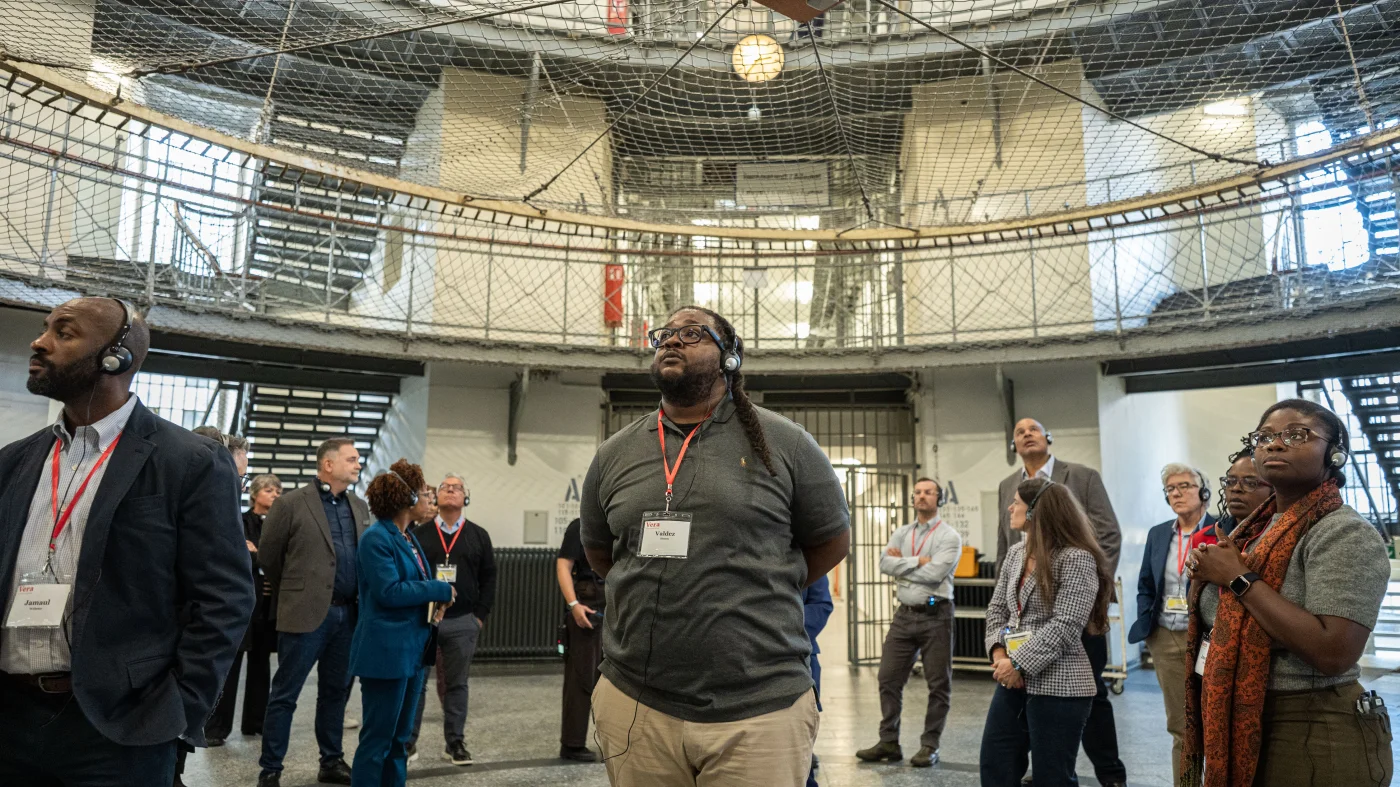
A group of key New York City criminal justice officials spent time this October inside Berlin’s Tegel Prison, seeking a blueprint to modernize a troubled local jail system that is currently undergoing a massive reimagining.
The trip, organized by the nonprofit Vera Institute of Justice, marks a growing trend as U.S. leaders increasingly look toward Western Europe and Scandinavia to solve deep-seated issues in domestic correctional facilities.
The delegation, which included a judge, a prosecutor, and a prison official, found a reality in Germany that stands in stark contrast to the American experience. At Tegel Prison, inmates carry keys to their own cells.
Prison director Martin Riemer explained to the group that this allows men to lock their doors when attending work or school, a small gesture intended to provide a sense of agency and privacy that is largely absent in U.S. institutions. Riemer said the guards still hold keys, but the gesture offers a semblance of privacy.
The differences go beyond keys. The American visitors said that the Berlin facility lacked the pervasive, unpleasant odor often found in poorly ventilated U.S. jails. The environment was notably quiet, and the cells featured natural light and operable windows—requirements under German law.
Aisha Elliott, chief program officer at the Women’s Prison Association, who spent over 20 years incarcerated in New York, pointed out the furniture as a major differentiator. “There’s a lot of wood and movable objects, which I think makes it more bearable. Everything in New York is steel, metal, thin and painful,” she said.
She said that while American jail toilets remind her of metal dog bowls, most in Berlin were porcelain, similar to a home. “It’s speaking to me because it’s the smallest thing,” said Tina Luongo. “I have to believe that makes a difference in how you show up in those places.”
The Philosophy of Normalization
At the heart of the German model is the concept of “normalization,” the legal requirement that life inside a prison must resemble life outside prison as much as possible. This approach stems from a post-Holocaust constitutional commitment to human dignity, where the loss of freedom itself is the punishment rather than the conditions of confinement.
Nancy La Vigne, dean of the Rutgers School of Criminal Justice, emphasized the value of this firsthand exposure. “It’s what happens when they get there that makes a world of difference, really seeing it with their own eyes,” La Vigne said.
“Touring the facilities, talking to the officers, talking to the incarcerated population, witnessing rehabilitation in real time is very inspiring,” Vigne said.
Scaling the European Model in the U.S.
While the German system is frequently held up as an international model, it is not without its own challenges. Officials in Germany, as well as in Norway and Denmark, still grapple with overcrowding, understaffing, and occasional violence.
Officials at several German prisons told the New York group that correctional officers still deal with issues like drug overdoses and violence between prisoners. German prisoners also reported longing for better food and more human touch.

However, the U.S. faces a much larger scale of incarceration, with around 2 million people behind bars—the German system is about 3% of that size.
The Vera Institute’s “Restoring Promise” initiative has launched units in Connecticut, Massachusetts, South Carolina, North Dakota, Colorado, and Idaho, focusing specifically on 18- to 25-year-olds.
The Economic and Human Stakes
For the officials tasked with managing New York City’s jail system, the question is whether the political and financial appetite exists to move away from the traditional, steel-and-lock model of incarceration.
“I feel like they are headed in the right direction, which is toward release, supporting people toward their release,” Elliott said.
Worth a look

Connect to Providence: Mayor Smiley Calls Transition to Morales Smooth – WJAR
Providence Mayor Brett Smiley announced on Tuesday that he does not intend to enforce a voter-approved divestment measure...
U.S. Postal Service Reports Fiscal Year 2026 Results – Pennsylvania newsroom
The U.S. Postal Service announced its financial results for the 2026 fiscal year on September 30, reporting a...

Kia Sorento PHEV and Hyundai Santa Fe HEV Offer Different Hybrid Paths
The Kia Sorento PHEV and the Hyundai Santa Fe HEV offer two distinct electrification strategies for seven-seat family...

10 Best New Hampshire Events to Do This Weekend: Nov 13-15
New Hampshire is fully committed to Christmas shopping as local markets and craft shows prepare for the weekend....