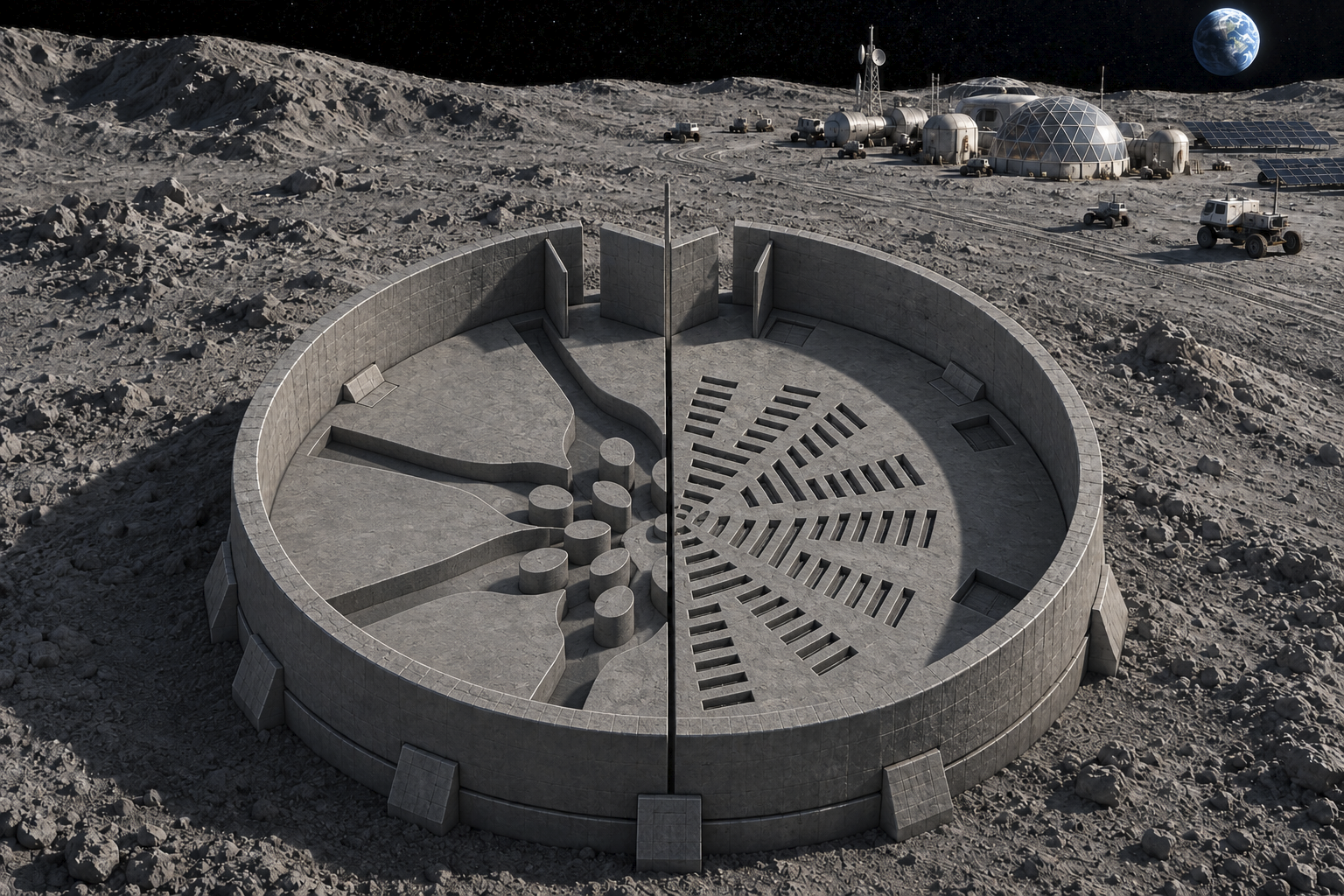
Three rocket-motor firings this summer at the University of Alabama in Huntsville’s Propulsion Research Center sent exhaust screaming through channels in a 3.65-meter concrete prototype, proving that a vented, modular landing pad can redirect the plume that would otherwise blast lunar dust across the surface and into orbit, Universe Today reported.
The tests mark a concrete step toward solving one of the Artemis Program’s messiest engineering problems: when spacecraft land or take off vertically on the Moon, the rocket exhaust kicks up regolith at high speeds, threatening nearby habitats, power systems, and orbiting spacecraft with abrasive, fast-moving debris. Unlike Earth, where a dense atmosphere contains the blast, the airless Moon allows dust clouds to travel vast distances, potentially reaching the far side or even low lunar orbit.
A Design Built From Moondust Itself
Led by Dr. Judy Schneider, a professor in UAH’s Department of Mechanical and Aerospace Engineering, the student research team partnered with Linc Research Inc. of Huntsville through NASA’s Small Business Technology Transfer program to develop landing infrastructure that protects both vehicles and surface assets. Their prototype consists of interlocking concrete components arranged into a 12-foot-diameter circle, with integrated sensors recording how exhaust flows through the vent system during each firing.
The concrete serves as a stand-in for materials that could eventually be manufactured on the Moon from local regolith, either sintered into 3D-printed ceramics or mixed with a bonding agent to create “lunacrete.” This in-situ resource utilization means future pads could be built without hauling heavy construction materials from Earth, making large-scale lunar bases more feasible.
“On Earth, we use water-cooled flame buckets to redirect rocket exhaust. But we won’t have those resources on the lunar surface, where water will be in limited supply. Our goal is to redirect the rocket plume so it doesn’t damage the landing vehicle or any surrounding structures,” Schneider said in a UAH press release. “The hot-fire tests demonstrated that we could redirect the rocket plume. By using an internally vented structure, we were able to prevent the heat from damaging the pad as it could in a solid structure.” As Schneider
From 12 Feet to 20 Feet
The modular approach also addresses the practical constraints of building on the Moon, where manufacturing space will be limited. Smaller components are easier to transport, assemble, expand, and repair over time. After the successful summer tests, the team is now constructing a 6-meter (20-foot) diameter version that will be delivered to NASA’s Marshall Space Flight Center in Huntsville for additional evaluation.

Those upcoming tests will push the technology’s readiness level and determine whether the vented design can scale for repeated use by crewed and cargo missions. The contrast with Earth-based solutions is stark: solid landing pads here endure significant damage from rocket plumes, as seen in early Starship test flights that cratered launch mounts and scattered debris. The UAH design channels exhaust through built-in vents rather than absorbing the full thermal and kinetic force.
With multiple missions planned for the coming years, landing pads that can safely handle vertical takeoff and landing represent essential infrastructure for sustaining a human presence on the lunar surface.
🛬 Dust-Free Lunar Landing Pads: UAH Students Test a Prototype To make lunar landings and takeoffs safer, a team from the University of Alabama in Huntsville (UAH), led by Judy Schneider, is developing modular "vented" landing pads. On the Moon, the absence of an atmosphere… pic.twitter.com/z75dsST42M
Related reading

University of Michigan Hires ZRG Partners to Lead Search for New Athletics Director Amid Organizational Restructuring (Nov. 4, 2026)
Sixty-eight thousand students, more than 668,000 living alumni, 29 NCAA-sanctioned sports, and a department that has won more...

DOER to hold training for officials on MESH clean energy portal
Municipal officials, developers, state agencies, and residents across Massachusetts now have a single free online hub where clean...

D.C. Democratic nominee wins all eight wards in landslide, topping 75% in each
In Washington, D.C., Janeese Lewis George soared to victory in all eight wards Tuesday night. As of Wednesday...

CEI Offers Certified Homebuyer Education and Counseling in Maine
Eight hours. CEI delivers a comprehensive, eight-hour homebuyer education program throughout Maine, a state-certified course designed to prepare...