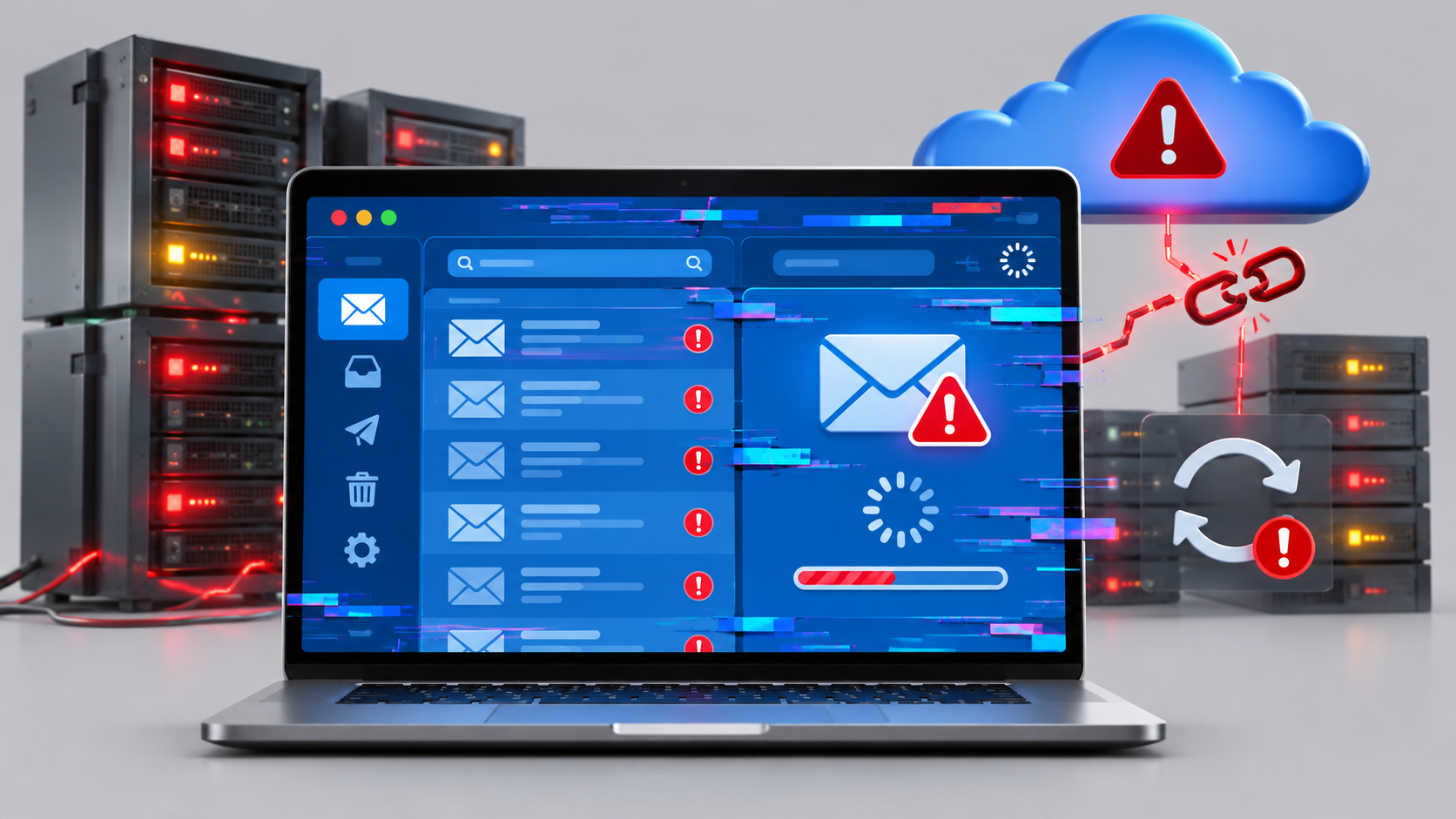
Millions of Outlook inboxes went offline until the next workday last Thursday afternoon after a Microsoft outage hit users worldwide.
On Friday, every domestic flight in the U.S. was grounded for only the third time in modern history following a telecommunications failure during upgrade work on air traffic control infrastructure.
While the two outages stemmed from different root causes, they exposed a shared structural vulnerability in modern digital systems. A single small failure spread rapidly until it completely disabled an entire network.
Microsoft email operations run on servers distributed across the globe. When one server experiences heavy traffic, the system typically rebalances the workload by shifting processes to alternate servers.
During last week’s incident, that load rebalancing failed entirely. One overloaded server crashed, forcing its traffic onto adjacent servers and triggering a cascading collapse.
“We can think of this as the domino effect,” said Ariel Pinto, professor and associate dean for external partnerships in UAlbany’s College of Emergency Preparedness, Homeland Security and Cybersecurity, regarding the Outlook outage. “There are backup servers all over the world. However, they would only be effective if this rebalancing of load functions well.”
Pinto leads the Cyber Cascade Risk Lab, which studies how risk spreads across interconnected systems. He said that the extreme reliability of contemporary cloud services has paradoxically heightened our vulnerability to rare failures.
“These services have been so reliable in the past that we often forget that they may actually fail, just like what happened here,” Pinto told the University at Albany.
Because countless organizations rely on identical cloud platforms, the fallout from a single server failure reverberates much farther than it did a decade ago. Businesses and households looking to mitigate future disruptions must prioritize basic operational resilience.
Pinto recommends mapping out which daily workflows matter most and identifying the specific technologies supporting them. Organizations should establish redundant offline alternatives, such as secondary communication channels or manual workarounds for periods without internet access.
“By knowing which are the most important services, you can come up with plans on how to conduct the same operation a bit more slowly, but still would not disrupt everything,” Pinto told the University at Albany.
Related reading

Democrat Mary Peltola Flips Alaska Senate Seat, Giving Democrats 56-44 Majority
Democrat Mary Peltola flipped Alaska's U.S. Senate seat on Tuesday, unseating Republican incumbent Dan S. Sullivan after a...

UAMS Invests Gresham Richter, M.D., in James Y. Suen, M.D., Chair in Otolaryngology – Head & Neck Surgery
The University of Arkansas for Medical Sciences invested Gresham Richter, M.D., in the James Y. Suen, M.D., Chair...

Arizona Regulators Approve 10% TEP Rate Hike and Formula for Annual Adjustments
The Arizona Corporation Commission voted 4-1 Tuesday to raise Tucson Electric Power rates by roughly 10%, adding about...

Hien T. Nguyen, a Montgomery County Woman
Hien T. Nguyen, a Montgomery County woman who ran a nationwide travel scheme that stole thousands from members...