The Arizona Corporation Commission voted 4-1 Tuesday to raise Tucson Electric Power rates by roughly 10%, adding about $13 a month for residential customers.
The decision locks in a 9.4% increase for typical users and adopts an Annual Rate Adjustment Mechanism — ARAM — that lets TEP request formula-driven changes each September. Commissioner Lea Márquez Peterson cast the lone dissent, warning the formula strips the commission of meaningful oversight. “However, with the ARAM in place … I’m not comfortable with this rate case,” she said before voting.
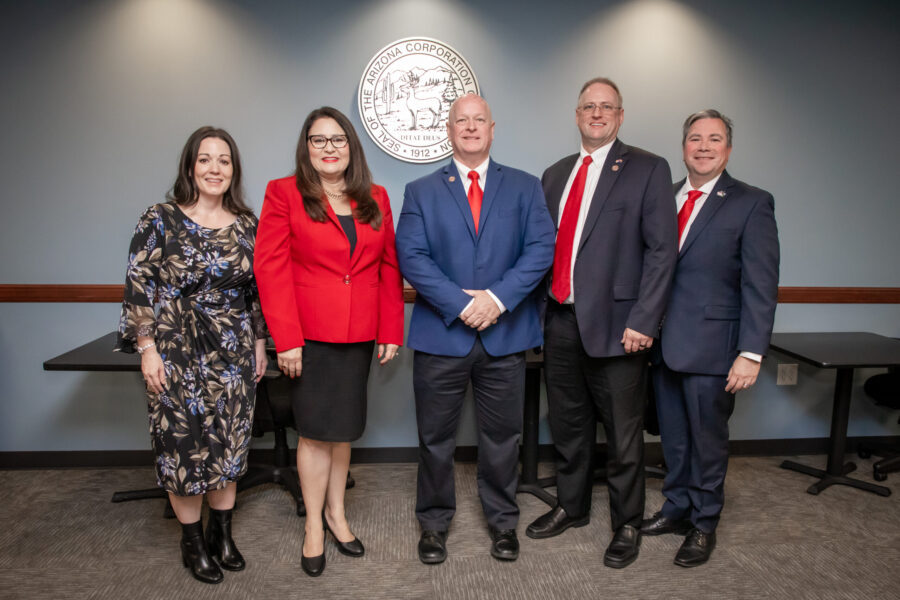
Commissioner Kevin Thompson called the outcome “amicable,” saying the commission worked alongside TEP, the Residential Utility Consumer Office and other intervenors to reach it. Commissioners Nick Myers, Rachel Walden and Rene Lopez joined Thompson in the majority. “I hope formula rates are given a chance to see if they improve the ratemaking experience for customers and reduce regulatory lag,” Thompson said during the meeting.
The formula fight
Formula rates have been contentious since the commission adopted a 2024 policy statement allowing utilities to request them. RUCO is suing over that policy and challenging the ARAM approved for UNS Gas — TEP’s sister company — in February.
At Tuesday’s hearing, RUCO Director Cynthia Zwick told commissioners the UNS Gas adjustment process has not allowed her agency to fully audit the utility’s proposal. “This is a very fast process, but we’re not sure that there’s really a benefit to the customers at this point as a result of that,” Zwick said.
RUCO attorneys estimate UNS Gas customers could face a 7% or 8% increase under the formula, while UNS Gas attorneys put the figure closer to 4.4%. Thor Nelson of the Arizona Large Customer Group warned the test-year structure could lead to a situation where the company is constantly over-earning and customers would never see rates reduced.
Why TEP says it needs the money
TEP originally sought a 14% increase in May 2025, later amending it to 10%. The utility points to $1.7 billion in grid investments, while its current rates reflect costs from 2021.
“Inflation over that period – 15 percent – so if we’re coming in at 9.8 percent or anywhere in there, we’re definitely below the rate of inflation,” TEP spokesman J.D. Wallace said. The company operates more than 120 substations at $25 million to $30 million each and 107,000 steel transmission poles at $25,000 apiece.
“TEP made $1.7 billion worth of investments in our local energy grid in this application, and we must begin recovering those costs,” Wallace said. In 2025, TEP reinvested all earnings back into the system, and parent company Fortis Inc. paid no dividends while shareholders provided additional capital, he added.

Political shifts may block future rate adjustments
The first formula-driven adjustment could be requested in September. But the political ground shifts in January when Democrats Clara Pratte and Jonathon Hill join the commission. Márquez Peterson has already signaled opposition to formula rates; the two incoming Democrats could join her to block future adjustments. Several intervenors are expected to challenge the ARAM in court.
The commission also ordered TEP to return in 180 days with triggers for cost-of-service studies on large-load customers like Project Blue, a hyperscale data center planned just outside Tucson. “These cost-of-service studies are important to make sure growth pays for growth,” Walden said.
Meanwhile, Arizona Public Service’s request for a 14% increase with its own formula rate remains pending — and it’s unclear whether the current commission will decide it before Pratte and Hill are sworn in.
“We know household budgets are tight, and we know that some of our customers are struggling. That matters to us.”
— Susan Gray, TEP CEO
Alexandra Macias, a low-income mother of a child with special needs, said the increase will hurt regardless of the amount. “It’s very detrimental to a lot of families in Tucson. On top of everything else going on with groceries being so expensive and gas being so expensive.”
Keep reading

Study: Oahu Could Hit Critical Sea-Level Threshold Between 2073 and 2102
A new study says Oahu could hit a critical sea-level threshold between 2073 and 2102, but the infrastructure...

No. 10 Illinois Defeats No. 5 Duke 99-78; Stojakovic, Coleman Score 73 Points
No. 10 Illinois defeated No. 5 Duke 99-78 on Tuesday night in Durham, North Carolina, as Andrej Stojakovic...

Boise Unveils Two Restoration Designs for Historic Lowell Pool
Empty for more than six years, Boise's historic Lowell Pool moved a step closer to reopening on Tuesday...

FSU Swimming and Diving to Face Seven Ranked Programs at Georgia Invite
Florida State’s swimming and diving teams will line up Thursday against seven nationally ranked programs at the Georgia...