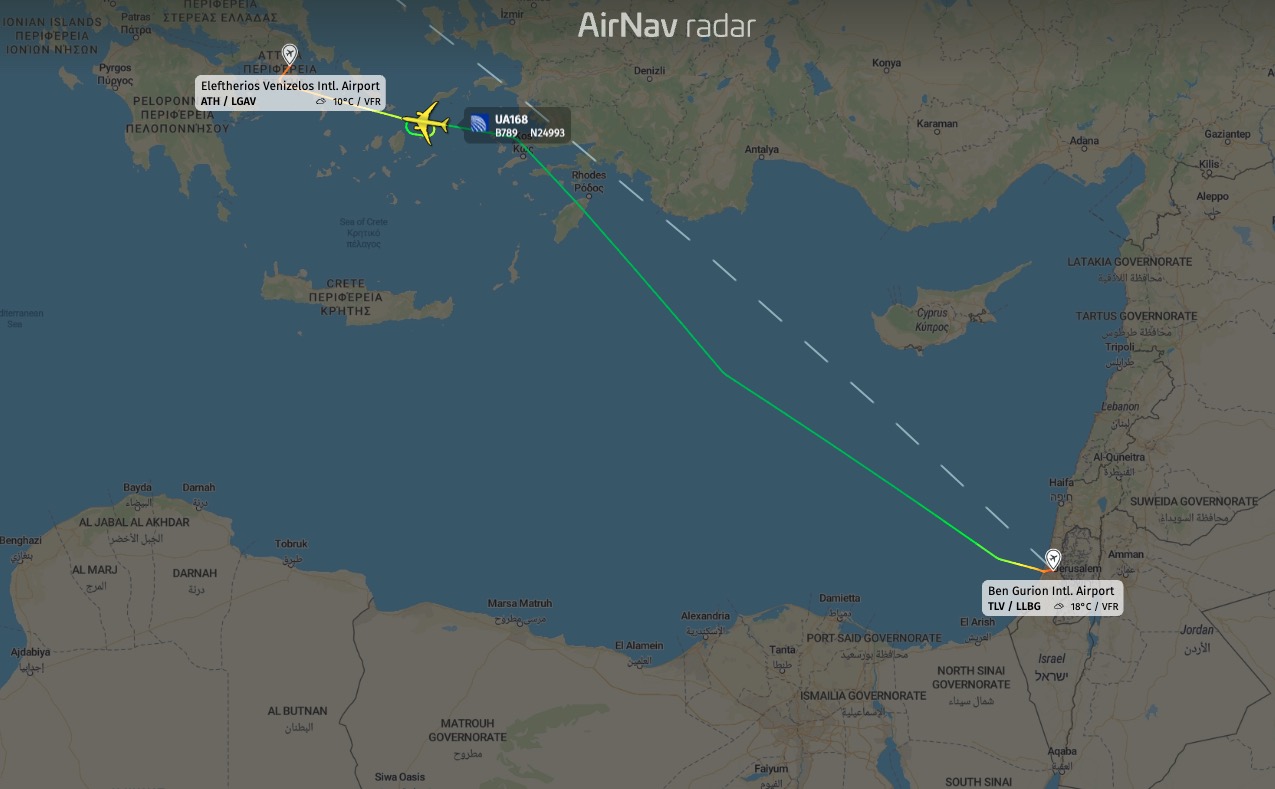
A routine transatlantic crossing from Tel Aviv to Newark turned into an urgent mid-air diversion early Monday morning when United Airlines Flight UA168 signaled an emergency over the Aegean Sea.
The Boeing 787-9 Dreamliner, carrying 230 passengers and 13 crew members according to Brit Brief, was forced to abandon its journey to New Jersey, touching down safely in Athens instead.
The Emergency Over the Aegean
The flight departed Ben Gurion Airport at 12:45 a.m. IST on November 9, 2026. Roughly 90 minutes into the flight, while cruising at 32,000 feet, the cockpit crew encountered a technical issue that prompted them to broadcast a 7700 squawk code—the universal signal for an in-flight emergency. As reported by The Aviation Hub, the diversion was specifically triggered by reports of smoke fumes in the cabin.
Diverted to Athens due to smoke fumes in the cabin @AirNavRadar https://t.co/s7YSvx1mM1
While the aircraft was designed for a 12-hour, 5-minute flight to Newark, its sudden diversion meant it was significantly heavier than the standard maximum weight for landing. To reach the runway in Athens safely, the pilots jettisoned fuel during the descent, a standard procedure for widebody aircraft in emergency situations, as noted by The Yeshiva World.
Ground crews in Athens were already prepared when the Dreamliner touched down on Runway 3R just two hours after its departure. Emergency vehicles and fire crews met the aircraft as a precaution, though officials confirmed there was no active fire on board. Passengers disembarked normally once the plane reached a remote stand.
Boeing 787-9 Undergoes Inspection After Cabin Odor
The aircraft involved, a 19-month-old Boeing 787-9 with the registration N24993, is now under a full maintenance inspection to identify the root cause of the cabin odor. United Airlines confirmed the diversion was necessary to address an “odour in the cabin,” though the carrier has yet to pinpoint the exact source of the fumes.
Smoke and fume events rank among the most time critical scenarios a flight crew can face. Even when the cause proves minor, pilots cannot rule out an electrical fire at altitude.
This conservative approach to airmanship is standard practice for long-haul operations. By choosing Athens, the crew secured access to long runways and the necessary infrastructure to manage a widebody aircraft and its passengers overnight. The flight has been officially canceled, and ground teams are currently managing the complex task of rebooking over 200 passengers to their final destination.

Diversion to Athens Shows Aviation Safety Protocols in Action
The incident disrupted international travel for passengers and showed the aviation industry's strict cabin air quality safety protocols. When an odor is detected, the inability to verify the source at 32,000 feet leaves the crew with few options other than a diversion to the nearest suitable airport.
As the investigation into N24993 continues, the incident shows how much long-haul emergencies rely on secondary airports. Athens International Airport provided the necessary rescue cover for the flight, preventing what could have been a more complicated situation had the crew attempted to press on across the Atlantic.
United Airlines has not yet provided a timeline for when the affected passengers will arrive in Newark, leaving those travelers in a holding pattern while engineers in Greece work to clear the aircraft for service.
United Airlines Flight UA168 declared a midair emergency after a burning smell was reported aboard. The Newark-bound Boeing 787-9 diverted to Athens and landed safely.https://t.co/HzEVYVtmOP
Athens became the diversion airport for United Airlines UA168, operating Tel Aviv to Newark. The Boeing 787-9 landed at ATH at 00:51 UTC. Reason not yet confirmed. pic.twitter.com/sxBnRozDGz
Worth a look

Democrats Unseat Greg Abbott and Take Texas House Control
Texas politics underwent a historic transformation last week as voters unseated three-term Greg Abbott and handed control of...

Tennessee Volleyball Sweeps Alabama on Senior Day
The Tennessee Lady Vols concluded their final regular-season homestand at the Food City Center this Sunday, sweeping Alabama...

Crystal Palace Weigh Future of Pierre Sage After Liverpool Defeat
Pierre Sage finds himself at a precarious crossroads at Selhurst Park. Following a bruising 3-1 home defeat to...

Peninsula Women’s Soccer Defeats Lower Columbia 3-0 to Reach NWAC Final Four
The Peninsula College women’s soccer team is heading back to the NWAC Final Four after a commanding 3-0...